Showing posts with label Correa. Show all posts

Sunday, December 1, 2019

A Puerto Rican Look at: Y-DNA111 (Correa)

Like my Avilés/Magraner line, I tested my Correa Y-DNA line while I was in Puerto Rico, this time with my maternal grandfather. Though I originally tested this line at Y-DNA67, I have upgraded the line to Y-DNA111 on FTDNA and with the recent Thanksgiving sales I have finally upgraded the line to Big-Y 700. The results will take a while to upload, especially with what I can only imagine are a bunch of people taking advantage of the sale. So I figured I would write about what I know at this level and see what else comes from the upgrade.

CORREA - SURNAME ORIGINS 

Though I have posted about the Correa surname before (post here and here). I'd figure I cover this quickly again to tie it into the genetic understanding of this line. The Correa surname comes to me via my mother and her father, and from there runs via the paternal line up to the 1700s. This is what the paper trail has shown me at least, remember that there is always the possibility of a NPE (Non-Paternity Event) which are usually not traced on paper. Below you can see me, Luis, at the bottom and my line all the way until my 6th great-grandfather Juan Francisco Correa (I have blurred of people who are still alive).

9 Generations of Correa [Personal Photo]

In an ideal genealogical world, this would mean that my Correa cousins and any other male Correa tied to this line would all descend genetically via their Y-DNA from this same man. Matching other Correa men would help attest to this, but unfortunately so far there haven't been other men in my family or relatives that I know who have tested. Y-DNA testing (and rightfully so due to its cost) is something more serious geneticists/genealogists use to trace lines that either ran dry via paper-trail, experienced traumatic events such as slavery, the holocaust, wars that disconnected them from information, and/or was adopted and not sure of their origins. I personally have not tested all of my Y-DNA possible lines, especially since I would have to find distant males cousins to test for lines that have "daughtered out". So far, I have tested my own Rivera line (since I wanted to know more about it since it's a common surname), my maternal Avilés line (said to be tied to Mallorca via a NPE), the Charles line (arrived to Puerto Rico from Guadeloupe and was previously enslaved), and my Correa line (surname interest/since the paper trail ran out). 

When I mean surname interest, I have always been interested in this name for two reasons. 1) It's not that common of a surname in Puerto Rico, though there is always the mention of Capitán Antonio de los Reyes Correa it's not a surname I often hear when I meet other Puerto Ricans, and 2) I have always heard that the surname is tied to Sephardic Jewish origins in Spain. 

The surname for example appears in Amsterdam via Isabel (Rebecca) Correa, a famous Dutch Sephardic poetess who was born in Portugal.

Isabel (Rebecca) de Correa [Jewish Virtual Library]

It has also appeared amongst those tried for "judaizantes" ("Judaizers") during the time of the Spanish Inquisition. A quick search of Correa + Inquisición gave me various hits. 

Tribunal de la Inquisición en Llerena [PARES]


Tribunal de la Inquisición en Llerena [PARES]

Does this mean that my own Correa family were Jewish as well? Not necessarily but the genetic information is interesting to add. Let's see what my grandfather's genes say about this line!

CORREA - GENETIC ORIGINS

When I got the autosomal and haplogroup results for grandfather on 23andme, I was very interested since it seems that his haplogroup isn't that common amongst men in their database/that have tested. So I wanted to see what it would be like in FTDNA.

FTDNA Landing Page [FTDNA/Personal Photo]

My grandfather's haplogroup is current listed as "J-Z18271", this name is expected to change once I get my Big-Y700 results - expected to arrive sometime in February. Below you can see where this specific SNP (Z18271) has been found in Europe. This specific branch can be found in various parts of the world, but it's interesting to note that it's mainly found amongst Eastern European countries. This is a very different result than expecting to find many "genetic cousins" scattered amongst the Iberian Peninsula and other parts of western Europe.

SNP MAP [FTDNA/Personal Photo]

CORREA - HAPLOGROUP ASSIGNMENT

The main haplogroup my grandfather belongs to is "J" which you can see how it got into Europe below. Further below is an image of my specific haplogroup for my grandfather as well, currently at Y-DNA111.

Migration Map [FTDNA]


Correa Haplogroup [FTDNA/Personal Photo]

This group has its origins mainly in the Middle East amongst the Arab and Jewish populations. This was interesting to me taking into consideration the Sephardic Jewish theory of this surname. Remember that genetics predate current religious, political, geographic divides. It is possible that somehow my Correa family was a part of the Arab/Morsico or Jewish/Sefardí population in Spanish which was later pushed out during the reconquista. It made it's way into Puerto Rico where it has been present for the last 300 years.

Some research places the haplogroup amongst the "Kohanim" or Cohen branch of Jews, which is the "priest" class. If this is the case for my family, this would obviously be very far back and probably not in recent times, though it would be very interesting nonetheless! My family has likely been Christian/Catholic for at least the last 300 years while in Puerto Rico. Since I haven't been able to trace them off the island yet, I am not sure what their history and religious practices were before arriving to Puerto Rico.

J-Z18271 Branch [GenoGenea]

GENETIC MATCHES

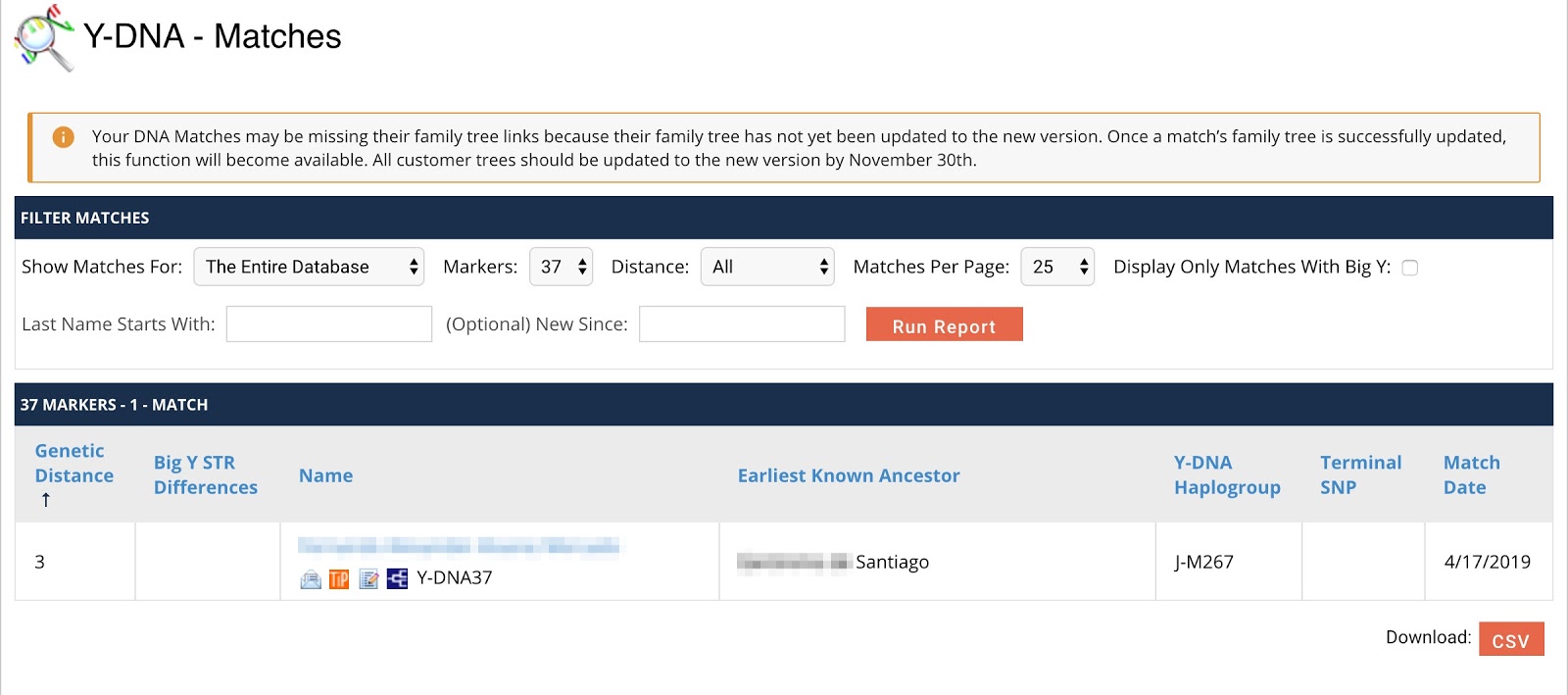
Currently, I have one match from the entire database of FTDNA for my Correa Y-DNA111 test, and it's a genetic cousin who shares another line with me, so it was interesting seeing him match me on the Y-DNA level on another completely different line as well. As you can see the surname for his earliest ancestor is not "Correa", if not "Santiago". So somewhere along our lines there was a NPE, we're not sure who's line it comes from but we're thinking it might be his. Currently, this cousin is tested at Y-DNA37 so their haplogroup isn't as specific as mine. The genetic distance is 3 meaning that our relationship is further back in generations, but I'm not sure if this distance "closes" once they upgrade their Y-DNA test.

Y-DNA Match [FTDNA/Personal Photo]

CONCLUSIONS

I'm hoping that upgrading the test will give some more insight into whether it's more likely to be Arab or Jewish in origin. I have been in contact with some of the administrators of the FTDNA project I am a part of via my results in the J haplogroup. They are also interested to see what comes out of this result since I don't match many other people. This is very fascinating for me and definitely something I am learning along the way with. I'm not super well-versed in Y-DNA analysis so learning via my multiple accounts has been pretty helpful! Hoping my results come faster than I expect!

ARE YOU A CORREA FROM PUERTO RICO? 

HAVE YOU TAKEN A Y-DNA TEST? 

Thursday, July 4, 2019

My 200th Post- 8 Years of Blogging, 15 Years of Genealogy

July 4th, 2019 marks 8 exact years since I began blogging. It all started when I was 21 years old and home from college over the summer. I was inspired by Cece Moore who runs Your Genetic Genealogist and has become a common name in the genealogist household with all the work she has done with DNA, adoptees, and even working on "Finding Your Roots". In June of 2011, she herself had completed her first year of blogging and so I decided to trace my own family via a blog as well. Who would have thought that 8 years and 200 blog posts later, I'd still be on this journey!

Though I don't have many official followers for my blog (as I haven't dedicated myself full-time to running it/putting it out there), I really started doing this for two reasons:

1) Personal Motives - To keep track of my own progress, hurdles, difficulties, breakthroughs, and as of recently analyzing my DNA in conjunction with my paper trail/genealogical searches. In a sense it would serve as a digital journey for which I could refer to and keep track of my finds and brick walls.

2) Visibility - While initially researching my family, I hadn't found too many blogs that covered a wide range of Puerto Rican topics in regards to genetics and genealogy and I ultimately wanted to be a contributor in order to make Puerto Rican Genealogy more visible. There is a big misconception that genealogical records from Puerto Rico have been burned, lost, or destroyed by hurricanes and people give up without even realizing all of the amazing resources available for Puerto Rican research there are out there.

5 years ago, I posted my Post #100 and I actually really liked the style I wrote in so I think I'm going to mimic it for Post #200! Feel free to read post #100 to compare and contrast now that I have 100 more posts and 5 more years added!

What I've Learned

My first blogpost was titled "What Started it all - Part I", where I write about the typical Puerto Rican love story of a "Spanish man" and a "Taíno woman" who had fallen in love in Lares, Puerto Rico - my 2nd great-grandparents. By the time I had written that post I had about 7 years of genealogical research under my belt but I had only just begun to scratch the surface of research. There were many doubts about my tree and definitely many, many ancestors' names yet to be discovered. When I began at the age of 14 there were no known (to me) family trees out there, none created by my grandparents, uncles/aunts, parents, or cousins. All I knew at the time when I began my tree were 2 out of 2 parents, 4 out of 4 grandparents, 6 out of 8 grandparents, and 7 out of 16 great-grandparents - though it's a little, it's also a lot compared to what some people start out with.

My First Blog Post - July 4th, 2011 [Personal Photo]

I've been very fortunate that since I started my research and blog I have come pretty far with my pedigree, which I am both fortunate and blessed to have. Various of my lines reach the early 1700s with a few reaching the 1600-1500s and very few the late 1400s when they came over from Spain. A few lines stop at the 1800s due to the lack of records for slaves - these being my lines from Martinique and Guadeloupe. However, "Rome wasn't built in a day"! It's been 15 long years of painstaking research where I have put in literally thousands of hours to search for my ancestors. I have been blessed to be able to travel to Puerto Rico to continue my searches various times, as well as traveling to Mallorca to research my ancestors. I have also been able to visit towns in Spain where my ancestors lived/were from before heading to the New World. Recently, I have been able to continue to test various family members with DNA and across various companies to help triangulate and find new information about who we are on a genetic level.

I've linked above and below various posts to the different themes I've discussed over the years! 

Advances in Genetic Testing

There have been many advances in genetic testing since I first started researching my family, to believe when I first tested with 23andme back in 2010 the cost was somewhere near $600 for one single DNA test! Nowadays, genetic DNA testing has become much cheaper and fairly accessible to many, not only here in the US but in various other countries. Here are some of the more recent posts that highlight these advancements throughout the years. 

My Favorite Discoveries

Since 2014, there have definitely been some exciting finds! These discoveries are a combination of things: from DNA testing, finding new genealogical documents, to discussing/receiving help from other genealogists. There were a wide range of discoveries made, from very intimate ones to discovering my Dávila line's origin in Spain in the 1700s. Listed below are some of the recent discoveries I've been able to make! 

Words of Advice

I would tell myself keep doing what you're doing! I have come a long way since my initial searches and there is still a lot to find out! Researching my family has brought me much closer to Puerto Rico and my identity as a first generation mainland American born citizen. To those of you budding genealogists - it's never too late! Ask family members questions, document what they have to say, and search online to see what you can find. If you're interested in genetic genealogy - test those family members (with permission, of course!) who might be willing to help you learn more about your family's past.

Hopes, Dreams & Aspirations


Reading my post from 2014 it was interesting to see where I was amongst my hopes and dreams for genealogy. There are some I have been able to check off and some that are still on my genealogical "bucket list". For example, being able to travel to Puerto Rico and go around the island to discover the towns, barrios my ancestors lived in, and the churches my ancestors would have married in. I have been fortunate to travel to distinct parts of the island and as of recently meet cousins in Lares, Puerto Rico. I have also been able to travel to Mallorca which was amazing. I still haven't become a professional genealogist, though I'm sure there is still plenty of time and I also haven't been able to travel to Martinique and Guadeloupe yet. I haven't brushed up on my French though hopefully that is in the works and I am still interested in bringing genealogy to my everyday life and profession.

I still dream about connecting Eglantine Lautin to a certain country/tribe in Africa and it would be amazing to have DNA cousins that confirm my ancestors are connected to Martinique and Guadeloupe (I have one potential lead with a cousin but nothing solid yet!). I also want to continue collecting stories and record them to have a digital audio database of stories from my current living family members that I could look back on years from now and listen to. A genealogist's work is never done as you can see!

Here's to 2024 when I complete 20 years of genealogy! Let's see what's in store! 

Wednesday, March 27, 2019

Testing, Testing...

DNA tests ready to go! [Personal Photo]

Just like that I'm back home from my spring break trip to Puerto Rico! Though it was a quick trip I was able to get a lot of genealogical work done, among one of those tasks was fulfilling my goal to get DNA testing done from various companies (FtDNA, 23andMe, and AncestryDNA) from various relatives. These test are in line with my genealogical New Year's Resolutions of getting my Avilés and Correa line Y-DNA tested and adding more autosomal cousins to the mix of relatives currently tested. Here's the breakdown of the testing I got done while in Puerto Rico.

AncestryDNA

This DNA test was only one and it was an autosomal test for my maternal grandfather. I wanted to add him to AncestryDNA since they also have an African breakdown that I would like to see how he scores in and also to widen the pool of genetic cousins I receive. Though AncestryDNA isn't my first choice for autosomal DNA testing since you don't get the maternal/paternal haplogroup(s) or chromosome segments, I decided to add him anyways. 

23andMe

For this one, I got two autosomal DNA tests done. I brought an extra DNA test just in case I came across another cousin but I decided to test two Avilés cousins from Lares, Puerto Rico since I was already there and could benefit from having two cousins from this line. One test was for my 1st cousin 2x removed, his father was my great-grandmother's full brother, and he's a male descendant from the Magraner line - having him tested will help separate out my DNA from my 2nd great-grandparents in DNA Painter. I also tested my 2nd great-uncle, son of my 2nd great-grandfather and from his second wife. I'm hoping that by testing another generation closer to my 2nd great-grandfather connections to Spain will be stronger. Interestingly enough, my 2nd great-uncle's mother, though not my 2nd great-grandmother is my 2nd cousin, 4x removed - her paternal grandfather is my 5th great-uncle via a line that came from Yauco to Lares, Puerto Rico... that'll be interesting to see how it interferes with the DNA segments we match together!   

FtDNA (Y-DNA 67)

Y-DNA Test [Personal Photo]

This was my first time getting a Y-DNA test done in recent years, I had tested a Gustave/Charles cousin a few years back and so far I don't have any super helpful/relevant matches, besides the fact that it's a European line that matches men from the UK/Ireland/Scotland area. It was, however, the first time I administered a Y-DNA test myself. I tested two men on this trip - my 1st cousin, 2x removed and my maternal grandfather. Some people aren't very interested in haplogroup testing but for me these two tests will help shine some light into two very mysterious lines. My Avilés line which is supposed to be Magraner from Sóller, Mallorca and my Correa line which I'm not sure where it's from and 23andMe says the line is commonly found amongst Arabs/Jews. Hopefully these tests will help better understand those lines in my family. 

Cheek swaps ready to go! [Personal Photo]

Once my DNA results appear for these various tests I'll update with some posts my findings. I'm glad I was able to get this done and excited as well to learn more about my family!

Wednesday, December 19, 2018

At a Complete and Utter Standstill...

In the last couple of weeks, I've taken another stab at researching my Correa side of the family but as the title suggests I am going nowhere! Though I haven't be able to move much further into the family tree, I've decided to post about them and what I do know about the family and hopefully get some clarity or ideas for new places to search.

Salinas

Back in 2015 I visited Salinas, Puerto Rico. Here I was able to meet some cousins who were Correa distant cousins as well and was able to chat with them about our history. Since this is the more recent town in our family's history finding baptism, marriage, and death records has been fairly easy. My great-grandfather was born there in 1920 along with my 2nd great-grandfather born there in 1895. My 3rd great-grandfather Manuel Correa Ortiz, was either born in Salinas or Coamo, I have yet to find a baptism record for him. His siblings born before and after him are registered in the baptismal books of Salinas yet my Manuel is estimated to have been born around 1858 and he doesn't appear in the 1st baptismal book of Salinas which covers the years 1854-1867. Maybe he's a bit older than I expected or maybe he was actually born in Coamo?

Coamo

My 4th great-grandparents married in Coamo in 1850, They were Juan (Nepomucino) Correa and Bibiana Ortiz. They're both listed as "pardos libres" and being natives of that town. Their parents are listed as José León Correa and María de la Cruz Rodríguez for Juan Correa and Antonia Ortiz for Bibiana Ortiz. It is possible that the first children from this relationship were baptized in Coamo and honestly I'm not sure if I've ever checked the first years after their marriage to see if any children were born in Coamo. However, by 1854 they had registered their daughter María Asunción Correa Ortiz.

A quick look at the baptismal book of Coamo between 1851-1855 show no "Correa" children indexed at the end of the book.

Marriage Nº 193- Juan Correa & Bibiana Ortiz [FamilySearch]

Moving up to my 5th great-grandfather José de León Correa, he married twice in Coamo - once in 1809 to Rosa Ortiz and a second time in 1819 to my 5th great-grandmother María de la Cruz Rodríguez Ruiz. In his first marriage in 1809 it seems that the church in San Juan was aware of his marriage seeing as how it mentions ... "Santa Yglesia Catedral de Puerto Rico". It seems that José León Correa had permission or was approved by the church in San Juan to marry and the priest in Coamo was aware of that. No race is mentioned here for them but in other records José León Correa appears as "pardo libre".

Marriage- José León Correa & Rosa Ortiz [FamilySearch]

The question now is: Where in San Juan are they registered?

San Juan

In San Juan for the 1700s there was one church that appears on FamilySearch which is the "Iglesia Católica, Nuestra Señora de los Remedios". What's interesting is that in the notes it states: "La iglesia también se conoce por las denominaciones Catedral de San Juan, Basílica Menor o Sagrario de la Santa Iglesia Catedral" (FamilySearch). Here we see the same terminology of Catedral de San Juan and Santa Iglesia Catedral, so my hunch is that my family should be somewhere within these books.

But unfortunately... I can't find ANYTHING!

I've searched between 1783-1800 in the San Juan pardos baptisms searching for José León Correa. According to the records I have he would have been born around 1790, so technically this range of years should be enough to find him... Nothing!

Next I checked marriages for Juan Francisco Correa and María Eugenia Carcaño - my 6th great-grandparents. I searched the white marriages from 1772-1778, the pardo weddings between May 1797-1818... Nothing! I even checked in Guaynabo which is nearby between Aug. 1771-Dec. 1790 and nothing there as well. I know there is a chunk missing before 1797 in the pardo marriages so it's possible that they're in there somewhere.

I've also checked the confirmations of San Juan between 1792-1808 for any Correa Carcaño children... nothing! Here there are a mix of white, mixed, and slave children so I would technically catch one of their confirmations one way or another, but still no hints of a Juan Francisco Correa or María Eugenia Carcaño.

My last searches were the death records of San Juan, I've searched between 1803-1809, 1820-1834 for my 6th great-grandparents and of course... nothing!

Something I do suggest is keeping track of these searches in the notes of your family tree, I have mine on Ancestry and so I have notes on what and where I have searched. That way I'm not searching in circles for their records, especially when you stop and pick up searching months later.

Notes on José León [Personal Family Tree]

Elsewhere?

It's possible that they were registered somewhere else and that José León Correa really wasn't from San Juan. Usually when someone says they're from another town, jumping into those records I have been able to find them. This is the first time that I'm having such a hard time finding even any hint of them. There are actually very little mentions of "Correa" in San Juan to begin with. Some people have suggested that he might have been from Arecibo where there are a good number of Correas, but seeing as how the records for this town aren't online I haven't been able to search their church records.  Coamo is another town with Correas, but as you can see my family is from there and I have searched those years to no avail.

Conclusions

Really there aren't any! My next guess would be to push back the years and see if possibly José León was born before the 1780s. This would make him a bit older than Rosa Ortiz when they married seeing as how she was born about 1791 but honestly in this time and even recently, men could be older than their wives and no one would blink any eye. Another theory is that they were not consider pardo in San Juan but "mulato" or even "blanco" but I feel that might more of an off theory. Still, it's important to keep an eye open for changing of races across documents which definitely happened back in the days.

Also, I'd have to continue searching in nearby towns for any hints of Juan Francisco Correa and María Eugenia Carcaño. Hoping that sooner rather than later I'm able to crack this wall once again and push these lines further back! 

Thursday, June 29, 2017

Those Places Thursday – Salinas, Puerto Rico

Finally a prompt I can use on the actual day! This post is similar to Tuesday's prompt so I want to focus on a specific town I visited back in March 2015. One of the main towns I wanted to visit while I was in Puerto Rico was Salinas in the southern region of Puerto Rico. I mainly wanted to visit Salinas because my great grandfather Manuel Correa Rivera was from this town – who was a very hard line to crack! This was also the town my 4th great grandparents Jean Charles Gustave and Julienne Malvina Lautin settled in after reaching Puerto Rico through Vieques and traveling down the eastern coast. So I knew this town meant a lot to my family history and I wanted to set foot here.

My first stop in Salinas was the church which was located downtown. I stopped by to see the church where many of my ancestors had married and were baptized. While there, I started talking randomly to some people who were there setting up for an outside mass. The man had keys to the church so let me in to see this inside which was nice of him. He gave me a quick little tour giving me some information about the church and the parts that were recently renovated. I appreciated the fact that he took the time to give me this little tour though he had something else to do – Puerto Rican hospitality at its best!

Iglesia de Salinas, Puerto Rico [Personal Photo]

Inside the church [Personal Photo]


Cuna del Mojo Isleño - Salinas, Puerto Rico [Personal Photo]
My next stop was heading towards Playita or Playa, the area of Salinas I knew my family had last lived in. I knew distant family had owned a restaurant there named "Ladi's Place", so I headed there with the help of GPS to see if family still lived nearby. We parked the car and headed towards the water to get a view. It was amazing to see how close to the shore things were in this area of Salinas. Literally the ocean was the backyard to many families here!

As I stopped to take pictures we were approached by a woman selling lottery tickets. My grandmother decided to buy one and this is where my genealogical trip took a turn for the best! 

The ocean and mangroves [Personal Photo]

As my grandmother bought the ticket I worked up the courage to ask her if she knew of any "Correa" families living in the area. She stated that she herself was a Correa (from Río Jueyes… which is another area my family is from though she didn't want to engage me on her family history) and she pointed across the street and said that the man there was a Correa himself. I was excited because he was probably a cousin as well! We knocked on his door and he came out to speak to us – turns out he WAS a cousin! I think I scared him though when I started rattling off names and relations to his family and mine. He said that if I wanted to learn more, there was a cousin who would know more information about the family and that she was another cousin who lived down the street and was 100 years old.

100, I thought?! I asked him for her name and was surprised when he said the name, as I already had her on my family tree with the help of census records! We walked over and knocked and luckily she was there! We were let in and we chatted about our family's connections, she showed us pictures, and talked about our family's origin in Salinas. Apparently our family had been one of the first families to arrive in Playa, Salinas, Puerto Rico and helped to settled the area. They had come from Coamo before that which was nice to hear because it is true on paper trail as well! She told me stories of how her father was referred to as "Monsieur" because of his mother's Martinican & Guadelupean mix; her father and my 2nd great grandfather were brothers! 

Salinas, Puerto Rico [Personal Photo]

I was amazed to have met this family and yet kicking myself in the butt for not having a DNA kit with me at the time to see if she was willing to test!! Pro-Tip: Have at least one DNA kit with you as you travel just in case you meet distant family members willing to test! I'm hoping she's still alive and that I can write to them and send a letter over explaining my interest in getting her tested! I imagine her African percentages are higher than most Puerto Ricans seeing as how she is a descendant of slaves on various lines and fairly recently as well. Fingers-crossed she's alive and able/willing to do it!

My family in Salinas were mainly fishermen and sugarcane workers while they lived there. This statue below is dedicated to those fishermen in Salinas who day-in and day-out worked in the waters to provide for their families. I'm glad I was able to take a picture of his statue while there. Here's to returning to Puerto Rico soon and returning to Salinas!

Friday, March 14, 2014

52 Ancestors – #11 José de León Correa Carcaño (1778?-1856)

Today's ancestor is a maternal ancestor who I'm kind of stuck on and would love to learn more about! He is my 5th great grandfather and his name is José de León Correa Carcaño.


This ancestor is the earliest documented "Correa" on my family tree so far. Growing up, I was aware of my Correa family as it would have been my 2nd last name had I been born in Puerto Rico, yet I was unaware of the family's origin. I have written previously about this family and all of the information and even misinformation I had on them. Luckily, I was able to crack my Correa brick wall and learn more about my maternal family.

José de León Correa Carcaño was born about 1778 in San Juan, Puerto Rico to his parents Juan Francisco Correa and María Eugenia Carcaño. As you can see, José was born a long time ago and thus would not appear on any census records. So I must rely on church records in order to find out more about my ancestors. José's son and my 4th great grandfather was named Juan Nepomucino Correa Rodríguez and according to records he was born in Coamo yet he lived and passed away in Salinas, Puerto Rico in 1883 – he is the first generation of Salinas inhabitants of the Correas. As you can see we are dealing now with three different towns: San Juan, Coamo and Salinas. This Correa family moved around pretty quickly, within two generations they had covered three towns and finally settled in Salinas probably around the mid-1800s.

San Juan – Coamo – Salinas [Google Maps]


José de León had two marriages and both occurred in Coamo, PR. I was fortunate and lucky to use the microfilms from Coamo in order to try and find José's marriages. Jose's first marriage in 1809 was to Rosa Ortiz, a illegitimate daughter of Luisa Ortiz, both natives of Coamo. With Rosa, to date, I know that José had four children: Antonio, María, Maximo and Juana. 10 year after his first marriage, José married my 5th great grandmother María de la Cruz Rodríguez Ruiz – they married on the 21st of November in 1819 in Coamo, Puerto Rico. Since they lived in Coamo, they most likely married in the Church of San Blás de Illescas, which began construction in 1661 making it one of the oldest churches on the island.

San Blás de Illescas, Coamo, Puerto Rico [Wikipedia]

I'm not sure however of where or when José de León passed away. It is very possible that José moved to Salinas with his son and died there, but it would have to have happened before 1885 as I've checked the books after that year or possibly José stayed in Coamo and lived out the rest of his life there [UPDATE: I have found José de León Correa's death record in 1856 in Coamo, Puerto Rico]. I also don't know where my 5th great grandmother María de la Cruz passed away. I'll have to order the church records from Salinas and Coamo again to search and see if I can find their death records. María de la Cruz was the daughter of Sebastián Rodríguez Rodríguez and María de Gracia Ruiz Sánchez, and it seems that both her parents and grandparents were from Coamo as well. Coamo was founded in 1579 and who knows how long my family had lived there! Salinas on the other hand wasn't founded until 1851!

Coamo, Puerto Rico [Google]

What's interesting is that my Correa line's Y-DNA is J1/J1e. This group can commonly be found in the Middle Eastern area which to me is super interesting. What's interesting is that Correa is commonly referred to as a Sephardic Jewish surname and there are males with a J1e paternal haplogroup who are Jewish. Could my male ancestor originally have fled Spain during or after the inquisition? Or was he a male that arrived in Spain from Africa via the Muslim Conquest? So far these are two possible theories, until I can truly document my Correa males with a paper trail or take a more in-depth Y-DNA test I'll have to settle for the hypotheses I have so far.

Haplogroup J1 Frequency [Eupedia]

Hopefully, I'll be able to find out who José de León's grandparents were and hopefully get a step closer to learning more about my Correa family origin. I haven't come across too many Correas in my life (besides my family) and/or in my genealogical search so hopefully finding them in documents will be easy peasy! 

Friday, January 31, 2014

52 Ancestors – #5 Manuel Correa Rivera (1920-1993)

Post #5! I'll dedicate this post to a man I knew soooo little about until recently. Literally, growing up I only knew his name and that was about it. Yet now with how much I know about him, I feel a strange connection to this ancestor. I wish I would have meet him, but unfortunately he has passed on and so now I can only carry his stories and listen and learn about the life of my great grandfather, Manuel Correa Rivera.

Manuel Correa Rivera, was actually born as Isidro Correa Rivera in Río Jueyes, Salinas, Puerto Rico. Our family isn't sure why he took on the name Manuel, but that was also his grandfather's name so it could easily have been in his honor or because he looked so much like him. Manuel was the eldest of three children, Manuel was born on the 4th of March 1920, his brother Alejandro on the 17th of March 1923 and his sister Modesta on the 16th of January 1927. Their parents were Julio Correa Gustavo (son of María Paulina Gustavo Lotten) and Julio's wife has gone by the names Amalia Rivera Rodríguez and Amalia Rivera Masantini.

Salinas, Puerto Rico [Google]

Living on the coast and literally by the water meant that being fishermen was probably an accessible business and easy job to get into. My great grandfather never officially worked as a fisherman from what we know but his father Julio certainly did. Odds are Julio's father Manuel Correa was also a fisherman in Salinas. Unfortunately, at the age of nine my great grandfather lost his father Julio to Tuberculosis in 1929. Three years later, Manuel and his siblings would lose their mother to what is known as Pre-eclampsia. Most likely, Amalia was pregnant at the time of her death (In the 1930 Census, she appears living with a Francisco Giraud López who could have been the father of the child). I imagine this was a tough time for Manuel and his siblings, by the age of 13 he had lost both of his parents leaving him, his brother and sister orphaned at a young age.

Luckily, the 1935 Census can tell us where the children were sent to live. Manuel Correa Rivera appears in the 1935 Census living with his aunt Senovia Correa Gustavo and her husband Francisco Alvarado Santiago. Modesta Correa Rivera was also living in this same household. I can't however find Alejandro Correa Rivera anywhere on any of the census records. Could he have passed away as a child? 

By 1940, Manuel is living and working in San Juan, Puerto Rico. In the 1930 Census, Manuel had appeared living in San Juan (briefly I guess), with his cousin Celedonio Sécola Correa – son of his paternal aunt Luisa Correa Gustavo. In 1940, Manuel (recorded with his nickname 'Manolo') was living with Luis Sanchez-Vahamonde Oller and his wife Sarah Aparicio on Calle Padre Berrios in San Juan. Luis Sanchez-Vahamonde was working as a lawyer in San Juan and my great grandfather was the family chauffeur. 

Between 1940 and 1944, my great grandfather would meet my great grandmother Ernesta (Ernestina) Miranda Rivera, originally from Vega Baja, Puerto Rico. Together they had two children, the first my grandfather and the second his little sister who passed away from Meningitis at the age of 5. This picture below was taken sometime between 1944-1950 (my guess probably 1948-49), pictured is my great grandfather in the middle with his two children on his side. When I showed my grandfather is picture, he remembered that they nicknamed his father "Joe Louis" because he looked so much like the boxer. 

Manuel Correa Rivera Center [Personal Family Photo]

For many years I had known so little, there were rumors that he might have been from Ponce or Guayama, until I finally discovered he was from Salinas. We knew that he worked for the AMA (Autoridad Metropolitana de Autobuses) company in San Juan and apparently had become one of its first drivers when it first started. Recently, this summer I learned more about my great grandfather from my half great-uncles who were his children from a second marriage. Manuel was apparently a very intelligent man who loved to read the newspaper and complete the crosswords in the back, always finishing them completely. He was apparently very musically talented, he was able to play the guitar, the marímbola and even the accordion. The accordion to me was interesting because it makes me think of French people right away, could he have learned to play from his father when he was young?

I was also told that he loved to speak to foreigners in San Juan when he was driving for the taxi company. Manuel apparently was able to speak four languages: Spanish, English, French and another they couldn't remember. I was floored when I heard he spoke French! Did he inherit French as a language from his father and maybe other family members he lived with when he was younger? Could the fourth language my uncles couldn't remember be Créole?

This small fact drew me closer to my great grandfather, especially being the only one in my family greatly interested in languages. I talked before about genetic memory, could Manuel have passed down a love of languages to me? I had always wanted to learn French and travel to France when I was younger, when I completed my goal it just felt right. Was it encoded in my DNA?

I unfortunately don't know what my great grandfather passed away from but I know he passed away on the 7th of May, 1993. I also don't know where he is buried but I imagine it is somewhere in the San Juan/ Hato Rey area. Hopefully I'll be able to visit his grave someday and pay my respects to him. I would have loved to hear his stories of his childhood in Salinas and find out whether or not French was a household language used between family members. Hopefully there are more stories of him and his family somewhere in Salinas, waiting to be found! 

Saturday, May 11, 2013

1935 Social & Population Census of Puerto Rico

Recently (as in just yesterday), ancestry.com uploaded the 1935-1936 Census for Puerto Rico. I have been waiting for this census for a while and I'm glad it's been released! It adds another set of records available on ancestry for Puerto Ricans to use for researching their ancestors.

Here is some background information given by ancestry:


This census is particularly helpful because it's right between the 1930 and 1940 censuses so if someone died between those years you'll be able to find out if it was after or before 1935. Also, there is a 1935 agricultural census which if your ancestors owned land on the island they would appear on and give you information on that.

So far the 1935 census has helped me in a few ways. I've been able to find all of my direct ancestors that were alive for that time period in the records, except for one pair of great grandparents who I'm still trying to track down.

Before the 1935 Census, I wasn't sure when my 2nd great grandfather Nicodemus Vélez Ríos died. I knew that it was sometime between 1930-1940 but that was a pretty wide area to cover. Luckily, I was able to find his wife Domitila Mercado Cruz living in Arenas, Utuado, Puerto Rico with her children and widowed. Now I know that Nicodemus must have died sometime between 1931-1935 and probably in Adjuntas where they had lived for a little over 12 years. Now I'm trying to track his death record between those years. Here is the 1935 census record of Domitila as a widowed woman living with her children in Arenas, Utuado.

1935- Arenas, Utuado, Puerto Rico
Secondly, the 1935 Census gave me another piece to the life of my great grandfather Manuel Correa. Manuel Correa was born in 1920 as "Isidoro Correa Rivera"; his father would later die in 1929 and his mother in 1933 leaving him and his siblings orphaned. From the information I have, Isidoro, who went by the name Manuel lived in 1930 with his cousin in San Juan, Puerto Rico while his sister Modesta still lived with her mother in Río Jueyes, Salinas, Puerto Rico. It seems that 5 years later, Isidoro moved back to Salinas and lived with his sister and their aunt Senovia and her husband Francisco Alvarado. Also in the house was Luisa another aunt, mother of Celedonio. Later in 1940 he would move back to San Juan and work for a Luis Vahamonde-Sanchez and it seems that Manuel would stay there for the rest of his life until his death. Speaking with a great-uncle confirmed that I have the right family but I hope that Isidoro and Manuel really are the same person! Here is the 1935 Census of them in Río Jueyes, Salinas.

1935- Salinas, Puerto Rico
As I search for extended family, the 1935 Census will help with tracking movement across towns, births, deaths and even new relationships that formed between 1930-1940. Now for finding my missing great grandparents in this census!!

Wednesday, January 2, 2013

A New Year- New Genealogical Resolutions

A New Year Is Here!!

As the new year rang in, I thought about all the things I want accomplished in my life throughout 2013. But I also thought about the genealogical resolutions I would make for this upcoming year. So I decided to come up with some resolutions and wishes (in no particular order) for my genealogical adventure this year! I came up with 13 resolutions +1 for good luck, just in case :)

Resolutions for 2013:
  • Discover more about Jean Charles Gustave (Juan Carlos Gustavo), like whether he was from Martinique or Guadeloupe, his parents' names, his background, etc. 
  • Extend my branches in Puerto Rico further back. 
  • Learn more about my ancestors from Martinique and their lives. 
  • Speak to more relatives and collect more stories about my ancestors. 
  • Discover more about myself and my family through DNA. 
  • Connect with more genetic cousins on 23andme and AncestryDNA.
  • Find out more about my 2nd great grandmother Amalia Rivera Rodríguez (Masantini). 
  • Find out more about José Avilés and whether his father really was Damià Magraner from Sóller, Mallorca. 
  • Look through more Puerto Ricans records at the LDS Family Center. 
  • Learn more about my Correa family and their J1/J1e paternal ancestry. 
  • Try and figure out my parents' family connection to one another. 
  • Find out more about Jewish genetic connections in my family. 
  • Read more about the history of Puerto Rico and Spain and their contributing cultures . 
  • Discover a new set of ancestors from outside of Puerto Rico. 

Hopefully these resolutions will inspire you to find something new, discover more about yourself or to dig deeper in your family tree and genealogy! There are still 363 days for you to get started :)

PS- Thank you to everyone that has viewed my blog, so far 3000+ views! Hopefully I've helped answer questions or spark interests in your own genealogy! Happy 2013!!

Sunday, December 9, 2012

Establishing Ashkenazi Connections

In my last post I mentioned that with the new Ancestry Composition you can interactively highlight certain populations in your chromosome by clicking on the group. I provided one with an Ashkenazi separation for myself and a Sub-Sarahan African separation for my grandfather. I want to chat a bit more about the Ashkenazi group and how I've been able to use those chunks of DNA.

When you glance across my DNA, the Ashkenazi chunks only appear three times in "Standard Estimate". The pieces appear on Chromosome 1, Chromosome 4 and Chromosome 9, and with "Speculative Estimate" I receive another piece on Chromosome 7 and a tiny sliver on Chromosome 11. The cool thing about having multiply people tested from my family is that I can rule out who did or didn't give me some of these genes. The two Chromosomes I want to focus on are Chromosome 1 and Chromosome 4. Both of these Ashkenazi genes on those chromosomes I received through my mother and from her father exclusively.
Ashkenazi Connection on Chromosome 1
Here you can see various Chromosome 1 pieces from different people. The first is myself, the second my mother, the third my mother's brother, and the fourth my mother's father. The last entire blue Chromosome 1 is from my Jewish cousin who as you see when compared to myself, my mother and grandfather match us on the same segment. You can also see that I've circled the piece of Ashkenazi gene I received on my Chromosome 1 from my mother and she in turn received it from her father. What's so cool so that this piece of DNA was passed down without really changing, you can see my uncle even received the same piece of DNA on his first Chromosome. Now I want to look at Chromosome 4 where I match a cousin through Ancestry Finder but doesn't have a public account.
Ashkenazi Connection on Chromosome 4 
Here I decided to show it a bit differently by organizing the bars vertically and creating a rectangle horizontally where the Ashkenazi piece is. You can see that my piece of Ashkenazi is a bit longer than my mother's or even grandfather's yet we all inherited that piece on the same spot on Chromosome 4. 

Now, the only thing is trying to figure out how I got that Ashkenazi gene on those Chromosomes. My grandfather's paternal Haplogroup is J1 and my uncle has J1e (for whatever reason, my uncle was placed under J1e) which is found in significant frequencies across the Middle East, being the most frequent in the Arabian peninsula as well as parts of the Caucasus, Sudan and the Horn of Africa. So this Ashkenazi piece could very well be from the male ancestor who passed down the J1 Haplogroup to the Correas. (My maternal male ancestor is Correa but could be something else further back before Spanish surname conventions were adopted. Also I'm not sure whether my family is connected to Antonio de los Reyes Correa from Arecibo, Puerto Rico since my Correa family is located on the South-Eastern part of the island). I have a 4th cousin on 23andme who shares confirmed Correa ancestry with me. When I search her Chromosome 1 or 4 for Ashkenazi ancestry she appears to not have received any on those specific chromosomes, not even on the Speculative level- this could mean two things. It could mean that this piece of Ashkenazi DNA was inherited through the Correa J1 ancestor but wasn't inherited by her. Or it could mean that it came from another family line which she does not connect with. It would take testing other Correa members and people along my maternal paternal family to figure out where these Ashkenazi links come from. 

Also, are they Spanish Inquisition Jewish roots which were passed down to my family or could it be from an actual Eastern European ancestor? These Jewish cousins have ancestry from Germany, Poland, Austria and Lithuania so who knows for sure what the history behind my Ashkenazi pieces are. Hopefully one day I'll be able to look at the Jewish genes and say "You see those pieces of DNA, they came from So-and-so in our family". 

Monday, April 23, 2012

ReConstructing/DeConstructing Race

So this post was inspired by my grandfather's results from 23andme and my conversation with him while I had him taking the test.

During Spring Break, I visited my grandfather in Puerto Rico who I rarely see and built up the courage to ask him to take the DNA test. I had to semi-explain (and I say "semi-" because he was semi-listening to what I had to say) about how the exam would help me with my genealogical research. Interestingly, he kept bringing up that he was 'negro' (Spanish for black) whenever I talked about ancestry and our family. My grandfather isn't all THAT black (he does have features similar to that of an African American but a much little complexion in my opinion) and so I found his statement interesting. In many of the photos he sent his mother in Puerto Rico of himself in Georgia during his military training, he always ended with 'tu negrito', an endearing term which translates clumsily to 'your little black one'. Unfortunately, I never got to meet any of my grandfather's parents, and he only had one sister who passed away when he was younger.

Here is one picture that I have of all three of them (my grandfather, his sister and his father) below:

From Left to Right: Luz Correa (great-aunt), Manuel Correa (great grandfather),
Carlos Correa (grandfather)

I would say that my grandfather's family is probably the darkest side of my family from what it seems. My grandmother's would come second with a lot of her ancestors written down as dark, mulatto, etc. But for me what was most interesting is how we decide to construct race or even identity for that matter.

I was raised Puerto Rican in New York and it is what I heavily identify with. I'm not too sure how my grandfather was raised but he always says that he's 'negro'. Who would I be to tell him what he should say? He isn't aware of his genealogy from what I've gathered but maybe he's onto something. My grandfather's line for a long time remained a puzzle shrouded in mystery. With my recent discoveries it seems that his great great grandparents were immigrants to Puerto Rico from Martinique/Guadeloupe (I'm still trying to figure out exactly where they were from and who they were). Maybe they were former slaves looking for a better life or descended from slaves themselves? So maybe my grandfather wanted to keep their stories alive by recognizing that he was 'negro'.

As of today I got my grandfather's 23andme results, which I was super excited to see! Some of the numbers are off because since the database has only a certain number of samples, sometimes the African and Asian percentages of slightly skewed, but here they are none the less:

My grandfather's results

His breakdown by percentage

His African percentage reached 32% which is the highest I've seen so far in my family and his European is at 59% which is the lowest I've seen in my family as well. Granted, from some of the lines I've traced and have gotten helped from others, trace back to ties in Spain like most Puerto Rican families but what interests me the most are the African and Asian percentages. Could his great great grandparents really be descendants from slaves/former slaves in the French islands of Guadeloupe/Martinique? Could they have some other European mixes they are adding to his percentages (from the looks of it there might be some German mixed in there)? What are the stories they carried with them on their voyage to Puerto Rico.

I wish I could show him these results and talk to him more about his family. I image deep down somewhere he has stories he never realized where related to his ancestors. I also hope that what I've found in the paper trail is correct and adds to the story that I have so far. So back to the notion of race, who are we to say where someone fits in? I never thought of my grandfather as 'negro' but he surely does think of himself like that. Which makes me think of how I identify with Puerto Rican rather than American because of where my heritage and identity lies. None the less I'm learning a lot about family and identity through the stories of my ancestors and the paper trails and DNA they've left behind. 

Monday, July 11, 2011

Digging For More Information

So today at the wee hours of the morning I was searching for the death certificate of my great aunt, Luz Lilliame Correa Miranda. I knew that she only lived to be about 4-5 years old and lived in San Juan, Puerto Rico. I started searching from July 1950 backwards and once I hit March I found her!!

On a trip to Puerto Rico last year, I found my great grandmother's bible in my grandmother's closet (it was her husband's mother's bible). Inside as either a page holder or tucked away for safety was Luz' birth certificate; sadly when I pulled it out it ripped in half from how sensitive the paper was, luckily there is tape! On the certificate it stated that she was born on April 8th, 1945 in Santurce, San Juan, Puerto Rico and that her parents were Manuel Correa (my elusive great grandfather) and Ernestina Miranda. I asked my grandmother what she knew about her and she told me that Luz only lived to be about 5, unfortunately dieing as a little girl. I was lucky enough to have pictures of her that had once belonged to my grandfather and so I decided to keep them since they were only sitting inside a closet in Puerto Rico.

Luz Lilliame Correa Miranda, circa late 1940s
Finding Luz' death certificate helped me solidify more that Manuel Correa is the man I think he is and what I know about him. On her death certificate he is stated to be 'Manuel Correa Rivera' (Just like on his Social Security Application and what my grandfather told me). Interestingly, Luz is buried in the Isla Verde cemetery (it says Mapal. Isla Verde, but I wonder if "Mapal." is short for Municipal, maybe I'll be able to visit!)

Luz and Carlos (her brother/my grandfather)

Unfortunately Manuel didn't sign his name on the Death Certificate so I'm not able to compare it to the two other signatures I have of him. Manuel himself is said to have passed away on May 7th, 1993 in Hato Rey, Puerto Rico but I haven't had any luck finding his death certificate. From my knowledge Manuel and Ernestina only had Carlos (my grandfather) and Luz (his sister) so the picture I have of them with a man has to be their father, especially since both Manuel Correa and my grandfather look so similar. I wonder where the picture was taken? My guess is somewhere in San Juan, but where; it looks like they're near a road or very open space. The search still continues and each day my great grandfather becomes less and less elusive!


Manuel and his children Carlos and Luz