Showing posts with label Guadeloupe. Show all posts

Wednesday, October 9, 2019

Genetic Connections to Guadeloupe

Connecting to DNA Cousins from Guadeloupe [Google Maps] 

DNA testing is something I initiated about 10 years ago, and I was fortunate to have stumbled upon it when I did. With testing, I have been able to make great discoveries - some of them thanks to the DNA itself and others to the people I have met and interacted with along the way. If you have been following my blog (Thank you & ¡Gracias!), then you know a few years back (8 actually to be exact!) I begun to unravel a previously unknown discovery in my family about a connection to the islands of Martinique and Guadeloupe via my maternal grandfather's side of the family. At the time I knew very little about this branch but thanks to digging through documents and connecting with French Caribbean genealogists throughout these recent years, I was able to discover much more about this side of my family.

My research up until now has revealed two distinct sides in my 3rd great-grandmother's family, one side (her father's) comes from Guadeloupe while the other (her mother's) comes from Martinique. 

María Paulina Charles Lautin - 3rd Great-grandmother [Personal Photo]

Unfortunately, there is not much information past María Paulina's grandparents. It seems that on the Jean-Charles side, the family might have been mixed-creole seeing as how her parents were enslaved themselves, yet a Y-DNA test points to European origins for the "Charles" line. It is important to note that this side of the family received their freedom from slavery before 1848, unlike most of the enslaved peoples did in the French owned Caribbean islands at the time, this allowed María Paulina's paternal Guadeloupean grandparents a chance to marry before they passed away. Meanwhile, the "Lautin" side is probably all African in origin. Julienne was born a slave (noted as "negresse" on her birth certificate in 1844) and Eglantine herself was brought over from Africa. Unfortunately, we have no idea who the father of Julienne was. We only have a potential clue - in Puerto Rico the father's surname was written down as "Pedro" and searching the records in Martinique has allowed me to identify a family with the surname "Pitroo" who worked on the slave plantation as the Lautin clan; there might be a possible connection to that family and only time and DNA will tell.

Charles-Lautin Family Tree [Personal Photo]


One of my genetic goals was to potentially one day find a cousin who descends via their maternal line all the way down to Eglantine Lautin, this would allow for a MtDNA test to potentially identify a region in Africa she would have originally been from. I have been able to find a genetic cousin via AncestryDNA but they haven't logged into their account for over a year so I haven't heard back from them. The question now became were there segments in my DNA linking me back to potential cousins in Guadeloupe and Martinique? If not, would my grandfather's DNA contain segments? Luckily I have been able to test myself and my maternal grandfather on 23andMe and AncestryDNA along with our Y-DNA line on FtDNA. Thanks to the suggestion of David (a French Caribbean genealogist), I migrated my grandfather's DNA to MyHeritage - which seems to be more popular in France. 

After breaking up my DNA in DNA Painter into segmented colors of who gave me what, you can clearly see all the yellow segments below belonging to my grandfather. 

DNA Painter [Personal Photo]


This DNA in turn comes from his parents, grandparents, great-grandparents, etc. meaning that though those segments cover much of my maternal DNA, I would have inherited genetic material from one out of eight 2nd great-grandparents on that side of the family with ties to Martinique and Guadeloupe. And since it is far back, the odds of me receiving many segments is low as well, but having my grandfather tested means there are more odds of him having more segments as well. Recently in my DNA, I have been able to identify two matches on AncestryDNA and one match on MyHeritage with clear connections to the island of Guadeloupe. 

AncestryDNA

My first match shares DNA with my grandfather but not myself or my mother. Though they share 3 segments across 49cm it's possible that my grandfather was the last generation to inherit these segments. In their "shared matches" list they only share three matches, which is very uncommon for Puerto Rican matches to share such low and limited cousins, so I can probably rule out the fact that this cousin as remotely Puerto Rican. This cousin does however have on their shared matches a cousin who is Puerto Rican but connected to my grandfather via his Correa family which is tied to Martinique and Guadeloupe via María Paulina Charles. The first match I have no idea how they are connected and the third match is a cousin with is mixed Guadeloupean and I think African American. Since AncestryDNA does not share where they match on their DNA, I have no idea how to "chart" this for my grandfather on DNA Painter. The cousin I think is not on Gedmatch either, and I have reached out but no return message so far. 

Guadeloupean Cousin [Personal AncestryDNA]

This 2nd cousin shares DNA across 3 segments as well with my grandfather but this time at 38cm, my guess is that these 3 segments are probably the exact same ones as the first cousin from above. However with this cousin, my mother and myself are said to share DNA with as well. Unfortunately, I have no way of knowing where on my DNA these segments are located.

Cousin with Guadeloupean Ancestry [Personal AncestryDNA]

MyHeritage

This was my grandfather's first official Guadeloupean cousin to first appear for him which was very exciting, since it helped to solidify all the research I had done in the past 8 years. As you can see below I was able to find this cousin by filtering his DNA matches by geographic origins and selecting "France". The segment is listed as only one shared segment but also at 38.3cm like one of my grandfather's AncestryDNA matches. You can also see that based on our trees we both have "Guadeloupe" as an ancestral place for our families based on the trees we have built. I have gotten a chance to chat with this cousin and our families both have ancestry from Les Saintes, which are a set of smaller islands belonging to Guadeloupe! It is possible that there are more matches amongst my grandfather's DNA matches who have a connection somehow to Guadeloupe but so far this is the only one I have been able to find on MyHeritage. 

Guadeloupean Cousin [Personal MyHeritage]

Luckily, on MyHeritage you can see where in your DNA you share the segments. For my grandfather and this match, the segment is located on chromosome 11. 

Shared Guadeloupean DNA [Personal MyHeritage]

My own personal chromosome 11 is inherited mainly in the same spot from my grandfather as the Guadeloupean match comes from but doesn't mean that I would necessarily share that same piece of DNA with that cousin, in order to better know I would probably have to transfer my own DNA into MyHeritage and see if I match this cousin as well.

My Chromosome 11 divided into Grandparent Inheritance [DNA Painter]

Interestingly enough, the region my grandfather shares with this cousin on Chromosome 11 is European on one side and African on the other and specifically the DNA on that side is registered as Nigerian. In a previous post, I took a look at inherited African DNA and I analyzed a bit the fact that Nigerian DNA was much higher on my grandfather's side of the family and potentially connected to María Paulina Lautin. If I had to put some money on it, I wouldn't be surprised if their shared DNA was on the Nigerian side via a slave(s) brought over to Guadeloupe. I'll have to read up on the African influx of slaves to Guadeloupe and see if any studies have been completed on which regions these slaves specifically hailed from.

My grandfather's Chromosome 11 [Personal 23andme]

Why no genetic connections with Martinique? 

I'm not sure why I originally expected genetic connections from Martinique over Guadeloupe. Maybe because I discovered the former side first versus the latter, I expected that my genetic connections would happen in the same order. But taking a closer look it kind of makes sense why I might not have Martinican connections right away, we know that Eglantine was from Africa and Julienne's father probably was as well. Out of Eglantine's five children (one of them being my own 4th great-grandmother), only three (two siblings) went on to have children and who knows if they were were full or half siblings (I'm guessing half over full). 

Next Steps

Nonetheless, this is exciting stuff! The next step would be to try and figure out how we're all related! It doesn't seem like we have any surnames overlapping with each other, but at the same time, knowing that my 5th great-grandparents from Guadeloupe were slaves means that they didn't carry surnames in the traditional sense we have come to know. My 5th great-grandmother only went by "Marie Lucie" and used no surname on documents while my 5th great-grandfather was known as "Jean-Charles Chaleau" and the children passed on both "Chaleau" and "Jean-Charles" as surnames depending on the time period. 

Recently, a document was discovered on Terre-de-Bas (merci beaucoup David!) which mentions Jean-Charles as an uncle in a death record in the year 1853, which would mean he would be related to one her parents. As you can see, there is still much to be discovered and I'm hoping that our DNA will reveal more about our connections. This is also why it is important to explore various companies of DNA and search within your matches! 

Nº 1 Françoise - Décès 1853 [ANOM]

I also can't wait to visit Guadeloupe one day!

Terre de Bas, Guadeloupe [Guadeloupe Le Guide]

Saturday, January 28, 2017

Guadeloupeans in Puerto Rico

After having found out that my 4th great-grandfather from Guadeloupe, I was interested in seeing who else came to Puerto Rico from that island. Maybe there were other people from the same town or (smaller) island as my 4th great grandfather. I was also interested in seeing how surnames changed once they came to Puerto Rico and seeing if there was a way to track the immigrants via records and ship manifests. I was able to track a good number of people in Puerto Rico and I imagine there are many more who can be traced with some more leg work. So here I want to talk about some Guadeloupeans in Puerto Rico and just open up that conversation especially for those interested in finding out how to establish connections with their ancestors back to Guadeloupe.

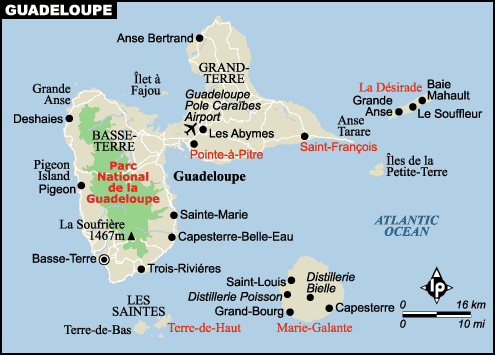
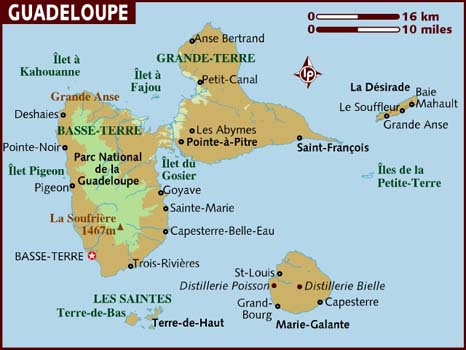
Guadeloupe [Google]

Many of the people I traced back to Guadeloupe was easily down back of ship manifests showing their town or city of origin on their native Guadeloupe. Without that the search can be quiet difficult, like how it was finding my 4th great-grandfather and this can be for various reasons. Guadeloupe is quiet a big island, similarly set up to Puerto Rico, in the sense that there are various towns and even other smaller islands that make up part of the whole of "Guadeloupe". Taking that into consideration and the fact that many surnames were changed, it can take quiet a while to trace someone to their original town.

To start the search, I began creating Excel sheet with the names, dates, and any information available in the Puerto Rican records. With that information I could see where I could head my search. Some death or marriage records of the Guadeloupeans provided information and even birth records of children, though mainly their ship manifests recorded their origins. Guadeloupeans and even Martinicans who appear in Puerto Rico mostly before 1910 are sometimes hard to trace because those ship manifests from that time for Puerto Rico aren't online. 

It's interesting seeing how many people from the island married others who immigrated from Guadeloupe and even though who came from Martinique, which is the same case with my 4th great-grandparents. So far I found one woman marrying a Spaniard in Puerto Rico, her name was Emilia Duteil and I will focus on how I found out more information about her. 

Emilia Duteil first appears on the 1910 Census living in Vieques, Puerto Rico, widowed and says that 6 children were born but 0 are alive at the time of the census. It says her birthplace is Guadeloupe while her parents are listed as "France", and says that Emilia immigrated in 1870. Interestingly enough the it says she is white which I haven't seen too many of since many are mixed, mulatto, or black. Emilia was living in the 1910 census with two "criadas" one being a servant and the other a cook, Leocadia was listed as mulatto while Ana Colberg who was also from Guadeloupe was listed as "N" for negra. 

1910 Census [Ancestry]

Emilia would die in Santurce, living in Miramar on the 29th of April 1918. Here was listed as Emilia Duteil Rosseaux, widowed of Juan Lujan and the daughter of Juan A. Duteil and Adela Rousseaux. The person who came forward to report her death was Salvador Giuliani, listed as sobrino or nephew of the deceased.

Emilia Duteil Rousseaux - Death [Ancestry]

It seems that Emilia wasn't the only one from her family to make it to Puerto Rico. There is a Rose Alsina Duteil Rousseaux who passed away in Vieques, Puerto Rico in 1909 also the daughter of Juan Duteil and Adela, most likely her sister. Both are said to be from Point-à-Pitre, Guadeloupe where I will need to search for a birth record -- which I haven't found yet. This can be because the years listed as their birth years are incorrect and so I have to expand my search to other years. Also, their town of origin can be listed incorrectly and isn't where they were born if not where they last lived before coming to Puerto Rico.

But this is for the most part the process - using documents to trace backwards their origin. Sometimes some cases are easier than others. Coming from a white béké family can help make the search easier while those were mulatto or black might come from families that were previously slaves and so the search can be harder depending on when they were released and how far into Guadeloupe their time as slaves goes. Also those who didn't know how to spell their name ended up received warped Spanish-ifed names which makes the surname harder. I noticed that more Martinicans received small name changes while though from Guadeloupe necessarily didn't.  In the meantime I'll keep collecting information about those who came from Martinique and Guadeloupe to Puerto Rico and trying to piece together the information. 

If you need help searching or have any of these surnames in your family, give me a shout and I don't mind sharing the information I have! These are the surnames I have for Guadeloupe, I'll probably create another post but dealing with those that came from Martinique. 

Guadeloupe: Ballet, Baptiste, Benjamin, Cognet, Duteil, Harris, Guiougou, Lastor, Manceau, Saint-Paul

Sunday, September 4, 2016

174 Years After Emancipation

Broken Chains - Free at last! [Google Images]
The 26th of August marked 174 years of freedom for my 5th great grandfather, Chaleau Jean Charles. He was lucky to receive emancipation 6 years prior to all French slaves being freed on the islands of Martinique and Guadeloupe. There is still much to learn about this family, especially since DNA results show that Chaleau Jean Charles carried an European Y-DNA haplogroup meaning that his paternal side was either White or a Freed Mulatto. So I want to dedicate this post to trying to understand more the situation surrounding his freedom.

First we start with the actual record which mentions his freedom. It states:

L'an mil huit cent quarante deux et le lundi cinquième jour du mois de septembre, à huit heures du matin, par devant nous Vincent Lasserre, maire officier de l'état civil de la Commune des Saintes, dépendances de la Guadeloupe, est comparu le sieur Chaleau Jean Charles, âgé de cinquante six ans, charpentier, né est domicilié en cette île, le quel assisté des sieurs Jean Baptiste Caille, âgé de quarante six ans, et Paul Désiré Petit, âgé de trente ans, tous deux propriétaires et domiciliés en cette commune, nous à présenté l'extrait de l'arrêté de Monsieur gouverneur, en date de vingt six du mois d'août dernier, de cette année, qui déclare libre le dit comparant, et il nous à requis de faire sur nos registres l'inscription présente pour l'article V de L'ordonnance de Rois du douze juillet mil huit cent trente deux. A cet effet, nous avons arrêté, et avons signé avec les témoins après lecture. Le requérant a déclaré ne le savoir, de ce requis. 

1842, Terre de Bas, Guadeloupe - Affranchissement [ANOM]

1842, Terre de Bas, Guadeloupe - Affranchissement [ANOM]

So my 5th great grandfather was a native of Terre de Bas, a island part of the chain of islands of Guadeloupe known as "Les Saintes". There he was born circa 1786 (no parents listed), and his profession is listed as a carpenter. David, my genealogist helper, says that possibly his parents were still slaves and therefore could not come forward in certain records since slaves had no say. Two men though appeared for his "affranchissment" or emancipation, their names being Jean Baptiste Caille, born about 1796 and Paul Désiré Petit born about 1812. Since both of these men were born after Chaleau Jean Charles, we know that none are eligible to be his father. But who were these men and why did they appear to help attest to the freedom of 5th great grandfather? Could their families have owned him? And was there any significance for his freedom in 1842?

I'm currently trying to decipher the information I have found on these men, for example: Paul Désiré Petit seems to be native to France where his parents still live, so we know that Paul Désiré's parents couldn't have been Jean Charles' slave owners since they were abroad in France. Jean Baptiste Caille's family could have been the slave owners or even Paul Désiré himself having purchased Jean Charles from another family once he established himself on Terre-de-Bas. I'll have to update this post with more information once I have found some to make a better theory surrounding my 5th great grandfather's freedom. Currently, I'm documenting all of the births, deaths, and marriages on Terre-de-Bas onto an Excel sheet since many weren't occurring every year since the island is tiny enough. Hopefully this will allow me to see some patterns and learn more!

Stay tuned! 

Tuesday, December 22, 2015

The Languages They Spoke…

This is just a quick post looking at genealogy through another aspect --- linguistic heritage.

When I learn about ancestors, I always try to learn different aspects of their lives, and for me that includes even the languages they speak. Luckily, most of my ancestors spoke Spanish (in some form or another) and is the language I was raised in by my parents. However, there are other ancestors who spoke different languages that came into my family. Those languages so far are Catalan and French (creole as well).

Catalan

Even though Catalan is very similar to Spanish, it is for sure another language. This language can be found in the eastern parts of Spain near France and on the balearic islands. Now a days, the language is blossoming again with Catalan pride where the language is used in everyday life, school, and government.

Catalan speaking areas of Europe [Wikipedia]

Recently, I found out that Duolingo in Spanish has a course for Catalan, which I had no idea since I usually take the courses for learning a foreign language from English. It has been cool to learn Catalan and see the similarities with Spanish and/or French. I'm not sure how good I'll get with it through Duolingo but I want to have some working knowledge of Catalan. It was most likely the language (or one of the languages) Damián Magraner spoke in Sóller, Mallorca and I would love to be able to converse and/or read in it. Hopefully if and when I return to Mallorca I'll have a good handle of Catalan and use it while I'm there!

Duolingo Catalan course tree 

French (Creole)

With my ancestors coming from the French islands of Guadeloupe and Martinique, I knew that I would like to relearn French and get much better at it. My goal is to one day head to both of the islands and use my French to get around. Chat with some people about life on the islands and who knows --- maybe even find some long lost cousins! But these islands also speak their own version of French, which are both creoles. From what I have seen it's hard to understand any of the creoles without some kind of base with how their grammar works; even though they are rooted in French they vary enough that not anyone could easily understand some of their words (think Jamaican Patois and English).

Similarly on Duolingo you can learn French which has been fun to relearn a lot of what I forgot from high school. Also, on Amazon I was able to find two books about Martinican and Guadeloupean Creole so hopefully I can learn a thing or two about speaking those languages. 

Guides to Créole Martiniquais & Guadeloupéen [Amazon]

Why learn a language?

Even though you might not have any plans on becoming fluent in the language, just learning some of the simple phrases can do a lot for you. It's never a bad idea to try and learn a foreign language especially if you have plans to travel there. Also, seeing as how your ancestor spoke this language it could bring you that much closer to understanding their life and even struggles in a new country. They say when you learn a new language you develop a new personality, so even though your 2nd great grandmother was known as stern and quiet in English, she might have been comedic and quick witted in her native tongue. Also, if you do decide to advance a lot in the language, it can help you read and study records in the original language. By taking French in high school and college, I was fortunate to be able to read records from the French islands and not have to hire a translator, allowing me to delve right into the documents myself and with the help of Google Translator I was able to fill in the gaps of words I didn't know. Having that knowledge provided, for me at least, some comfort knowing that I could at any moment read the documents and analyze them at my own pace. 

Languages play such important roles in our day-to-day lives, so why not take a look at what some of your ancestors spoke when they were around! 

Monday, June 15, 2015

How a RAOK Broke my Guadeloupean Brick-Wall

[Google]

A few months back while I was still in Madrid studying abroad, I received a message from another 23andme member wondering if I needed any help searching for my ancestors in Martinique. As you might already know, offering your help to others is known as a RAOK or Random Act Of Kindness, and in the genealogical community, you can surely find it pretty easily with people sharing their knowledge either with documents, countries, or languages in order for others to find their ancestors. Luckily, I had figured out the mystery of my Martinican ancestors with the help of David but I was stuck on the Guadeloupean side. Where was Gustave Jean Charles from? We know he had been married in Basse-Terre previously to a Françoise Jackson but with no marriage certificate or town of origin for Gustave we were stuck. We knew Françoise was from Marie-Galante but there was no marriage certificate for them there, or basically in any other town… my search was so thorough that I pretty much searched all of the towns nearby Basse-Terre and other parts of the island, such as Point-à-Pitre. However, no luck. So I told this member about Gustave and all the information I had on him, such as his occupation, estimated birth year, his mother's potential name of María Luisa, and his marriage to Françoise Jackson. We exchanged some messages about Gustave Jean Charles, and to be honest, I wasn't very hopeful. I knew that my search had been ongoing now for a couple of years and since I had searched most of the island, I had a feeling that he might actually be from Saint Thomas or another Caribbean island. When I received the response starting with "I found him" my heart dropped, could this really be Gustave Jean Charles?!?

An island of an island 

Pompierre, Terre-de-Haut, Les Saintes

The message continued with, "he is not from Basse-Terre but from Terre-de-Bas (Les Saintes)". My initial reaction was "HUH?!" Terre-de-Bas? Where's that? I've searched all of Guadeloupe and I haven't seen that town! But of course, I had stupidly ruled out a tiny island belonging to Guadeloupe, just below the area of Basse-Terre, and of course, it would be MY ancestor to have lived there!! The chain of islands, known as Les Îles des Saintes, include the islands of Terre-de-Bas and Terre-de-Haut (part of 9 islands in total). The island's population is rather small and because of its rather 'different' influx of immigrants, the islands diversity isn't completely the same as mainland Guadeloupe, "the archipelago of Les Saintes is mostly populated by the descendants of colonists from Brittany and Normandy, and inhabitants of Poitou, Saintonge, and Anjou who are mostly from the first French families that lived on Saint Christopher and Nevis when it was a French colony. The population has the peculiarity of being primarily of European origin and speaks a variety of popular American French, with some terms of Old French" [Wikipedia]. This would explain why Gustave Jean Charles' descendants carry a European Y-DNA haplogroup! 

Guadeloupe [Google]

The messages then began to flood my inbox with new documents, information, dates, and names. I was completely flabbergasted, could it be possible that my search for Gustave Jean Charles was really coming to an end?! After so much time wondering, contemplating, and trying to figure out where or who Gustave Jean Charles, were the walls finally starting to come down! 

A New Name in the Mix

When I glanced over the marriage record I was sent from 1843 in Terre-de-Bas, my first reaction was "OH OH! this isn't the same man". The marriage record was for a Gustave Chaleau and a Françoise Jackson, but I don't know a Chaleau! As I started reading the record I started to realize that this in fact was my ancestor and I'll explain why in a bit. The record stated that "the sir Gustave Chaleau, 21 years old [born about 1822], a sailor, born and domiciled in Terre-de-Bas, of age, the legitimate child of Chaleau Jean Charles and Marie Lucie, both landowners and domiciled on this island; and the miss Françoise Jackson, 20 years old [born about 1823], a seamstress, born on the island of Marie-Galante and living in this community, the natural daughter of Clarice Jackson, a laundress, domiciled at Point-à-Pitre, both appeared for marriage". 

For starters a lot of the information matched up, such as Françoise being from Marie-Galante and Gustave's birth year, his profession dealing with boats/sea, and especially that his mother was named Marie Lucie (which in Puerto Rico was translated to María Luisa). What's also important here to notice is that Gustave's father was named Chaleau Jean Charles, therefore we know that the Jean Charles name is there somewhere and as we know, the names did jump around in Puerto Rico so for it to happen in Guadeloupe wouldn't be so surprising. Also, luckily there was signature for Gustave which was similar to his Puerto Rican signature: 


Here on the right you can see his Puerto Rican signatures, if you focus on the first way he wrote Gustave you find some similarities to his signature in Guadeloupe. His signatures are a bit sloppy but this is probably due to the fact that he was in his 60s when signing as a witness in Puerto Rico. Here on the Terre-de-Bas signature we can see that Gustave signed with this new name of Chaleau, which has never appeared in any Puerto Rican records. The mystery of this new surname though can easily be solved with the help of another document -- the freedom record of my 5th great grandfather, Chaleau Jean Charles. 

A Free Man

My 5th great-grandfather Chaleau Jean Charles was manumitted from slavery on the 26th of August in the year 1842. Though it doesn't state who was his master, it does state that Jean Baptiste Caille came forward along with Paul Désiré Petit during his manumission. David has told me that it is possible for one of them to be an owner or even friends, though the record does not state an relation between the men. It states that Chaleau Jean Charles at the time of his freedom was 56 years old and a carpenter (which makes sense since various of his descendants would also take up this job!). It also states that he was a native of Terre-de-Bas, meaning that he was born there and not brought over as a slave like on my Martinican side of the family. However we don't know who Jean Charles' parents were and where they were born.   

Nº 8 Chaleau Jean Charles - Manumission, 1842 [ANOM]

So we see that Chaleau and Jean Charles were probably his names and out of there comes the confusion of using either "Chaleau" or "Jean Charles", and in some records they use Jean Charles as the surname rather than Chaleau. Most likely he was known as "Jean Charles" most of his life and then the Chaleau was added later on as a surname, however Gustave stuck with Jean Charles when he immigrated to Puerto Rico and even his other son goes back and forth between both Chaleau and Jean Charles on records. 

With his new found freedom, Chaleau Jean Charles was able to marry the next year and married on the 4th of September 1843 my 5th great grandmother Marie Lucie; two months later his son Gustave would marry Françoise Jackson. Chaleau Jean Charles' marriage record states that he and Marie Lucie were both from Terre-de-Bas and he 56 and she 55 years old. Their record also states that before this said marriage, together they had three children who apparently were: "inscrits sur les régistres de l'état civil de cette dite commune, de leurs actes d'affranchissements, en dite la premier janvier mil huit cent trente trois" meaning that the children were registered in the records for manumission on the 1st of January in 1833, records which I have yet to find! These three children include Charles (aged 23), Adelaïde (aged 28), and Gustave (aged 19) all living on said island. It's nice to see that Chaleau Jean Charles and Marie Lucie were able to marry! And even though Chaleau Jean Charles wasn't able to sign his own name on his marriage record, it's interesting to note that his son - my 4th great-grandfather  Gustave - at only about 19-20 years old was able to sign his own name, which makes me wonder about their education and childhood upbringing as slaves. 

Conclusions

At this point, I'm fairly certain this is the same man, just like with the records in Martinique, there are far too many coincidences for me just to brush it off. Because things like the name, year of birth, and especially the mother's name matches, I'm fairly confident that these two men are one and the same. I can't believe that that my search for Gustave Jean Charles is over, especially with all the confusion in the records and the craziness that was name order in Puerto Rico. Goes to show that with constant searching and some help a lot can be achieved. My next goal is to try and find out more information about Jean Charles and Marie Lucie, for example we know that Jean Charles was manumitted in 1842, but Marie Lucie seems to be manumitted in the year 1832 along with her children. I wonder why so much earlier then he was. Were they from two different plantations or owners? I don't know much more about the family and I would like to hopefully one day find where they were from before Terre-de-Bas. 

I'm excited to finally have names of towns in Guadeloupe and Martinique, and I can't wait to hopefully one day visit these two places. I can't wait to add more pieces to this puzzle, or rather make this picture a bit clearly in regards to their life on these French islands and the history that comes along with them to Puerto Rico. So happy that I can add more to my own story of my ancestors especially to a branch of my family that was so closed off to me genealogically for many years. 

Remember to keep searching, asking questions, revisiting documents and never give up! Sometimes it takes stepping away from a puzzle in order for you to gain a new outlook on how to potentially solve it. For any Puerto Ricans that might have ancestors from Guadeloupe and/or Martinique, feel free to reach out to me if you have any questions on how to get started on finding those ancestors. Also, I have written about it on my blog what feels like extensively, so feel free to poke around and read other posts for some tips and tricks. 

Can't wait to see this view one day! :D

Grande-Anse, Terre-de-Bas, Les Saintes, Guadeloupe [Google]

Thursday, October 9, 2014

52 Ancestors – #41 María Paulina Gustavo Lotten (1867-1948)

Yay for writing a new post (and on time!) Today I want to focus on my 3rd great grandmother who I've mentioned multiple times throughout my blog but I wanted to dedicate a section of the 52 Ancestors challenge to her.

My 3rd great grandmother on my maternal side was María Paulina Gustavo Lotten, and boy did it take me a long time to figure out all of that information. Officially, my 3rd great grandmother's should either be A) María Paulina Jean-Charles Lautin or B) María Paulina Gustave Lautin. And I'll explain why!

María Paulina was born on the island of Vieques, a island on the eastern coast of Puerto Rico on the 15th of January 1867, and later baptized on the 14th of February of the same year. Paulina was the daughter of two immigrants who had probably just recently arrived to the island when she was born. Her father was Gustave Jean Charles (also known as Gustavo Juan Carlos/Charles or Juan Carlos Gustavo- know you can see why there are two options for Paulina) and her mother was Julienne Malvina Lautin (also known as Juliana Malvina Lotten). Both were from French islands, Gustave hailing from the island of Guadeloupe and Julienne from the island of Martinique. So far, I've hit a brick wall with searching Gustave's origins on the island of Guadeloupe. I was very fortunate to find Julienne's original town in Martinique, which was Rivière Salée, a section of Trois Bourgs. We know that Gustave was married previously in Basse-Terre, Guadeloupe around the years 1851-1865, when his first wife Françoise Jackson passed away from Cholera. Hopefully I'll be able to find out where Gustave Jean Charles was from, whether it be Guadeloupe or another town!

My 3rd great-grandmother was the first born of seven children, as the family traveled the children were born along the way in different towns. María Paulina and Tomás Octavio were born in Vieques, Areopajita and Valentina were born somewhere between Vieques and Fajardo. Dionisio was born in Fajardo, Alberto Fermin in Salinas, and Martina Isabel in Santa Isabela. As you can see the family did some traveling! Finally the family would settle in the southern coast of Puerto Rico in the Salinas, Guánica, Ponce area. My 3rd great grandmother lived and married in Salinas, but later moved up north to San Juan, PR.

María Paulina married in the town of Salinas in 1896 to Manuel Correa Ortiz, son of Juan Nepomucino Correa Rodríguez and Bibiana Ortiz. Together they would have eight children together, my 2nd great grandfather being the 3rd to last born.

It's important to note that my 3rd great-grandmother probably received her name as a namesake from her mother's deceased sister. Julienne was born in 1844 and later a sister named Pauline was born in 1846, Pauline would later pass away in 1855 at the age of 8. I'm pretty sure this is where she gets her name, as a memory and dedication to her mother's deceased younger sister; both born into slavery and freed together with their mother in 1848.

By the year 1940, María Paulina (who sometimes went by the name 'Octavia') is found living alone in San Juan, Puerto Rico on Calle Progreso. Eight years later, on the 20th of September 1948 Paulina would pass away from cardiac troubles.

I wonder a lot about María Paulina and what kind of life she would have lived. Would she have been raised bilingual by her parents? Could she speak French, Martinican or Guadeloupean Créole and Spanish? Her mother would have been 23 when she was born and probably a recent immigrant to Puerto Rico, had she already begun to learn Spanish when Paulina was born? Did María Paulina know much about her parents' origins and about their past lives in the West Indies? Did she raise her own children by speaking créole to them and telling them stories about her parents?

Unfortunately, any of those stories would be cut short from me when my 2nd great-grandfather died in 1929 leaving my great grandfather without a lot of that information if he had any of it at all. I wish I knew more about this family and their cultural ties to Guadeloupe and Martinique. Did the children dream about visiting these islands themselves and seeing where their parents had spent the beginning years of their lives? Did Julienne or Gustave ever what to return? When I found out about this family and my sudden connection to Martinique and Guadeloupe I was completely surprised, flabbergasted, shocked (positively), and every other adjective there could possibly be. How could this information slipped by my grandfather, had his own father had no idea about their créole roots from the French West Indies??

I so far have met one other descendant from the Gustavo-Lotten clan but I would love to see if there are any other children from my other 3rd great-grandaunts/uncles. Were they raised with stories about the French West Indies and maybe kept some Créole words in the families? Maybe they use the names Paulina, Juliana and Gustavo/Juan Carlos in their families? Maybe they have pictures of those Gustavo-Lotten children/grandchildren of the family?

I would love to meet some more descendants and share the stories of our mutual ancestors if they don't know the stories already! When I found out I was very excited and I definitely want to visit these islands and walk the streets my ancestors walked. And maybe pick up on some French Créole! 

Tuesday, June 24, 2014

Emigration/ Migration / Immigration (Book of Me -- Prompt 43)

I bumped into this topic from the Geneabloggers emails which posts prompts (amongst other links) from a blog by Anglers Rest. Pretty much the prompts are created for you to fill out, that way you are building up some genealogical information about yourself as well! I think it's a great idea, especially since we focus so much on the past that sometimes we forgot -- one day we'll be a part of that past! And prompt #43 is a great prompt for me for many reasons, so I decided to give it a go!

Here are the questions for the prompt. I've reorganized a bit to my liking since I want to tackle them in a certain way. 
  1. Have you ever lived overseas from your place of birth? Would you want to? Could you?
  2. Did your ancestors or even a more recent generation?
  3. Do you feel akin to another country from that in which you were born?
  4. If so have you found any ancestral links in your research that perhaps explains those feelings?
The process of emigration, migration, or immigration have always been completely interesting to me -- And I think mostly because my parents are Puerto Rican. When they came to this country they technically weren't "immigrations", yet a lot of the experiences we share are those of "immigrants" (The language barrier, custom/cultural differences, etc.). I never saw my family as immigrants but more so as emigrants. Yet, I can't fathom the courage it takes to uproot your family (or yourself) and completely move away from everything you know, love, and cherish. 

I've experienced living abroad through my experiences from study abroad. I was able to spend a semester in Yaroslavl, Russia as an exchange student. And those four months changed my outlook on life completely. Being disconnected from the outside world (barely any internet to Skype back home properly) and the complete change of culture and language was definitely hard on me. Don't get me wrong, I thoroughly enjoyed my time in Russia yet I had the luxury of emails, Facebook, and occasionally Skype. I can't imagine how my mom came here at the age of 18 and her only communication with her own mother was through the occasional phone call and letters (and she 'migrated' in the late 1980s). I definitely think living abroad (even for just a short period of time) definitely makes you a stronger, more independent, and just overall livelier person. Now with my next adventure of living abroad on the way, I'm excited to compare and contrast how living abroad in Spain will be to Russia. Obviously, language, locality of country, and similarities in culture will play a huge role in my "easing" into the country but I wonder how easy it will be in Spain. I actually didn't suffer from culture shock in Russia but will I in Spain? 

Before my parents coming to the USA, pretty much every generation dating back to the 1800s/mid 1700s had been living in Puerto Rico. I can't imagine the jump from (A) to (B) being easy, both in the case of A being Puerto Rico and B being the United States. But also the jump of A being Spain and B being the new territory of Puerto Rico. Did the fears and concerns my family had in the 1980s mirror those of my ancestors in the 1600s/1700s? Leaving family and friends behind for a new land which they had only heard about through stories. 

My fourth great grandparents are currently super, über intriguing to me -- they immigrated (since they were crossing territories of countries) respectively from Guadeloupe and Martinique. I can't even begin to imagine their journey from a land of French/Créole to that of Spanish. A least when I went to Russia I had an idea of what Russian sounded like; I could read, write, and speak in the language pretty well by the time I landed in Moscow. But what about Gustave Jean-Charles and Julienne Malvina Lautin? Where did they muster up the courage to travel from their home islands and make their way to Vieques (a small island of Puerto Rico on its eastern coast). Were they scared they wouldn't fit into the culture there? Had they heard such wonderful stories of Puerto Rico and its people that they had to see, experience, and live it for themselves? 

How well did they 'mold' into the culture when they first arrived and in their first years? Living on Vieques probably wasn't an issue, they must have known some other immigrant families settling themselves in the island. But were they nervous when the appeared before the church in 1869 to get married? Or when they had to baptize and register the birth of their children? Did Julienne whisper songs in créole to Paulina and Tomás as small children? Did she feel the need to preserve her Martinican traditions, words, and mannerisms? Did she lug them from Martinique to Vieques and finally to Río Jueyes, Salinas or did they stay behind in Rivière Salée?

I often wonder and worry that as time continues I'll begin to lose my "Puerto Rican-ness". That I won't teach my children Spanish, how to sing La Borinqueña, or share with them the traditions, customs, and superstitions my family passed down to me. (Never walk with one shoe off and one shoe on, it means you want your mother to die!). Yet, deep down I know (and hope) this won't happen. My ties to the island, my culture, and the way I was raised are too strong and too important to just let go. But yet I still worry -- did Julienne and Gustave feel the same way? In just three generations, it seems that the ability to speak French/ Créole was lost (my great grandfather being one of the few who I was told spoke French). Will three generations after me not care what their 4th great grandfather Luis Rivera talked and preached about culturally? 

Hopefully, living in abroad in Spain will give me some more insights. Remind what it is to be in a land that isn't your own (no matter how similar they might seem). I wish to learn more about the immigrants who came from El Puerto de Santa María, from Huelva, and from Pastrana and made their way to Puerto Rico. To learn the stories of those who came from unknown towns to the beautiful island of Borikén and settled there. To learn the stories of those who against the odds made the various towns of Puerto Rico their home, their nest, their humble abode. Did other people in my family move to Puerto Rico without knowing Spanish? Or maybe those of different religious backgrounds into a Catholic territory? 

I don't know where I'll end up -- where I ultimately will set up my own nest and home. But I do hope that wherever that may be (either here in the USA or else where), that I bring along my heavy yet important Puerto Rican bags. That I open them up, air out the contents inside, and let them breathe old yet new life into my home. That my children and grandchildren will run around saying "Bendición papi, bendición abuelo". That most importantly, they'll know and care what it feels like to be Puerto Rican. Because I know I definitely do!

Monday, May 12, 2014

Post #100 – Happy 10 Years of Genealogy!

Happy 10 Year Anniversary!
Who would have thought that 10 years would have flown by this fast!? It feels like just yesterday I began talking to my relatives, asking them about my ancestors, and typing names into Ancestry.com to begin my search. I have definitely come a long way since then! Equally, this also marks the 100th post of my blog – who would have thought that would come whizzing by as well? I've learned so much over the years and have made some great discoveries. Looking back at my beginning years I of course was naïve at times (Hey, I was only 14!) and I have definitely learned from many rookies mistakes, and I'm still learning to this day. So I guess I just want to take some time to talk about my research from the last past 10 years – the good, the bad, and the ugly!

How I Got Started

I will never forget what fueled my now semi-obsessive passion – a photograph, some curiosity, and some elusive stories. Granted, at the time when I first became interested as a kid I had no idea what genealogy was and the internet wasn't even a thing yet, but I wanted to learn about my family. Who was that man in the photo? Why did that woman look native? Were they related to me? What?! My great great grandfather was from Spain and married a Taíno Indian? Why are abuela's eyes green?

I was always curious about my family and our origin; it wasn't until I was 14, however, that I began to search for my roots. I started asking questions but this time expecting answers: Who was my great grandmother? What was her name? When and where was she born? Who were her parents? Initially, I was greeted with a few genealogical-rich responses sprinkled her and there. Oh, that's your great grandmother Epifania Dávila Orozco. She was born in Yabucoa, Puerto Rico on the 6th of January 1914. Her parents were Pedro Dávila Ruiz and Francisca Orozco Santiago. However, after a while the well of knowledge in my family began to dry up and I had to turn to records. I wanted to prove whether or not I had Spanish and Taíno blood. Wanted to know where my family was from on the island and where our roots took us back to. I wanted to know where my grandfather's pride of his African roots came from. While working for the NYPL, a co-worker had mentioned that I could access the records from Ancestry.com for free through the Public Library and off I was exploring through Census Records (1910-1930 at the time), as well as WWI and WWII Registration Cards. My mind was buzzing with new names, dates, and places in Puerto Rico.

Familia Vélez Avilés [Personal Photo]

What I've Learned

First and foremost – Patience! Don't expect to type in one name and find an extensive tree on your family dating back to Adam and Eve. Especially if you're the first one in your family creating a tree like I was, initially there might not be much. Expect to sit there for hours making sense of dates, names, and relationships. Expect to sift through hundreds and if not thousands of records and turn up empty handed. Expect to feel defeated at times because that one pesky ancestor is hiding somewhere in the records. But also expect pure bliss when finding that one record to connect your lines. Expect happiness and elation when you find a record to prove your theory. Expect to yell and scream with happiness when you've pushed your lines further back. Ultimately, expect to learn more about yourself.

10 years is definitely a lot of time – I have dedicated probably easily over 1,000+ hours (If not WAY more) to researching my family's lines. I regret none of that time, it was time well spent. For the moments I've felt most defeated and hopeless, I learned that I most search harder and find new methods. I also learned that staying optimistic is key! Cooped up in room and sitting there for hours on end to find absolutely not one record on your family can be nerve-racking – but I would do it again any day! I've also learned to be prepared to make mistakes, to back track, and to doubt yourself. Document, document, document! Make notes for yourself and leave clues about records that have been searched or need to be searched. I'm still working on how to perfect these techniques but I'm learning everyday!

My Favorite Discovery

I think hands down my favorite discovery (so far) of all time would have to be discovering my 4th great grandmother Julienne Malvina Lautin. For those of you who might have been following my posts for a while now you know how frustrated at first I was. Records from Puerto Rico mentioned any variation of the name Lautin as Lotten, Lotin, Lote, Lotett, Lotiz, Sotin, Soti. Records mentioned that the family could have been from Martinique, Guadeloupe, England, France, or Saint Thomas. To get an idea of some of the confusion about Julienne and her husband read the post "Tracing a Surname" to catch a small glimpse. With the help of a fellow genealogist I was able to learn about the BNPM which would eventually unlock the mystery of my slave-born 4th great grandmother Julienne and her mother Eglantine. I would discover that Julienne was born in Rivière Salée, Martinique on the 6th of February 1844 on a sugar plantation to an African mother (and likely to an African slave father). Unknowingly, this is where the pride of being negro came from within my grandfather. To learn more about the discovery feel free to read "Sparks, Sparks, Sparks, A-Flyin'".

I think the only other discovery that will top this one is of Julienne's husband Gustave Jean-Charles. I think once I have solved that mystery I'll be eternally happy! Of course there are many more brick walls in my family tree – who doesn't have more than a few good uncrackable walls?! And can a genealogist even be eternally happy?

My Worst "UH OH" Moment


Ramona Rivera Rivera [Personal Photo] 

One of my worst (well, worst is a heavy word but I'll use it) "Uh Oh" moments happened while researching Ramona Rivera Rivera, my 2nd great grandmother. At the time I was researching her I was using only the census records and stories -- my grandfather originally said her name was "Ramona Rivera Rodríguez". So I found a woman with the same name, from the same town, and around the same age to match the information I had on my 2nd great grandmother. I began to build this branch with the information I had discovered. When I found out about FamilySearch I quickly began to continue researching the line and didn't really bother to backtrack and see if I had the right woman (a bit naïve I know). It wasn't until I found my great grandmother's (Ernestina Miranda Rivera) birth record in Vega Baja that I realized I had the wrong woman and wrong line. I had been able to extend this other woman's line for a good 3-5 generations on various lines and with the help of another genealogist she was able to provide information from the family's origin outside of Puerto Rico. Again, things happen for a reason and I definitely learned a lesson from this experience – always double check your sources and cross-reference with other information on your tree. In Puerto Rico, since both surnames are used it's usually a bit easier to avoid these issues but when you work with common names like Juan, María, José and common surnames like Rivera, Rodríguez, Ortiz -- then it's more likely to have to double check!

Here's a quick post from 2011 where I talked about clearing up this little mix-up!

Words of Advice 

Advice for novice genealogists or for anyone wanting to get started in general? I would say document your family's stories first!! This is something that I'm actually going back and doing now! At first I sat and listened to others and only pulled out important information like names, dates, and places. But over the years I began to notice that even the smallest details or the family stories turned myths had some sort of truth or clues in them. Now when I ask my family about a certain ancestor I make sure to document what they told me even if they were unsure. Not only does this help for referring back to previous conversations but you never know when that person will leave this Earth. Listening to a story is a wonderful thing but when you try and recall details it might get foggy and you yourself unknowingly add twists to the story. Did she say this or that? Also, documents can't tell the full story of your family! And that's why stories, anecdotes, and family lore are important to your search. You never know if what you were told was fiction is actually reality. Never doubt the power of storytelling!

If I Could Tell Myself Something 10 Years Ago

If I could go back in time and talk to myself 10 years ago when I first began my search I would have probably told myself to record stories. I have definitely learned and done a lot in the 10 years I have done genealogy, I have cold-called relatives and cousins I never really knew and have asked all the important questions about my family even when sometimes the answers weren't so direct and informative. I would definitely tell myself to record some of the stories from older family members and ask them everything I wanted to know. The good thing however is that I'm fairly young and have enough of my family around to ask questions and start recording. The bad thing is that many of them are in Puerto Rico! Hopefully in the coming years (as early as this summer -- starting with my grandmother), I'll begin to record short interviews with my family members where I'll be able to ask them questions and record their answers. This will not only give me information to have for years to come but also an audio file of the voice of my family members. I wish I would have started early on so that I could have gotten the chance to interview my great grandfather before he passed away. Audio recordings will definitely add another layer to my researching and family tree.

Hopes, Dreams, and Aspirations

I hope to continue doing genealogy for another 10 years (and hopefully even 50+ years)! I have thoroughly enjoyed searching for my family's past and learning the stories of the people that have contributed to making me who I am today. I aspire to becoming a professional genealogist one day with a focus on Puerto Rico and potentially the islands of Martinique and Guadeloupe since I have ancestors from there, meaning I would also have to brush up on my French (another aspiration!). I would love to tie in my obsession for genealogy with my everyday life/profession. I don't know where my life will lead me but I know that having genealogy there with me will make me a happier person. I would love to become an expert on Puerto Rican Genealogy and help others discover their past and ancestors. I dream of traveling around Puerto Rico discovering the lands my families lived, worked, married, and were born on – I have only seen a limited amount of Puerto Rico and I dream of visiting the different municipalities my ancestors lived on and the churches they would have attended and married in as well. I dream of visiting Rivière Salée, Martinique, Basse-Terre, Guadeloupe, and other places my ancestors immigrated from. I hope to find new names in my family tree, meet new cousins, and hear new stories. I dream of connecting Eglantine to a country and tribe in Africa.

These have been a great 10 years and can't wait for the next set of 10 years to roll by -- here's to 2024, my 20th anniversary of genealogy!

Saturday, April 26, 2014

Happy DNA Day!!

April 25, 2014 [DNAart]
I know I am a day behind with this post but I still wanted to publish it! DNA has truly changed the way I view myself, my culture, my history, and my view on the world. I wanted to share a bit why taking a DNA test was important to me.

Before taking my 23andme test, which back then was a hefty price ($500), I didn't really know what to think of myself. I knew that my history was full of multicultural ancestors, yet how much of me was actually native Taíno, African, or European? I had always been proud to be Puerto Rican and my tree was definitely helping me to realize more and more how deep my roots are on the island, yet I still had no idea what continents my lines ran back to.

Parranda en Puerto Rico [ElBoricua]

Taking the 23andme test and later the AncestryDNA test really helped to show how mixed our culture, my culture, really was. I learned about my Y-DNA, mtDNA, and my ancestral composition. I learned that my Y-DNA traces back to the area between Spain and France where the Pyrenees lie; this wasn't too surprising since many Spaniards came to Puerto Rico. I learned that my mtDNA traced back to the natives of the Americas and probably specifically to the native Taíno and/or Arawaks who lived in Borikén before the arrival of Cristóbal Colón. I also learned that while I am little over half European, I do carry about 15% and 12% African and Native American genes respectively. Other haplogroups in my family tie into various groups such as: West Africa, Middle Eastern/Jewish, Irish, English/French, and there is more to learn about.

Ancestry Composition - Luis Rivera [23andme]

I learned that even though my family has been on the island of Puerto Rico for at least 200+ years I have ancestors who immigrated to Puerto Rico from Martinique and Guadeloupe, bringing their own culture and identity with them to their new land. In that 15% Sub-Saharan African, I carry their names, their stories, their memories.

Many of us come from very complex and interesting backgrounds, we have to learn more from both a genetic and historic standpoint to understand who we are here today. I am a combination of curious explorers, friendly natives, and determined slaves. I have learned to view the world differently, that skin color doesn't make or break your identity and that there is more than meets the eye. My DNA results have made me proud of all aspects of my ancestry, to realizing that I am my own melting pot. 

So Happy DNA day: take your own DNA test, test someone in your family, or learn more about your results! I don't think you'll regret it!

Spanish, Taíno, Africans [TainoNationNews]

Tuesday, April 8, 2014

52 Ancestors – #14 Julienne Malvina Lautin (1844-1897)

I know I have talked plenty about this ancestress but I love talking about her and she definitely deserves a spot in my 52 Ancestors Challenge! This ancestor is my 4th great grandmother, Julienne Malvina Lautin- a woman who was born a slave, later freed, and immigrated to another country with another culture and language. Even though we are separated by many years and generations, she is one ancestor I would have loved to get to know, if given the chance!

Rivière Salée, Martinique [Wikipedia]

Discovering Julienne Malvina Lautin definitely took a while! I've posted about her many a times before, pre- and post-discovery when all of the clues were beginning to unravel. Julienne Malvina Lautin was born on the 6th of February 1844 in Rivière Salée, section of Trois Bourgs in Martinique. Julienne was born a slave on a sugar plantation owned by a family named "Lapierre". She lived there for a good portion of her childhood, even after her emancipation. Julienne was labeled "negrésse" on her birth record which means that both of her parents were slaves, her father we have no idea who he is yet and her mother was Eglantine, a native of Africa.

Julienne Malvina Lautin, Birth Record, 1844 [ANOM]

Julienne was the oldest child of Eglantine and one of four. Her siblings were Pauline, Jean, Rose and Marie. Her sister Pauline passed away at the age of 8 which I imagine was hard for Julienne since they were so close in age. My 3rd great grandmother would receive the name María Paulina and I'm pretty sure it was in honor of her Pauline. I'm not sure if any of Julienne's sisters or brothers traveled outside of Martinique as well, but it is very possible. When Julienne left Martinique her mother was still alive as well as 3 out of her 4 siblings, I imagine it must have been very difficult leaving her family behind!

In 1848, when Julienne was 4 years old she and mother along with Pauline attained their freedom from slavery. This is when they received the last name "Lautin", which was not their slave owner's surname. I've talked about before how surnames were given to slaves after their emancipation, and mostly these names were given at random.

I ask myself a lot of questions about Julienne's life. Did she speak French to her children in Puerto Rico? Did she ever learn Spanish while living in Puerto Rico? How did she pay for her voyage to Puerto Rico from Martinique? Where did she meet her husband? Did she find the transition from French-cultured Martinique to Spanish-cultured Puerto Rico difficult?

As you can see, this is why I would have loved to meet Julienne. I would ask her all these questions and more, we would sit and chat about life, its subtle differences in various cultures and about her thoughts. Julienne would go on to pass away in Salinas on the 7th of April 1897 as "Balbina Pérez Glantin" (originally I thought it was another lady in Ponce based on the information I had). However this Balbina (one of the many nicknames of Julienne), is my ancestor based on the names provided for her mother and husband. Another mystery we have is the use of Pérez or Pedro as her father's "surname" and I've pondered about what it actually was in Martinique if they even knew. One theory is that Pedro is a Spanish version of "Pitroo", another slave family that shared the plantation Lapierre with the Lautin family.

I plan to one day visit Martinique and walk around Rivière Salée and sit down and really think about Julienne's sacrifices and how generations and years later because of her voyage (as well as Gustave Jean-Charles), I am able to learn about their/our past and my history.

Merci Julienne, pour toutes les choses que tu as fait dans ta vie. 
Gracias Julienne, pour todas las cosas que has hecho en tu vida. 
Thank you Julienne, for all the things you have done in your life. 

Mwen ka rimèsié'w anlo.
Mèsi.