Showing posts with label genetics. Show all posts

Wednesday, October 9, 2019

Genetic Connections to Guadeloupe

Connecting to DNA Cousins from Guadeloupe [Google Maps] 

DNA testing is something I initiated about 10 years ago, and I was fortunate to have stumbled upon it when I did. With testing, I have been able to make great discoveries - some of them thanks to the DNA itself and others to the people I have met and interacted with along the way. If you have been following my blog (Thank you & ¡Gracias!), then you know a few years back (8 actually to be exact!) I begun to unravel a previously unknown discovery in my family about a connection to the islands of Martinique and Guadeloupe via my maternal grandfather's side of the family. At the time I knew very little about this branch but thanks to digging through documents and connecting with French Caribbean genealogists throughout these recent years, I was able to discover much more about this side of my family.

My research up until now has revealed two distinct sides in my 3rd great-grandmother's family, one side (her father's) comes from Guadeloupe while the other (her mother's) comes from Martinique. 

María Paulina Charles Lautin - 3rd Great-grandmother [Personal Photo]

Unfortunately, there is not much information past María Paulina's grandparents. It seems that on the Jean-Charles side, the family might have been mixed-creole seeing as how her parents were enslaved themselves, yet a Y-DNA test points to European origins for the "Charles" line. It is important to note that this side of the family received their freedom from slavery before 1848, unlike most of the enslaved peoples did in the French owned Caribbean islands at the time, this allowed María Paulina's paternal Guadeloupean grandparents a chance to marry before they passed away. Meanwhile, the "Lautin" side is probably all African in origin. Julienne was born a slave (noted as "negresse" on her birth certificate in 1844) and Eglantine herself was brought over from Africa. Unfortunately, we have no idea who the father of Julienne was. We only have a potential clue - in Puerto Rico the father's surname was written down as "Pedro" and searching the records in Martinique has allowed me to identify a family with the surname "Pitroo" who worked on the slave plantation as the Lautin clan; there might be a possible connection to that family and only time and DNA will tell.

Charles-Lautin Family Tree [Personal Photo]


One of my genetic goals was to potentially one day find a cousin who descends via their maternal line all the way down to Eglantine Lautin, this would allow for a MtDNA test to potentially identify a region in Africa she would have originally been from. I have been able to find a genetic cousin via AncestryDNA but they haven't logged into their account for over a year so I haven't heard back from them. The question now became were there segments in my DNA linking me back to potential cousins in Guadeloupe and Martinique? If not, would my grandfather's DNA contain segments? Luckily I have been able to test myself and my maternal grandfather on 23andMe and AncestryDNA along with our Y-DNA line on FtDNA. Thanks to the suggestion of David (a French Caribbean genealogist), I migrated my grandfather's DNA to MyHeritage - which seems to be more popular in France. 

After breaking up my DNA in DNA Painter into segmented colors of who gave me what, you can clearly see all the yellow segments below belonging to my grandfather. 

DNA Painter [Personal Photo]


This DNA in turn comes from his parents, grandparents, great-grandparents, etc. meaning that though those segments cover much of my maternal DNA, I would have inherited genetic material from one out of eight 2nd great-grandparents on that side of the family with ties to Martinique and Guadeloupe. And since it is far back, the odds of me receiving many segments is low as well, but having my grandfather tested means there are more odds of him having more segments as well. Recently in my DNA, I have been able to identify two matches on AncestryDNA and one match on MyHeritage with clear connections to the island of Guadeloupe. 

AncestryDNA

My first match shares DNA with my grandfather but not myself or my mother. Though they share 3 segments across 49cm it's possible that my grandfather was the last generation to inherit these segments. In their "shared matches" list they only share three matches, which is very uncommon for Puerto Rican matches to share such low and limited cousins, so I can probably rule out the fact that this cousin as remotely Puerto Rican. This cousin does however have on their shared matches a cousin who is Puerto Rican but connected to my grandfather via his Correa family which is tied to Martinique and Guadeloupe via María Paulina Charles. The first match I have no idea how they are connected and the third match is a cousin with is mixed Guadeloupean and I think African American. Since AncestryDNA does not share where they match on their DNA, I have no idea how to "chart" this for my grandfather on DNA Painter. The cousin I think is not on Gedmatch either, and I have reached out but no return message so far. 

Guadeloupean Cousin [Personal AncestryDNA]

This 2nd cousin shares DNA across 3 segments as well with my grandfather but this time at 38cm, my guess is that these 3 segments are probably the exact same ones as the first cousin from above. However with this cousin, my mother and myself are said to share DNA with as well. Unfortunately, I have no way of knowing where on my DNA these segments are located.

Cousin with Guadeloupean Ancestry [Personal AncestryDNA]

MyHeritage

This was my grandfather's first official Guadeloupean cousin to first appear for him which was very exciting, since it helped to solidify all the research I had done in the past 8 years. As you can see below I was able to find this cousin by filtering his DNA matches by geographic origins and selecting "France". The segment is listed as only one shared segment but also at 38.3cm like one of my grandfather's AncestryDNA matches. You can also see that based on our trees we both have "Guadeloupe" as an ancestral place for our families based on the trees we have built. I have gotten a chance to chat with this cousin and our families both have ancestry from Les Saintes, which are a set of smaller islands belonging to Guadeloupe! It is possible that there are more matches amongst my grandfather's DNA matches who have a connection somehow to Guadeloupe but so far this is the only one I have been able to find on MyHeritage. 

Guadeloupean Cousin [Personal MyHeritage]

Luckily, on MyHeritage you can see where in your DNA you share the segments. For my grandfather and this match, the segment is located on chromosome 11. 

Shared Guadeloupean DNA [Personal MyHeritage]

My own personal chromosome 11 is inherited mainly in the same spot from my grandfather as the Guadeloupean match comes from but doesn't mean that I would necessarily share that same piece of DNA with that cousin, in order to better know I would probably have to transfer my own DNA into MyHeritage and see if I match this cousin as well.

My Chromosome 11 divided into Grandparent Inheritance [DNA Painter]

Interestingly enough, the region my grandfather shares with this cousin on Chromosome 11 is European on one side and African on the other and specifically the DNA on that side is registered as Nigerian. In a previous post, I took a look at inherited African DNA and I analyzed a bit the fact that Nigerian DNA was much higher on my grandfather's side of the family and potentially connected to María Paulina Lautin. If I had to put some money on it, I wouldn't be surprised if their shared DNA was on the Nigerian side via a slave(s) brought over to Guadeloupe. I'll have to read up on the African influx of slaves to Guadeloupe and see if any studies have been completed on which regions these slaves specifically hailed from.

My grandfather's Chromosome 11 [Personal 23andme]

Why no genetic connections with Martinique? 

I'm not sure why I originally expected genetic connections from Martinique over Guadeloupe. Maybe because I discovered the former side first versus the latter, I expected that my genetic connections would happen in the same order. But taking a closer look it kind of makes sense why I might not have Martinican connections right away, we know that Eglantine was from Africa and Julienne's father probably was as well. Out of Eglantine's five children (one of them being my own 4th great-grandmother), only three (two siblings) went on to have children and who knows if they were were full or half siblings (I'm guessing half over full). 

Next Steps

Nonetheless, this is exciting stuff! The next step would be to try and figure out how we're all related! It doesn't seem like we have any surnames overlapping with each other, but at the same time, knowing that my 5th great-grandparents from Guadeloupe were slaves means that they didn't carry surnames in the traditional sense we have come to know. My 5th great-grandmother only went by "Marie Lucie" and used no surname on documents while my 5th great-grandfather was known as "Jean-Charles Chaleau" and the children passed on both "Chaleau" and "Jean-Charles" as surnames depending on the time period. 

Recently, a document was discovered on Terre-de-Bas (merci beaucoup David!) which mentions Jean-Charles as an uncle in a death record in the year 1853, which would mean he would be related to one her parents. As you can see, there is still much to be discovered and I'm hoping that our DNA will reveal more about our connections. This is also why it is important to explore various companies of DNA and search within your matches! 

Nº 1 Françoise - Décès 1853 [ANOM]

I also can't wait to visit Guadeloupe one day!

Terre de Bas, Guadeloupe [Guadeloupe Le Guide]

Wednesday, March 27, 2019

Testing, Testing...

DNA tests ready to go! [Personal Photo]

Just like that I'm back home from my spring break trip to Puerto Rico! Though it was a quick trip I was able to get a lot of genealogical work done, among one of those tasks was fulfilling my goal to get DNA testing done from various companies (FtDNA, 23andMe, and AncestryDNA) from various relatives. These test are in line with my genealogical New Year's Resolutions of getting my Avilés and Correa line Y-DNA tested and adding more autosomal cousins to the mix of relatives currently tested. Here's the breakdown of the testing I got done while in Puerto Rico.

AncestryDNA

This DNA test was only one and it was an autosomal test for my maternal grandfather. I wanted to add him to AncestryDNA since they also have an African breakdown that I would like to see how he scores in and also to widen the pool of genetic cousins I receive. Though AncestryDNA isn't my first choice for autosomal DNA testing since you don't get the maternal/paternal haplogroup(s) or chromosome segments, I decided to add him anyways. 

23andMe

For this one, I got two autosomal DNA tests done. I brought an extra DNA test just in case I came across another cousin but I decided to test two Avilés cousins from Lares, Puerto Rico since I was already there and could benefit from having two cousins from this line. One test was for my 1st cousin 2x removed, his father was my great-grandmother's full brother, and he's a male descendant from the Magraner line - having him tested will help separate out my DNA from my 2nd great-grandparents in DNA Painter. I also tested my 2nd great-uncle, son of my 2nd great-grandfather and from his second wife. I'm hoping that by testing another generation closer to my 2nd great-grandfather connections to Spain will be stronger. Interestingly enough, my 2nd great-uncle's mother, though not my 2nd great-grandmother is my 2nd cousin, 4x removed - her paternal grandfather is my 5th great-uncle via a line that came from Yauco to Lares, Puerto Rico... that'll be interesting to see how it interferes with the DNA segments we match together!   

FtDNA (Y-DNA 67)

Y-DNA Test [Personal Photo]

This was my first time getting a Y-DNA test done in recent years, I had tested a Gustave/Charles cousin a few years back and so far I don't have any super helpful/relevant matches, besides the fact that it's a European line that matches men from the UK/Ireland/Scotland area. It was, however, the first time I administered a Y-DNA test myself. I tested two men on this trip - my 1st cousin, 2x removed and my maternal grandfather. Some people aren't very interested in haplogroup testing but for me these two tests will help shine some light into two very mysterious lines. My Avilés line which is supposed to be Magraner from Sóller, Mallorca and my Correa line which I'm not sure where it's from and 23andMe says the line is commonly found amongst Arabs/Jews. Hopefully these tests will help better understand those lines in my family. 

Cheek swaps ready to go! [Personal Photo]

Once my DNA results appear for these various tests I'll update with some posts my findings. I'm glad I was able to get this done and excited as well to learn more about my family!

Thursday, December 27, 2018

A Puerto Rican Look at: DNA Painter

This summer I began to play with a tool called "DNA Painter" but with school starting up I didn't get a chance to write a blog post about it. Now that I'm on winter break, I can take sometime to talk about the tool and how as a Puerto Rican it has worked for me so far.

What is DNA Painter? 

DNA Painter is a tool currently in beta that allows you to take a look at your chromosomes with a bit of a more "microscopic" view into your exact segments and who you match with, also known as chromosome mapping. The tool was created by Jonny Perl and the application won the DNA Innovation Contest for 2018 at RootsTech. Take a look at this video about how he came into creating the tool and its uses!

DNA Painter Homepage [DNA Painter]

Taking a look into the homepage you can see what it does, breaks down your DNA into various segments matched to certain ancestors. You have to register for an account in order to use the tool and as always make sure the read the terms and agreements before you create your account.

Also, take a look at Blaine Bettinger's DNA Painter Video about how to use the tool as well.

How does it work? 

After creating an account you have to create a profile for yourself (or whomever you will be chromosome mapping for) and that is where you can keep track of your matching segments and cousins. You can create various profiles if you'd like and it has actually been interesting creating ones for my brothers and seeing where they match with certain people and the genes they inherited that I might not have.

You may use your genetic matches from various companies such as 23andme, Gedmatch (transferred results), and/or FamilyTreeDNA to name a few. Unfortunately, if you have AncestryDNA you can not use your segment data unless you have transferred them into Gedmatch and you'd have to hope (or convince that person) to transfer their results as well to see on which chromosome you match. This is important because this is how you begin to establish connections with those cousins and which ancestor(s) in your tree they match. Without the knowledge of the segment, you'd be lost as to where they match you and others.

Seeing as I have mainly used my 23andme information, this is what I'll mostly be referring to when it comes creating matches on DNA Painter.

If you take a look at how my grandfather and I match you can see that of course there are fairly large chunks. All of these segments below I got from him, so when I map these segments on my DNA Painter profile I can attribute them to him using his name or the name of his parents, my great-grandparents. Remember, these genes can be from any of his parents, so you'd have to use both of their names when you set the segments.

Me vs. My Maternal Grandfather [Personal 23andMe]

Under your DNA Painter, every time you want to set new segments or matches you have to click on "Paint a New Match". There, you can use the start position and end position of each chromosome you match on and upload that into the box (look below).

"Painting a New Match" [Personal Screenshot] 

The box will look something like this! Depending on how many times you match that person across various segments you can continue to pile on the segments on new lines in the same box. Once you have placed the segments and are ready to save the match, you can decide what color to save the match and what name they can go under. For example, I chose to use my grandfather's name and so anytime I match someone through him they go under the color yellow and attached to his name. For me, this allows me to see the matches that I have through him.

A Look at Comparisons

By using various of my own cousins, confirmed paper trail matches, and even unknown matches I have begun to map my chromosomes, currently they look like this!

My DNA Painting

As you can see there are various colors across my chromosomes and some gray areas. Overall, I have been able to map ~91% of my DNA through 489 segments of mapping. Some of the larger chunks such as yellow (maternal grandfather) and red/blue (paternal matches) are attached to just my great-grandparents while smaller chunks to older ancestors. It's definitely a work in progress and not so straight forward in the sense that you won't always have a match to help identify a grey zone or to go back further a generation. It also depends on how much the match knows about their family and how willing they are to talk about shared your genealogy.  

As I had mentioned each color is set to different ancestors in my family tree. A cool feature on DNA Painter is that you can limit it to your maternal or paternal side depending on who you are looking at or focusing on at the moment. 

Once you start matching up cousins they sort of begin to stack over one another. Taking a look at just my maternal side of chromosome 1, I'll break down what the colors means and the stacking: 

Maternal Chromosome 1

This view of my maternal chromosome 1 is an expanded view of the different matches I have, as you can see I have turned off the "show match names" to provide anonymity. However based off the colors you can notice a few things.

The chromosome starts off with two shades of green but quickly jumps to a long yellow segment. Then again to a dark green segment. As you know the yellow segment represents my maternal grandfather, while the dark green represents my maternal grandmother. Weirdly enough you can see how my maternal grandfather's DNA just cut in between and left a small segment in the beginning from my grandmother. The light green segments belong to my great grand-grandfather who I was lucky to test before he passed. This means that from the long dark green piece (grandmother), the light green piece (great grandfather) marks what I inherited straight from him. You can deduce than that the other sections from the long dark green piece are from my great grandmother (red boxes added by me). Marked below: 

Chromosome 1 - Maternal Great-grandparents

Within the red boxes I added you can see there are purple segments, the segments are from matches that match my 2nd great-grandparents Pedro Dávila and Francisca Orozco, parents of my great-grandmother. Any match that falls in between the dark green lines match my maternal grandmother and then from there I can deduce if they match me through my great grandfather or great grandmother. 

On the flip side, there are the yellow segments. As you can see I only have yellow there, which means that I don't have other family members to help narrow where along my grandfather's family these matches are from. However, it's interesting to see who matches me there. 2 years ago I wrote about genetic Ashkenazi Jewish matches that had segments with me on chromosome 1 and they all overlapped one another. Read here! As you can see below, these matches are from my maternal grandfather and they are all stacked one on top of the other meaning that they along with my maternal grandfather somehow share an ancestor. The segments are fairly small so I would imagine this match is rather far back. 

Chromosome 1 - Jewish Matches

As you can see, there are a couple of ways to use DNA Painter. The cool thing is that it technically helps matching others a bit easier since you can deduce where exactly they match you along your family tree a bit quicker, especially if that cousin is unaware of much of their genealogical history or just quiet about your connection.

As I mentioned early having siblings allows you to see where you matches might differ. A quick example below is the maternal side of Chromosome 8. My entire chromosome comes from my maternal grandmother where as my older brother inherits most of it my maternal grandfather. Lastly, my little brother gets good sizable chunk from both of our grandparents! 

Chromosome 8 - Older Brother

Chromosome 8- Me

Chromosome 8- Younger Brother

Another step can be adding your ancestral ethnicity information which overlap your segments and you can get a better idea who from your ancestors gave you certain ethnic segments. This however can be a harder task for those of us who have choppy pieces inherited from our ancestors which aren't inherited in longer pieces and we might have no idea exactly who they are from. However, if you take the time and with a bit of luck you might be able to piece together where some of these pieces came from.

Here you can see on my X-chromosome I've inherited some native Indigenous ancestry but also some European from my grandmother and her X-chromosome ancestors. These segments came from 23andMe and I overlapped them onto my grandmother's side seeing as how they all fall under the dark green line. 

X-Chromosome Inheritance

Conclusions

There's definitely a lot to play with and learn from on DNA Painter. For me, it's helped provide some clarity to matches especially when it seems that everyone matches everyone in my family. Knowing which lines they match through DNA Painter allow me to say "okay, now I can specify this conversation to my ancestors from this region/town/surnames". However, don't be fooled! Some matches share segments with both of my parents and therefore I save them twice, once under my maternal matches and again under my paternal matches when mapping my chromosomes. This way I don't associate incorrectly that segment to another ancestor. So you definitely have to be alert to how you match and use various cousins or profiles if you have them to confirm that match. I'm far from being an expert with DNA Painter but knowing the few things I know it has allowed me to become a bit more confident with genetic genealogy and using it to the best of my ability! 

Tuesday, August 29, 2017

A Family Reunion… 57 years in the making!

I have been pretty quiet here lately since I have been away traveling around Europe (will post about that later) and especially now that I have started work, but I want to blog about something amazing that happened recently! Two weekends ago my dad got a chance to meet his half brother who was given up for adoption. So here's the story leading up to how this amazing reunion came to be… a family reunion 57 years in the making!

Backstory

In May of 2016, I logged onto 23andme expecting nothing out of the ordinary on my accounts, but shortly realized that my father had a new member on his relative list… a half-brother. At first this was not too shocking since I grew up with a few half-uncles and half-aunts, but when I checked their haplogroups and realized that it was a maternal match and not a paternal match… I, and ultimately my family, was completely surprised. I knew my dad was 1 of 9 siblings and I grew up knowing about each of those siblings, but little did we know that my dad was actually 1 of 10! (the number is either 9 or 10 and I'll get into this debate in a bit which ties directly into this story).

Half-Brother Discovered [Personal Photo]

As you can see, directly after me the highest match my father has is his half-brother at 28.8% DNA shared across 58 segments. And a glance at their X-chromosome shows that they inherited a completely identical X from their mother through which they are related. Also, once I saw they both share the maternal haplogroup L2a1… I quickly knew that this match was through his mother as well.

Completely Identical X-Chromosome [Personal Photo]

When I broke the news to my dad he was a bit shocked. He knew of a half sister from his father's side and grew up with all of his maternal half-siblings… or so he thought. Our first reaction was to reach out to various family members. We called my grandfather, great-aunt, and a few uncles/aunts to see if anyone had any idea of an adoption in our family - specifically in regards to my grandmother. But to everyone's surprise, no one had known that my grandmother had had another child who would end up adopted. Because of the American name, I figured that this sibling was probably born in the USA and left for adoption there. We started to chronologically go through my grandmother's life listing major events and other children's birth years and I remembered hearing from my great-aunt that my grandmother had spent part of the 1950-1960s living in Florida working for a doctor as live-in help there. Could this half-uncle of mine be from Florida himself?

Sharing Maternal Haplogroups [Personal Photo]

I debated whether I should reach out first or give him some time to process this information and wait for his message. But then doubt set in, what if he never logs in again? What if he's not sure how to find/use relative finder? So I bit the bullet and sent him a message. The next day... I had a response! 

Getting to know Charles

As I had suspected, my new half-uncle had been born in 1960 and raised in Florida, which fits the narrative of my grandmother's time there. Though both parties were initially shocked, we chatted back and forth a bit sharing information and pictures of his mother, grandparents, and new half-siblings. We added each other on Facebook and knew we would try to remain in contact. As time passed, my family and I kept trying to dig in more into this unusual and unspoken adoption. 

The reason I say unusual is become Charles was neither the first born nor the last born of the bunch, Charles would be child 3 of 10 and my grandmother would go on to raise all of the children (we thought) she had given birth to. As our family kept thinking and coming up with new ideas, a story I had heard various times through my genealogy searches crept back into my head. 

My dad always told a story that my grandmother had lost a child right after childbirth. This child, a boy, was born alive and my grandmother held him on her chest. The nurses took him off to be cleaned up and that was the last my grandmother saw of him… he apparently had been declared dead shortly after. Hearing this story, I always figured that my dad was 1 of 9 (8 who made it to adulthood, and one who had died in infancy). I had searched for the records of the Civil Registry of Puerto Rico searching for a children born in the 1960-1970s to a Carmen María Vélez Avilés in San Juan, Puerto Rico but nothing was found. And then I began to wonder… could this "deceased child" be the same child who was given up for adoption? What's interesting is that after meeting Charles, he told us that he had been adopted shortly after his birth and that his mother who raised him was told that his bio-mom (my grandmother) had died giving birth to Charles. So as you can see... there is a lot of mystery surrounding this event in my grandmother's life. 

As my trip in Europe came to close, my mother wrote to me and told me that they were on vacation in Florida and my father wanted to meet his half-brother. I messaged back and forth between my parents and Charles and set on a date - Sunday at 2pm! I was excited and a bit jealous that I wasn't there myself to meet this new family member, but happy nonetheless that my family was reuniting with a piece we had no idea was missing. 

A family reunites 

The day of the meeting, my mom and I were in constant contact. Tu padre está nervioso… your dad's nervous she wrote. They were 30 minutes away and both my dad and his brother had texted each other that morning both excited and nervous of what was to come. A little past 2pm I got a FaceTime call from my mother… and on the other end was my newly acquired family members: a new uncle, aunt, and cousins! We chatted a bit and I was happy to see everything was going well - a genealogist's dream come true! 

Really it's thanks to 23andme that my father was able to meet his half brother, and thanks to my parents for testing which helped me with my genealogical journey. Though we had tested years ago (I initially testing around 2009-2010), you never know what your results will show and who they can help out as well throughout time! I am definitely happy that I was able to reunite my father to his brother via DNA!

Here are some pictures of their meeting. I am happy to say my parents got another chance to meet up with my uncle and his family before they left Florida. We are excited to see where our relationship goes next, whether meeting again in New York or hopefully having a chance to head to Puerto Rico for Charles to meet his other siblings and see places connected to his maternal heritage.

PS - Though our families were able to meet, there is still a lot to question about my grandmother's life. We have no idea what conditions or situation my grandmother was under to give up a child for adoption (whether on purpose or forcefully). However, we do know that my grandmother was a young single mother and only had her own mother at home and two siblings, seeing as how her father had died early on in her life. We aren't sure who Charles' father is and we are hoping that with DNA we will be able to find out about more his paternal side of the family and piece together more about this story. We can neither condemn nor forgive those of the past for the decisions they have had to make, especially when we are not in their shoes. Nonetheless, we are happy that though initially separated our families have been able to reunite through the power of DNA!

Brothers José and Charles reunited! [Personal Photo]

My parents and aunt meet their brother and his family [Personal Photo]

Sunday, January 15, 2017

A Puerto Rican Look at: 23andMe's Ancestry Timeline

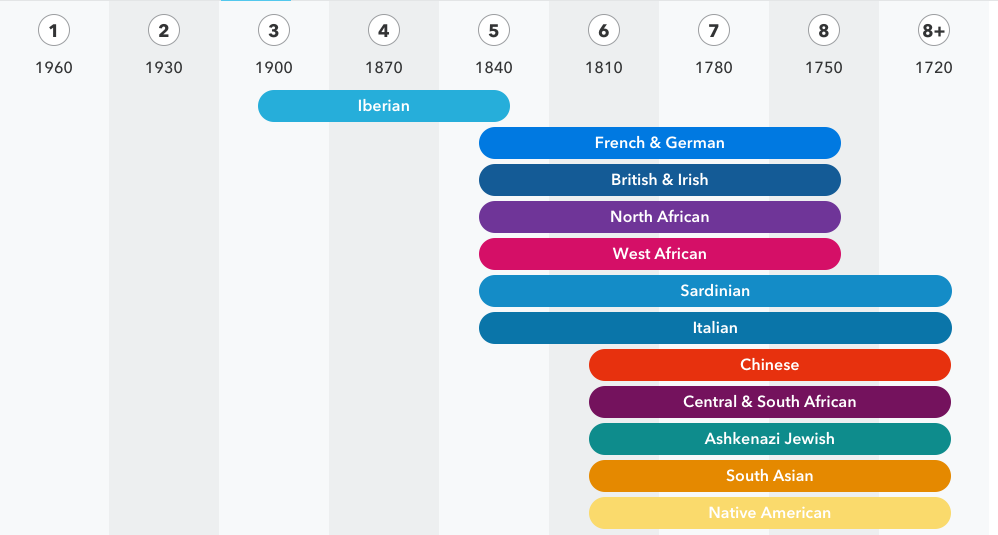
So it's been a while since I've posted and it's already 2017! As the new school year kicked off I saw myself being less and less able to write on the blog, despite having some new blog ideas! So finally I'm back and hopefully I'll continue to post throughout the year evenly and not in chunks. The reason I want to post today is because there is a new feature on 23andme and I'm excited to see how this feature can help discover or clarify more about my past. The feature is called "Ancestry Timeline" and I want to take a look at how this feature works through the lens of a Puerto Rican -- myself and my family! As a reminder, how is what my genetic breakdown looks like:

23andme results [personal photo]

I'm not sure exactly when the Ancestry Timeline feature was released but one of my genetic cousins posted her results on Facebook and so I had to go in and check mine! Here's what it looks like for me:

Ancestry Timeline [personal photo]

There you can see a couple of things you can see. First you can see colored bars which represent various different populations used to test against your DNA. Next on the top you can see various numbers and years, these represent approximately when that ancestor would have been alive in your family tree. There are, however, a few things to take into consideration, of course. Reading their white paper I was able to see a few things I should look out for as I consider these results. 


Translating Generations [23andme]

Not everyone's family follows the same trend of generation years, though the average is 30 and it is usually held that way just to estimate generations it can vary in your family. For example, I have fairly young parents and grandparents but before that it varies. My oldest great-grandparent was born in 1884 while my youngest great-grandparent was born in 1923 - a whole 39 years between them! Just remember that as you look at your own timeline. 

Violations of the "one genealogical ancestor" assumption [23andme]

In my case, I am sure that there are multiple ancestors that carry for example African genes, so I wouldn't be able to know exactly where and when this ancestor would have been alive in my timeline. Besides an 100% ancestor, who would be one of my 4th great grandparents, it is hard to know which of the segments combined or didn't to give me my 15.7% African DNA. 

Nonetheless, the results are very interesting and I think there is some truth to the timeline. Also, it would be interesting to compare my results to my parents' as well. It's interesting that my "Iberian" bar shows up between 1900-1840 while my parents and other tested family members have it at about 1860-1800. Initially I thought it was representing my 3rd great grandfather who lived around 1846-1910 and was from Mallorca, but shouldn't it appear for my father and great-aunt in the same spot since we share that common bar so recently? Equally interesting is my West African bar which appears between 1840-1750 and it states that "you most likely had a third great-grandparent, four great-grandparent, fifth great-grandparent, or sixth great-grandparent who was 100% West African". This does coincide with my 4th great-grandmother who was born in 1844 and was the daughter of two slaves in Martinique. But it's also important to notice that there are more ancestors in my tree somewhere that contribute to that West African bar. Bars like "Chinese" and "South Asian" represent only <0.1% of my DNA and I'm guessing that's just noise so I'm surprised that such a small percentage would show up here. 

It'll be interesting to see how other people can use this to find out certain information about themselves. For us new world people, it's interesting to see where time wise they place these bars and I would like to see how accurate or close to accurate they are for others. For me, I've seen some coincidences and based on what I know about my family they seem to correlate with the information. Excited to see where this heads! 

Saturday, May 10, 2014

A Puerto Rican look at: FtDNA's myOrigins

FtDNA myOrigins [FtDNA Email]

Recently I received an email about the release of FtDNA's myOrigins; this would replace the old version of the calculations given for ancestry breakdowns. I was pretty excited about this upgrade because it would add another view of my ancestral breakdown by another company. Currently I have 23andme's Ancestry Compositon as well as Ancestry's AncestryDNA. I have also used DNATribes for myself and a couple of other family members. So let's take a look through a Puerto Rican lens of the myOrigins release!


23andme Ancestry Composition
For comparison's sake let's look at my 23andme Ancestry Composition. Here on the left is what my percentages look like in Standard View. I go back and forth between the Standard View and Speculative View, but for this comparison sake let's stick to the main one. You can see that in solid, raw numbers I am approximately: 54% European, 15% Sub-Saharan African, 12% East Asian/Native American, 1% Middle Eastern/North African, and 18% Unassigned. I don't like the large amount of unassigned here in Standard View but we can't live in a perfect genetic genealogical world (Not yet at least!).  

FtDNA myOrigins 
Now take a look at my recently released myOrigin percentages! There are definitely a few similarities and some differences. Here on myOrigins you can see that I am slightly more European at 58%, which is only a ~4% difference from my Ancestry Composition. My African is listed as 21%, a good ~6% higher than 23andme. The Native percentage called here "New World" is a solid 10%. Here on myOrigins there is a Jewish Diaspora breakdown where I score 7% and then a Middle Eastern group where I score 3%. On AncestryDNA I do score 5% on their category of "European Jewish" but 0% on their "Middle East". 

The categories can then be expanded to show a more in-depth look at the main category. For example, my European breaks down into: North Mediterranean Basin, European Coastal Islands, and European Costal Plains. My African breaks down into: Niger-Congo Genesis, and East-African Pastoralists. While my Middle Eastern breaks down into: North African Coastlands (Which if you look at it that way I score a 4% on AncestryDNA). Here are the pictures of the breakdowns for my main categories. Note: New World is Bering Expansion which covers North, Central, and South American while the Jewish Diaspora hovers/radiants over and near Poland. 

European Ethnic Makeup [FtDNA myOrigins]
African Ethnic Makeup [FtDNA myOrigins]
New World Ethnic Makeup [FtDNA myOrigins]
Jewish Diaspora Ethnic Makeup [FtDNA myOrigins]
Middle Eastern Ethnic Makeup [FtDNA myOrigins]

It was definitely interesting looking at these numbers especially at the African and European scores. My African on myOrigins is at 21% while on AncestryDNA it's at 23%, the highest 23andme places me is at 15.7%. Also AncestryDNA predicts that 12% of my DNA is from the Mali region and here on myOrigins 17% of it is labeled as "Niger-Congo Genesis". I was also surprised that I scored 24% on the European Coastal Islands portion and I wonder if that has anything to do with the potential connection through Gustave Jean-Charles and also potentially through my great grandfather's Irish/English paternal haplogroup. 

All in all, I didn't think the ethnic breakdown was too far of from what I have seen with other companies. Whether or not it's true to my family is a completely different story! Since my family is pretty mixed for the last past 200+ years I don't really know where certain parts of Native, European or African come from -- rather it's coming probably from all my lines. I can only guess that my 4th great grandmother was 100% African because she was born on a sugar plantation in Martinique. I'm really interested to see if myOrigins develops a bit further and adds more specific breakdowns for African like AncestryDNA has done. 

Friday, October 18, 2013

A Puerto Rican look at: AncestryDNA 2.0 (African Portion)

This week something awesome happened- Ancestry.com updated their DNA part of the website and added more ethnicity groups! More importantly, they now break down Africa into various sections which is amazing since this is the first time (to my knowledge) that a company has broken down the Autosomal DNA by African countries.

Part of the website introducing the new AncestryDNA

My original breakdown from AncestryDNA is provided below:

Original AncestryDNA Breakdown
Below is the new breakdown from the updated AncestryDNA:

New AncestryDNA Genetic Breakdown
Like I mentioned what's awesome is that there is a new African ethnicity breakdown which is the first time I've had some genetic hints (from my own DNA) as to where my African ancestors are from. As you can see from the picture above, my African percentage is estimated to be 23% which at 23andme is currently estimated at 16.1% (Standard) and 17.7% (Estimated).  The first country is mentioned as Mali at 12% then the rest (11%) is part of "trace regions". As you can see the Trace Regions include: African Southeastern Bantu, Africa North, Cameroon/Congo, and Senegal. The Africa North part is most likely from southern Spanish ancestors who mixed with the Muslim inhabitants who arrived from northern Africa and lived in Al-Andalus. 

Top African Country- Mali
What was so interesting is that I score 0% in the categories of: Ivory Coast/Ghana, Africa South-Central Hunter-Gatherers, Benin/Togo, and Nigeria. I was surprised since many slaves were brought over from these West African countries. My 1% in Senegal and Cameroon/Congo make sense since they are along the coast. Africa South Eastern Bantu interestingly matches with the Zimbabwean and Angolan 23andme cousin matches I have.

I was very surprised to receive Mali at 12%. With research I've realized that current day Mali was part of the Ghana Empire as well as the Songhai Empire, which were big players during the trans-Saharan trade. It is very possible that my ancestor(s) lived inland and were brought out to the coast and put on ships or already lived in the coast through migration within the Mali empire when borders weren't officially set. 

Mali Empire
Present Day Mali borders
According to AncestryDNA a typical native Malian is in the range of 39% due the various multiple ethnicities that exist in the country. And interestingly I am at 12% which isn't too too far off. 

Me vs. Typical Native Estimates

Having "Mali" listed in my countries is eye opening. Even though I wasn't raised "Afro-centric" I knew that I have slave roots throughout various lines in my family. With the recent discovery of my 5th great grandmother, Eglantine Lautin, being a native African brought to Martinique as a slave I wonder if current day Mali would be her homeland? Or where does this high percentage of Malian ancestry come from, various ancestors? Did they speak Bambara and a part of the Mandé people? Did they mix with the Tualeg/Berber people or were tensions already high between the two groups?

Ethnic Groups of Mali Explained

There is still MUCH to learn. Both about these results, myself and the possibility of other countries/ethnicities not yet listed. I am patiently waiting for the updated 23andme version of their Ancestry Composition to see if there are any trends/patterns. For now I will continue my research on Mali, its people and history!