Showing posts with label haplogroup. Show all posts

Tuesday, July 10, 2018

A Puerto Rican Look at: Geno 2.0

Earlier this year, I took the National Geographic (Geno 2.0) test. It was one of the ones I had wanted to take a while back when I first heard about genetic genealogical testing, but it was still pretty pricey. With a recent drop in prices around Christmas time, I decided to get a Geno 2.0 and after a few months of waiting, I ended up getting my results. The results did take a bit to come back and with the idea of a "deep analysis" I sat down and waited... and waited... but finally the results came in! So here's a glimpse into the various different information provided to me by Geno 2.0. All in all, everything was pretty straight forward and similar to other DNA exams. Only one part was interesting which I'll get to in a bit.

There are various parts into the results: your genius matches, regional ancestry, deep ancestry, and Hominin ancestry. I'll quickly go through genius matches and Hominin ancestry before covering regional and deep ancestry. I'm placing the images below however how they show up on the website.

Genius Matches [Geno 2.0]

Regional Ancestry [Geno 2.0]

Deep Ancestry [Geno 2.0]

Hominin Ancestry [Geno 2.0]

Genius Matches


This feature is actually pretty cool because I haven't really come across it on other DNA websites, 23andme had a version of this but dunno where it is now... haven't seen it on the haplogroups part of the website in a while. Though it's cool to look at and explore, it doesn't really hold much genealogical value. Most of these people are probably related through off branches of your haplogroup and as you can see the ranges of years are pretty high. Nonetheless, it was a cool first thing to see when I logged into Geno 2.0. Here are two of my matches, Nikola Tesla and Martin Luther! 

Nikola Tesla [Geno 2.0]

Martin Luther [Geno 2.0]

Hominin Ancestry

This is another feature that's cool to look at but again, to me, it doesn't hold much genealogical value. As you can see below I score a 1.2% on my Neanderthal ancestry, which is a tiny bit lower than the average which is 2.1%. Truth be told, I didn't really explore this much but again, just posting it here because it's part of the analysis. 

Hominin Ancestry [Geno 2.0]

Regional Ancestry


Here is the most interesting part of the Geno 2.0 analysis, the regional and deep ancestry! First, you get a heat map of sorts that shows you the different parts of the globe where your regional ancestry can be found. By clicking on the map you are able to see the different percentages of your ancestry, which are also provided below the map. Equally, there is a continents break down as well! Check it out below!  

Map View [Geno 2.0]

Continental Average [Geno 2.0]

Regional Ancestry [Geno 2.0]

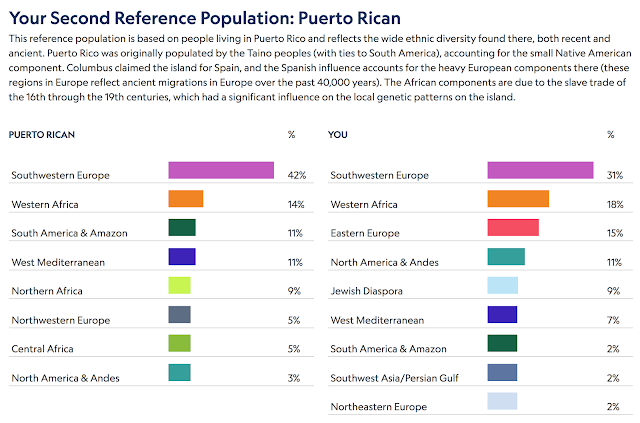
Most of the results match what I have seen on other sites, with a few variations here and there. For example, "Eastern Europe" is at 15% and "Jewish Diaspora" at 9% which I think is the highest I've seen it on any site. What's cool is that each region provides an explanation as well. I've screen shotted some of the explanations, check them out! I've provided some for "Western Africa", "Jewish Diaspora", "Eastern Europe", "South America & Amazon", and "North America & Andes".

West Africa [Geno 2.0]


Jewish Diaspora [Geno 2.0]

Eastern Europe [Geno 2.0]

South America & Andes [Geno 2.0]


North America & Amazon [Geno 2.0]

One thing that is kind of tripping me up is the low value I have in "South America & Amazon" and higher percentage in "North America & Andes". Mainly because in the description is says that South America & Amazon consists of the Taíno and Caribs which should be the main groups in my ancestry seeing as how my family is from Puerto Rico where these two tribes could be found. I have not compared with other Puerto Ricans, so I'm not sure if this is common/typical in the results or if I am a sort of outlier from the group. Being that I've done a ton of research into my family and know that we've been on the island since at least the early 1600-1700s through paper trial and obviously even earlier, there is no doubt in my mind that my ancestry is made up of native Caribbean tribes but it does make me wonder!

What's also interesting that they provide you with reference populations which are close to you. My first reference population was actually Colombian and my second, ironically, Puerto Rican. Maybe my high percentage of "North American & Andes" makes Geno 2.0 think that I'm potentially Colombian since they average at about 9% which the Puerto Rican reference population has a lower 3%. Despite having Colombia first, I know that I'm Puerto Rican 😉. I was also pretty surprised that I didn't get any northern African here, which I usually always score a bit of. Interesting seeing the similarities and differences between their reference population and my own results. 


Deep Ancestry

Lastly, there is the deep ancestry part which is basically the paternal and maternal haplogroups. As you saw above these two groups for me are C1b4 (Maternal), and I-F1295 (Paternal). This is the first time I've gotten a deeper "subclade" (if you can call it that) of my paternal haplogroup. For many years I knew it only as 12a1* and recently on 23andme it has gone to I-M26, I imagine I-F1295 is the same but I will have to do some more research into this group. There is also an explanation of the group provided, a timeline throughout the years to its current grouping, and a heat map of where it can be found around the world today. Interestingly enough my paternal haplogroup still seems to be under investigation as it hasn't really been directly pinpointed geographically as my maternal haplogroup. It is however good to see that it can be found in Portugal and Spain which is where I would imagine it to go back to due to my ancestry.

Deep Ancestry [Geno 2.0]

C1b4 Heat Map [Geno 2.0]

C1b Branch Explanation [Geno 2.0]

I-F1295 [Geno 2.0]

I-M26 Branch Explanation [Geno 2.0]

Conclusion


Overall, I think it was interesting having this DNA test done. I don't think I would recommend it to anyone who wants to do more genealogical and genetic work with their testing as there is no chromosome browser or relative finder you can use to continue working on your tree, but it is nice to have it to compare to other DNA test out there. 

I'll have to keep exploring my DNA and especially my paternal branch. My goal is to hopefully have it one day traced back to a town in Europe (probably Spain) where it originated from. Being Rivera/de Rivera/de Ribera I imagine is a pretty common name and probably not tied to a region in Spain like how other surnames are. Therefore, the search continues! 

Sunday, January 12, 2014

52 Ancestors – #2 Jean Charles Gustave (1819-1891)

This second post will be about a challenging ancestor of mine who I have mentioned a lot before but I
want to dedicate a post to him since he has been a troubling ancestor to pinpoint. This post will be about my 4th great grandfather Jean Charles Gustave.

Jean Charles Gustave has been very elusive since the first moment I set eyes on his name in a birth certificate of his grandchild, Julio Correa Gustavo (my 2nd great grandfather). When Jean Charles was registered in Puerto Rico with his wife, he was registered as living in Fajardo, Puerto Rico as a "domestico" from Martinique, married, and 55 years old. They were registered on the 30th of May 1874 as domiciled in Fajardo but were still French subjects. In his registration his name became "Juan Carlos Gustavo" and in subsequent documents his name remained in the Spanish form. Yet every time Jean Charles Gustave signed his name in documents he consistently used the French form of his name.

Jean Charles Gustave's Signature

We also know that by the time he was registered in 1874, he was already living at least 7 years in Puerto Rico because his first child and my 3rd great grandmother, María Paulina Gustavo Lotten, was born in 1867 on the island of Vieques, a municipal of Puerto Rico. Jean Charles and his wife "Juliana Balbina Lotten" who I later came to learn was Julienne Malvina Lautin, a native from Rivière Salée, Martinique had 7 children (to date) that I know of. I've decided to use the surnames "Gustavo Lotten" because it is the most similar to its original form, Gustave Lautin. There have been many variations of both surnames used throughout documents and the family eventually switched over to the surname "Charles". Here are the children in order:

1) María Paulina Gustavo Lotten 1867 – 1948
2) Tomás Octavio Gustavo Lotten 1869 – 1957
3) Valentina Gustavo Lotten 1878? – 1938
4) Areopajita Gustavo Lotten 1879 – 1900
5) Dionisio Gustavo Lotten 1880 – 18??
6) Alberto Fermin Gustavo Lotten 1882 – 1953
7) Martina Isabel Gustavo Lotten 1886 – 1888

Gustave Lautin Family


I have been able to track five out of the seven children from the Gustave Lautin line but I don't know what ever happened to Dionisio and Martina Isabel. Dionisio was born in Fajardo while Martina Isabel was born in Santa Isabel yet they never appear in census records and I have not found death records for them yet.

Something very interesting that I have noticed (and probably literally just right now), is that the family has always stuck by the ocean. For whatever reason, in whatever town they lived in, it was always by the coast. Vieques, Fajardo, Santa Isabel, Salinas, Guánica, Ponce – all coastal towns of Puerto Rico. Jean Charles Gustave was a carpenter by trade, so wouldn't he have found better work in San Juan? The family would later become fishermen with some carpenters here and there but I think it's interesting that they were always near water (most of their children and grandchildren were born in parts of the town called "playa" – in Santa Isabel, Ponce, and Salinas). Could Jean Charles Gustave originated from a coastal town in Martinique?

Despite knowing where Jean Charles Gustave has lived I have yet to find his death certificate. I know that his death had to have taken place between November 1887 – August 1891, with the help of his grandchildren's records. The question is where?! This span of 4 years is a pretty small gap to look for someone yet I have had no luck finding his death record in Salinas, Yauco/Guánica or Ponce (I'll be double checking again shortly!)

Jean Charles Gustave always seemed to me to be of a créole background for various reasons. 1) He didn't appear in the Actes D'individualités in Martinique – This could mean he was born free or freed before 1848. 2) He was able to sign his name in 1885 – which I think is a big feat for a black man in the mid-1800s from a colonial island. 3) His wife was much younger than him which makes me think she married "up" for a better life – either love brought them together or his status did.

After researching the Gustave line for quite a while, I was able to find a cousin who shared a connection with me. Her great grandfather, Alberto Fermin, and my 3rd great grandmother, María Paulina, were brothers and sisters. This 3rd cousin, 2x removed is more connected to the Charles family and thus was able to find a male descendant of Jean Charles Gustave who was willing to take a Y-DNA test to figure out our Martinican male haplogroup.

I was able to get a Y-DNA test through FTDNA from a 2nd cousin, 3x removed, the grandson of Alberto Fermin Gustavo Lotten. I was very excited when the results started coming in this week. I was caught between hoping it was an African haplogroup and a European haplogroup, but my gut feeling was that it would come back European – due to the créole theory. The group came back R-M269 (shorthand) also known as R1b1a2, which turns out to be part of one of the biggest European haplogroups. Hopefully I'll be able to pinpoint a surname through FTDNA which would give me a clue for my male ancestor in Martinique!

Haplogroup R1b Distribution [Wikipedia]

Take a look at this new blog post called "A New Piece to the Puzzle! The Jean Charles Gustave Mystery Continues…" with some new information regarding my 4th great grandfather!

Friday, March 8, 2013

Exploring Maternal Haplogroups

In honor of International Women's day and because I was itching to write about a certain haplogroup, I decided that this was the opportune time for me to write!

So far with 23andme, I have been able to test 7 people in my family including myself and have been able to discover 4 different maternal haplogroups. What's interesting about our haplogroups is that they aren't from just one area- with the migration to Puerto Rico coming from many different areas and for many different reasons, our maternal heritage (just like our paternal heritage) tells many different stories. But the one I want to focus on mainly today is my great grandfather's European haplogroup U5b1b1b. First I'll talk quickly about the others.

My own personal maternal haplogroup came as a nice surprise to me when I first tested in 2009. When I got my results I was able to see that my maternal haplogroup was the indigenous C1b4. This group as you can see below is present in both Asia and the Americas. My guess is that somewhere along my maternal ancestress' line I descend from a Taíno/Arawak woman.


Similarly, another group found on the maternal side of the family that is also connected to Native Americans is called A2. A2 has a higher concentration up in North America near the Bering Strait. However, you can also see that it is evenly common and widespread throughout Central and Southern America. Again, this haplogroup was most likely introduced to my family through a Taíno/Arawak ancestress.


Found on my paternal side of the family is the only African Haplogroup I've discovered so far called L2a1. This haplogroup is found amongst African Americans seeing as how it is commonly found in Sub-Sahara Africa amongst the Bantu-speakers. Since it is so widespread it is difficult to pinpoint exactly where in Africa my ancestress would have originated from. Some speculate that its origin lies somewhere in Central Africa. Due to the Atlantic Slave Trade, many L2a1 carrying women entered areas such as the Caribbean, South America and North America which is why it is so commonly found there. I have not been able to figure out who my original L2a1 African born ancestress was, but hopefully one day I'll be able to know more about this line and haplogroup.


Lastly, my great grandfather is the only one in my family tested so far to carry a European haplogroup yet with an interesting history. His maternal haplogroup is known as U5b1b1b and can be found amongst the Basque and even amongst the Saami population in Northern Scandinavia.


U5b1b1b is part of the branch U5 which "arose among early colonizers of Europe around 40,000 years ago". But what's more interesting about this group is that is seems to have made its way back into Africa via Northern Africa where it can be found amongst people in Morocco and even as far south as Senegal. The big question for me is: Where did my U5b1b1b ancestress come from herself? Did she live in southern Spain before heading off to Puerto Rico? Was she a Moroccan woman who's family found their way to Spain and settled in Al-Andalus? Or was she just a European woman who's husband decided to head to the Caribbean and she agreed to the journey?

So far any of these stories and many others are possible. What's interesting is that my great grandfather does carry, according to Ancestry Composition, North African genes. Pictured below is his Chromosome 4 on "Standard Estimate" and the dark blue on the top is the North African he carries. There is a smaller chunk of it as well on Chromosome 7. Who he receives these genes from is still a mystery to me! Also in Ancestry Finder he receives a match with all 4 grandparents born in Morocco.

Chromosome 4- North African Genes
Chromosome 7- North African Genes
Chromosome 2- Moroccan Match
Hopefully one day I'll be able to name who these women were and talk about the lives they would have lived!

Sunday, December 9, 2012

Establishing Ashkenazi Connections

In my last post I mentioned that with the new Ancestry Composition you can interactively highlight certain populations in your chromosome by clicking on the group. I provided one with an Ashkenazi separation for myself and a Sub-Sarahan African separation for my grandfather. I want to chat a bit more about the Ashkenazi group and how I've been able to use those chunks of DNA.

When you glance across my DNA, the Ashkenazi chunks only appear three times in "Standard Estimate". The pieces appear on Chromosome 1, Chromosome 4 and Chromosome 9, and with "Speculative Estimate" I receive another piece on Chromosome 7 and a tiny sliver on Chromosome 11. The cool thing about having multiply people tested from my family is that I can rule out who did or didn't give me some of these genes. The two Chromosomes I want to focus on are Chromosome 1 and Chromosome 4. Both of these Ashkenazi genes on those chromosomes I received through my mother and from her father exclusively.
Ashkenazi Connection on Chromosome 1
Here you can see various Chromosome 1 pieces from different people. The first is myself, the second my mother, the third my mother's brother, and the fourth my mother's father. The last entire blue Chromosome 1 is from my Jewish cousin who as you see when compared to myself, my mother and grandfather match us on the same segment. You can also see that I've circled the piece of Ashkenazi gene I received on my Chromosome 1 from my mother and she in turn received it from her father. What's so cool so that this piece of DNA was passed down without really changing, you can see my uncle even received the same piece of DNA on his first Chromosome. Now I want to look at Chromosome 4 where I match a cousin through Ancestry Finder but doesn't have a public account.
Ashkenazi Connection on Chromosome 4 
Here I decided to show it a bit differently by organizing the bars vertically and creating a rectangle horizontally where the Ashkenazi piece is. You can see that my piece of Ashkenazi is a bit longer than my mother's or even grandfather's yet we all inherited that piece on the same spot on Chromosome 4. 

Now, the only thing is trying to figure out how I got that Ashkenazi gene on those Chromosomes. My grandfather's paternal Haplogroup is J1 and my uncle has J1e (for whatever reason, my uncle was placed under J1e) which is found in significant frequencies across the Middle East, being the most frequent in the Arabian peninsula as well as parts of the Caucasus, Sudan and the Horn of Africa. So this Ashkenazi piece could very well be from the male ancestor who passed down the J1 Haplogroup to the Correas. (My maternal male ancestor is Correa but could be something else further back before Spanish surname conventions were adopted. Also I'm not sure whether my family is connected to Antonio de los Reyes Correa from Arecibo, Puerto Rico since my Correa family is located on the South-Eastern part of the island). I have a 4th cousin on 23andme who shares confirmed Correa ancestry with me. When I search her Chromosome 1 or 4 for Ashkenazi ancestry she appears to not have received any on those specific chromosomes, not even on the Speculative level- this could mean two things. It could mean that this piece of Ashkenazi DNA was inherited through the Correa J1 ancestor but wasn't inherited by her. Or it could mean that it came from another family line which she does not connect with. It would take testing other Correa members and people along my maternal paternal family to figure out where these Ashkenazi links come from. 

Also, are they Spanish Inquisition Jewish roots which were passed down to my family or could it be from an actual Eastern European ancestor? These Jewish cousins have ancestry from Germany, Poland, Austria and Lithuania so who knows for sure what the history behind my Ashkenazi pieces are. Hopefully one day I'll be able to look at the Jewish genes and say "You see those pieces of DNA, they came from So-and-so in our family". 

Friday, July 8, 2011

Ancestry Finder from 23&Me

So stepping away a bit from paper trail ancestry and back to genealogy from 23andme, I decided to take some screen shots from a tool called "Ancestry Finder" and talk a bit about its awesomeness and the results I have. So 23andme has some really cool stuff that you can get dragged into sometimes it seems for hours. Among them besides Relative Finder, Ancestry Painting, Maternal/Paternal Haplogroups and the "My Health" Section there is the Ancestry Finder tool. So the way it works is you fill out a survey telling them where your four grandparents were born (there are some more questions but you only see the countries they list). From those answers, whoever matches you as a cousin will show up in where ever they match you along your chromosomes and then show the countries where the grandparents were born. What's real cool about it is that you can switch around controls in the advanced options to what you'll like to see. For example, here is my Ancestry Finder set to: "5cm" Minimum Segment Size and 4 Grandparents born in the same country.

My results for Ancestry Finder

I added the countries over the bars to show where the grandparents were from. I was VERY surprised by the results; I matched people with grandparents born in Cuba, Columbia, Mexico, Ireland, Spain, Portugal, Lithuania, Russia, and the U.K. This doesn't mean that you have direct ancestors from there but that someone centuries ago from in your ancestry could have moved there, had extended family there, etc.. The ones that surprised me the most were ones like Lithuania and Russia! These are unexpected I would say for me being that my family is from Puerto Rico and you don't really hear about these groups having descendants in Puerto Rico.I do match people from Puerto Rico but since I didn't set it to show matches from the "US" they didn't show up.

You can also change around the advanced settings to 1+, 2+, 3+, born in the same country; to show matches from the US, Canada, Australia, New Zealand & South Africa; to show public segments; indicate segments people have marked to be of Ashkenazi Jewish ancestry and the minimum segment size.

I also took screen shots of my grandmother's and great grandfather's Ancestry Finders to show the different results they got. Here they are below:

Grandmother's Ancestry Results

Great Grandfahter's Ancestry Finder results

You can see how some segments my grandmother inherited from her father while other segments don't show up on his. What's really interesting is when segments overlap one another such as where on my great grandfather's Ireland, U.K., Portugal and Switzerland matches overlap. I wonder if they all/most of them share some same common ancestor? Its really cool to play around with the settings and see what countries you have distant cousins in.

I hope I can prove some paper trail matches with these cousins one day!

Tuesday, July 5, 2011

The Magic of Genes

Joining 23&me at the age of 18 opened my mind to A LOT, not just about genealogy, ancestry, genes and everything in between but it allowed me to take part and become a member of a community with genealogy buffs like myself. Logging on and seeing how some people have reached ancestors born in the 16th century pushed me to want to get to that level! I chatted with one very friendly and well informed cousin on the website who taught me some of the ropes of what all this meant and more. I was able to find out things like my Maternal and Paternal Haplogroups, my 'ancestry painting' and 'connect' to, at this most currently over 550, relatives. This relative introduced me to FamilySearch, a website which actually contains records before 1910 for Puerto Rico. How ecstatic and ready I was to start searching for records! Though at first I was a bit hesitant because it required me to search documents one by one (luckily some have indexes), I bit the bullet and started searching for ancestors and boy have I found a ton!!

Going back to my 23andme results, I got back some interesting information. My paternal haplogroup, which is passed down through the Y chromosome along the males in the family (son, father, grandfather, etc.) came back as I2a1*. Haplogroup I is surprisingly most common amongst Southern Europeans such as Balkans and Sardinians with 40% of Sardinian men belonging to this group. Yet my specific branch/subgroup (I2a1*) is "believed it originate high in the Pyrenees, the string of mountains that separates Spain from France. About 12,000 years ago, as temperatures warmed and glaciers retreated, men bearing I2a1 expanded into Spain, France, and nearby Mediterranean Islands." (23andme website). So this would mean that centuries ago, one of my paternal ancestors came from around that area of Europe. Pictured below is the screen shot for members of the I2a1* haplogroup and its concentration around Europe.

I2a1* Paternal Haplogroup passed down only to men

My maternal haplogroup, which is passed down from mothers to both sons and daughters, was very interesting. It came back as C1b4, which arrived from Asia into the Americas and is most common amongst Native Americans. Wanting to learn more I began to research this haplogroup and found that it was one of the common Haplogroups among the Taíno people of Puerto Rico!! This would mean that centuries ago a woman along my maternal line was most likely a native from either Puerto Rico or a nearby island. Due to the fact that many Spaniards arrived without woman on their conquest for new lands, they reproduced with the natives and/or slaves giving people such as myself these Haplogroups. Pictured below is the screen shot for members of the C1b4 haplogroup and its concentration around Asia as well as the Americas.

C1b4, Maternal Haplogroup passed down by mothers

All this information was fascinating, something I had seen on a TV show actually was real and capable for the average person to buy, use and understand! My ancestry painting, which has changed a bit from when I first tested, shows that I am (approximating of course): 75% European, 15% African, and 9% Asian. (As you saw from my results, Asian doesn't necessarily mean one my grandparents was Chinese, Indian, etc but can also be natives who carry those genes from their ancestors from the Asian continent and moved into the Americas.

My genealogical search was taking a new technological turn and with FamilySearch records in my hand, my branches on my tree were going to stretch a bit farther into the past!