Showing posts with label Ancestry Composition. Show all posts

Saturday, May 10, 2014

A Puerto Rican look at: FtDNA's myOrigins

FtDNA myOrigins [FtDNA Email]

Recently I received an email about the release of FtDNA's myOrigins; this would replace the old version of the calculations given for ancestry breakdowns. I was pretty excited about this upgrade because it would add another view of my ancestral breakdown by another company. Currently I have 23andme's Ancestry Compositon as well as Ancestry's AncestryDNA. I have also used DNATribes for myself and a couple of other family members. So let's take a look through a Puerto Rican lens of the myOrigins release!


23andme Ancestry Composition
For comparison's sake let's look at my 23andme Ancestry Composition. Here on the left is what my percentages look like in Standard View. I go back and forth between the Standard View and Speculative View, but for this comparison sake let's stick to the main one. You can see that in solid, raw numbers I am approximately: 54% European, 15% Sub-Saharan African, 12% East Asian/Native American, 1% Middle Eastern/North African, and 18% Unassigned. I don't like the large amount of unassigned here in Standard View but we can't live in a perfect genetic genealogical world (Not yet at least!).  

FtDNA myOrigins 
Now take a look at my recently released myOrigin percentages! There are definitely a few similarities and some differences. Here on myOrigins you can see that I am slightly more European at 58%, which is only a ~4% difference from my Ancestry Composition. My African is listed as 21%, a good ~6% higher than 23andme. The Native percentage called here "New World" is a solid 10%. Here on myOrigins there is a Jewish Diaspora breakdown where I score 7% and then a Middle Eastern group where I score 3%. On AncestryDNA I do score 5% on their category of "European Jewish" but 0% on their "Middle East". 

The categories can then be expanded to show a more in-depth look at the main category. For example, my European breaks down into: North Mediterranean Basin, European Coastal Islands, and European Costal Plains. My African breaks down into: Niger-Congo Genesis, and East-African Pastoralists. While my Middle Eastern breaks down into: North African Coastlands (Which if you look at it that way I score a 4% on AncestryDNA). Here are the pictures of the breakdowns for my main categories. Note: New World is Bering Expansion which covers North, Central, and South American while the Jewish Diaspora hovers/radiants over and near Poland. 

European Ethnic Makeup [FtDNA myOrigins]
African Ethnic Makeup [FtDNA myOrigins]
New World Ethnic Makeup [FtDNA myOrigins]
Jewish Diaspora Ethnic Makeup [FtDNA myOrigins]
Middle Eastern Ethnic Makeup [FtDNA myOrigins]

It was definitely interesting looking at these numbers especially at the African and European scores. My African on myOrigins is at 21% while on AncestryDNA it's at 23%, the highest 23andme places me is at 15.7%. Also AncestryDNA predicts that 12% of my DNA is from the Mali region and here on myOrigins 17% of it is labeled as "Niger-Congo Genesis". I was also surprised that I scored 24% on the European Coastal Islands portion and I wonder if that has anything to do with the potential connection through Gustave Jean-Charles and also potentially through my great grandfather's Irish/English paternal haplogroup. 

All in all, I didn't think the ethnic breakdown was too far of from what I have seen with other companies. Whether or not it's true to my family is a completely different story! Since my family is pretty mixed for the last past 200+ years I don't really know where certain parts of Native, European or African come from -- rather it's coming probably from all my lines. I can only guess that my 4th great grandmother was 100% African because she was born on a sugar plantation in Martinique. I'm really interested to see if myOrigins develops a bit further and adds more specific breakdowns for African like AncestryDNA has done. 

Saturday, April 26, 2014

Happy DNA Day!!

April 25, 2014 [DNAart]
I know I am a day behind with this post but I still wanted to publish it! DNA has truly changed the way I view myself, my culture, my history, and my view on the world. I wanted to share a bit why taking a DNA test was important to me.

Before taking my 23andme test, which back then was a hefty price ($500), I didn't really know what to think of myself. I knew that my history was full of multicultural ancestors, yet how much of me was actually native Taíno, African, or European? I had always been proud to be Puerto Rican and my tree was definitely helping me to realize more and more how deep my roots are on the island, yet I still had no idea what continents my lines ran back to.

Parranda en Puerto Rico [ElBoricua]

Taking the 23andme test and later the AncestryDNA test really helped to show how mixed our culture, my culture, really was. I learned about my Y-DNA, mtDNA, and my ancestral composition. I learned that my Y-DNA traces back to the area between Spain and France where the Pyrenees lie; this wasn't too surprising since many Spaniards came to Puerto Rico. I learned that my mtDNA traced back to the natives of the Americas and probably specifically to the native Taíno and/or Arawaks who lived in Borikén before the arrival of Cristóbal Colón. I also learned that while I am little over half European, I do carry about 15% and 12% African and Native American genes respectively. Other haplogroups in my family tie into various groups such as: West Africa, Middle Eastern/Jewish, Irish, English/French, and there is more to learn about.

Ancestry Composition - Luis Rivera [23andme]

I learned that even though my family has been on the island of Puerto Rico for at least 200+ years I have ancestors who immigrated to Puerto Rico from Martinique and Guadeloupe, bringing their own culture and identity with them to their new land. In that 15% Sub-Saharan African, I carry their names, their stories, their memories.

Many of us come from very complex and interesting backgrounds, we have to learn more from both a genetic and historic standpoint to understand who we are here today. I am a combination of curious explorers, friendly natives, and determined slaves. I have learned to view the world differently, that skin color doesn't make or break your identity and that there is more than meets the eye. My DNA results have made me proud of all aspects of my ancestry, to realizing that I am my own melting pot. 

So Happy DNA day: take your own DNA test, test someone in your family, or learn more about your results! I don't think you'll regret it!

Spanish, Taíno, Africans [TainoNationNews]

Sunday, December 9, 2012

Establishing Ashkenazi Connections

In my last post I mentioned that with the new Ancestry Composition you can interactively highlight certain populations in your chromosome by clicking on the group. I provided one with an Ashkenazi separation for myself and a Sub-Sarahan African separation for my grandfather. I want to chat a bit more about the Ashkenazi group and how I've been able to use those chunks of DNA.

When you glance across my DNA, the Ashkenazi chunks only appear three times in "Standard Estimate". The pieces appear on Chromosome 1, Chromosome 4 and Chromosome 9, and with "Speculative Estimate" I receive another piece on Chromosome 7 and a tiny sliver on Chromosome 11. The cool thing about having multiply people tested from my family is that I can rule out who did or didn't give me some of these genes. The two Chromosomes I want to focus on are Chromosome 1 and Chromosome 4. Both of these Ashkenazi genes on those chromosomes I received through my mother and from her father exclusively.
Ashkenazi Connection on Chromosome 1
Here you can see various Chromosome 1 pieces from different people. The first is myself, the second my mother, the third my mother's brother, and the fourth my mother's father. The last entire blue Chromosome 1 is from my Jewish cousin who as you see when compared to myself, my mother and grandfather match us on the same segment. You can also see that I've circled the piece of Ashkenazi gene I received on my Chromosome 1 from my mother and she in turn received it from her father. What's so cool so that this piece of DNA was passed down without really changing, you can see my uncle even received the same piece of DNA on his first Chromosome. Now I want to look at Chromosome 4 where I match a cousin through Ancestry Finder but doesn't have a public account.
Ashkenazi Connection on Chromosome 4 
Here I decided to show it a bit differently by organizing the bars vertically and creating a rectangle horizontally where the Ashkenazi piece is. You can see that my piece of Ashkenazi is a bit longer than my mother's or even grandfather's yet we all inherited that piece on the same spot on Chromosome 4. 

Now, the only thing is trying to figure out how I got that Ashkenazi gene on those Chromosomes. My grandfather's paternal Haplogroup is J1 and my uncle has J1e (for whatever reason, my uncle was placed under J1e) which is found in significant frequencies across the Middle East, being the most frequent in the Arabian peninsula as well as parts of the Caucasus, Sudan and the Horn of Africa. So this Ashkenazi piece could very well be from the male ancestor who passed down the J1 Haplogroup to the Correas. (My maternal male ancestor is Correa but could be something else further back before Spanish surname conventions were adopted. Also I'm not sure whether my family is connected to Antonio de los Reyes Correa from Arecibo, Puerto Rico since my Correa family is located on the South-Eastern part of the island). I have a 4th cousin on 23andme who shares confirmed Correa ancestry with me. When I search her Chromosome 1 or 4 for Ashkenazi ancestry she appears to not have received any on those specific chromosomes, not even on the Speculative level- this could mean two things. It could mean that this piece of Ashkenazi DNA was inherited through the Correa J1 ancestor but wasn't inherited by her. Or it could mean that it came from another family line which she does not connect with. It would take testing other Correa members and people along my maternal paternal family to figure out where these Ashkenazi links come from. 

Also, are they Spanish Inquisition Jewish roots which were passed down to my family or could it be from an actual Eastern European ancestor? These Jewish cousins have ancestry from Germany, Poland, Austria and Lithuania so who knows for sure what the history behind my Ashkenazi pieces are. Hopefully one day I'll be able to look at the Jewish genes and say "You see those pieces of DNA, they came from So-and-so in our family". 

Saturday, December 8, 2012

A Puerto Rican Look at: Ancestry Composition

This week, after much anticipation and excitement the new version of 23andme's Ancestry Painting was released! This new version, which replaced Ancestry Painting, is now known as Ancestry Composition. Ancestry Painting lacked populations which only used three main populations Asian (from China/Japan), European (which I think were US-European samples), and then African (using Yoruba samples from Africa). The issue with this was that many people for example that got Asian, couldn't differentiate between Native American Asian and East/South Asian. Ancestry Composition on the other hand has 22 populations which includes samples from all around world. Ancestry Composition is still in its infancy, seeing as it how just came out a few days ago, and there will be much to sort out and update. For example, currently Ancestry Composition can only separate West African and North African. This is unfortunate for many African gene-carrying individuals like myself who have no idea where specifically in Africa their genes came from. 23andme did state that the current African cluster will be broken down further but they are running tests to make sure everything will be in order. So without further ado, here is a Puerto Rican look into Ancestry Composition! [Note: results are still changing around, so these numbers and values are only applicable right now. Things may reflect differently later on.]

My Ancestry Composition

So this is who I am; at least as of a few days ago! Percentages have gone up and down compared to the old Ancestry Painting. We see that my European is significantly lower than what it used to be (75%) and my other levels pretty much stayed the same. 16.1% of me is still unassigned which means that as more samples are collected, hopefully this 16% can find a home for itself amongst the colorful bars. As you can see there are a few tabs on top. The first one called "Map View" allows you also to see "Split View" and "Chromosome View" which I'll show in a bit. Split view only works if you have tested either both or one of your parents and Chromosome View is similar in appearance to the old Ancestry Painting. Also you can see a tab called "Global Resolution" which allows you to hone in more on the various populations which are included. Then you see my name, which you can choose to see other people you're sharing with then you see "Standard Estimate". If you click on that tab, you get "Speculative Estimate", "Standard Estimate", and "Conservative Estimate". I'm not too sure on what exactly the defining difference is between them but I'll show you images of Standard and Speculative so you can see how they differ. Now, I'll show you a more in-depth Global Resolution:

My Ancestry Composition- Standard Estimate
Here you can see various populations which can be found in my DNA. There are some interesting and some expected ones. With European you can see that I'm further broken down into Southern and Northern European, and then from there even more. So 20.1% is Iberian which is very expected and 0.5% Italian which is also sorta expected. Then I get 0.2% British and French, which is interesting since in AncestryDNA I get 13% British Isles. Also I want to point out the "Nonspecific Southern European" and "Nonspecific Northern European". These mean that segments of my DNA can be found amongst these groups yet are widely distributed amongst them that they can't pinpoint exactly which subgroup it belongs to. So there could be more British in there somewhere amongst the 19.9% but isn't specific to just the British Isles. Interestingly enough I get Ashkenazi at 0.5%, I've seen cousins in my Ancestry Finder who claim Ashkenazi Jewish roots so I knew somewhere far back I'd have to have some too. It most likely comes from old Spanish Jewish roots or maybe a Eastern European ancestor which is also very possible. Then you can see I have 16.1% Sub-Saharan African which includes all of West, Central, Eastern and Southern Africa- my ancestry from there most likely comes from Western Africa due to the slave trade. Next you can see 11.1% East Asian and Native American, with a 8.6% further divided into Native American- definitely real and most likely from my Taino ancestors (there were also Arawaks, Caribs and even Mayan from Mexico present in Puerto Rico (Mayan through labor trades), then a <0.1% East Asian which I'm guessing is just noise and then you can see 2.5% Nonspecific East Asian and Native American. Lastly, you can see 0.1% which arrives from Northern Africa. My Speculative Estimate tells a little bit of a different story!

My Ancestry Composition- Speculative Estimate
I tend to lean more to this estimate which to me hopefully fits more of my ancestry. I say this because with my Martiniquan ancestors, there should have been some French estimated into my percentages (of course, if no French ever mingled with my ancestors that could be possible as well, but in those times slaves were mistreated as well as raped). I'll let you glance at it, I don't want to make this post too long. You can see some numbers have gone up while others have gone done. But still, 100% me :) Next I'll show you the Split View option which I can see since I've test at least one parent.

My Ancestry Composition- Split View
So here you can see how I've inherited from my mother's and father's side. My mother's side gave me more unassigned as well as much more Sub-Saharan African yet less European. You can also see that the 0.1% North African I receive earlier in my Map View comes from my mother's side of the family. Interestingly, both sides gave me roughly 5-6% East Asian & Native American. Split view is an awesome option for those who might have tested only one parent or wants to figure out which side of the family gave them what. The next few shots will include different "Chromosome View"snapshots.

My Ancestry Composition- Chromosome View
So I'll begin of course with my Standard Estimate of the Chromosome View. As you can there are a ton of nice colors flowing in and out throughout my chromosomes, this is my gene's artwork. Here you can see two bars for each chromosome, except the X which I received one of from my mother. The DNA has also been phased with smoothes out a lot of the colors allowing it to flow easier instead of looking like this (the old Ancestry Painting image with spliced chunks of colors):

My Ancestry Painting 
Now I want to show you my Speculative Estimate with all the previous populations from the Map View. Here is how they change up my DNA colors:
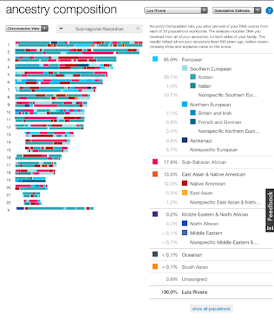
My Ancestry Composition- Speculative Estimate
Here you can see all the further divided colors and what's cool about the new Ancestry Composition is that it's a bit interactive. Meaning that if I want to see where in your DNA a certain population appears you can click on the population and that color becomes isolated while the others fade a bit away allowing you to see those pieces of your genes. For example, I did it twice with my Ashkenazi genes as well as my French and German genes:

My Ancestry Composition- Ashkenazi Population
My Ancestry Composition- French/German Population
What's very interesting is that practically one of my pairs from Chromosome 19 is practically all French/German. Interestingly none of my other family members receive such a huge chunk. Also, you can see the spread out pieces of Ashkenazi genes, one of them on Chromosome 1. Interestingly enough, I match a German/Polish cousin who has Ashkenazi genes on that same chromosome and most likely on that same spot. (I'll probably dedicate another post to that match). Lastly I want to show you my grandfather's Chromosome View with Sub-Saharan African highlighted. He is who has received genes from his 2nd great grandparents from Martinique. You can see he has received a lot of long African segments due to his relatively close ancestry with slaves.

Abuelo's Ancestry Composition- Sub-Saharan African Population
You can also see he has French/German ancestry (I want to point out this is the Speculative View which I feel is more correct to my family history). I'm no expert on DNA and genes but I'm learning a lot from these results about my family and what I carry and hopefully one day pass to my children. You can see that there are a lot of populations/ areas of the world which contribute to who I am and hopefully one day I'll know more stories of my African ancestry as well as my Native and European ancestry. Hopefully soon enough Sub-Saraharan will be divided further but until then I'm happy so far with these results! I'll keep posting about interesting finds with the new Ancestry Composition!