Showing posts with label FTDNA. Show all posts

Sunday, December 1, 2019

A Puerto Rican Look at: Y-DNA111 (Correa)

Like my Avilés/Magraner line, I tested my Correa Y-DNA line while I was in Puerto Rico, this time with my maternal grandfather. Though I originally tested this line at Y-DNA67, I have upgraded the line to Y-DNA111 on FTDNA and with the recent Thanksgiving sales I have finally upgraded the line to Big-Y 700. The results will take a while to upload, especially with what I can only imagine are a bunch of people taking advantage of the sale. So I figured I would write about what I know at this level and see what else comes from the upgrade.

CORREA - SURNAME ORIGINS 

Though I have posted about the Correa surname before (post here and here). I'd figure I cover this quickly again to tie it into the genetic understanding of this line. The Correa surname comes to me via my mother and her father, and from there runs via the paternal line up to the 1700s. This is what the paper trail has shown me at least, remember that there is always the possibility of a NPE (Non-Paternity Event) which are usually not traced on paper. Below you can see me, Luis, at the bottom and my line all the way until my 6th great-grandfather Juan Francisco Correa (I have blurred of people who are still alive).

9 Generations of Correa [Personal Photo]

In an ideal genealogical world, this would mean that my Correa cousins and any other male Correa tied to this line would all descend genetically via their Y-DNA from this same man. Matching other Correa men would help attest to this, but unfortunately so far there haven't been other men in my family or relatives that I know who have tested. Y-DNA testing (and rightfully so due to its cost) is something more serious geneticists/genealogists use to trace lines that either ran dry via paper-trail, experienced traumatic events such as slavery, the holocaust, wars that disconnected them from information, and/or was adopted and not sure of their origins. I personally have not tested all of my Y-DNA possible lines, especially since I would have to find distant males cousins to test for lines that have "daughtered out". So far, I have tested my own Rivera line (since I wanted to know more about it since it's a common surname), my maternal Avilés line (said to be tied to Mallorca via a NPE), the Charles line (arrived to Puerto Rico from Guadeloupe and was previously enslaved), and my Correa line (surname interest/since the paper trail ran out). 

When I mean surname interest, I have always been interested in this name for two reasons. 1) It's not that common of a surname in Puerto Rico, though there is always the mention of Capitán Antonio de los Reyes Correa it's not a surname I often hear when I meet other Puerto Ricans, and 2) I have always heard that the surname is tied to Sephardic Jewish origins in Spain. 

The surname for example appears in Amsterdam via Isabel (Rebecca) Correa, a famous Dutch Sephardic poetess who was born in Portugal.

Isabel (Rebecca) de Correa [Jewish Virtual Library]

It has also appeared amongst those tried for "judaizantes" ("Judaizers") during the time of the Spanish Inquisition. A quick search of Correa + Inquisición gave me various hits. 

Tribunal de la Inquisición en Llerena [PARES]


Tribunal de la Inquisición en Llerena [PARES]

Does this mean that my own Correa family were Jewish as well? Not necessarily but the genetic information is interesting to add. Let's see what my grandfather's genes say about this line!

CORREA - GENETIC ORIGINS

When I got the autosomal and haplogroup results for grandfather on 23andme, I was very interested since it seems that his haplogroup isn't that common amongst men in their database/that have tested. So I wanted to see what it would be like in FTDNA.

FTDNA Landing Page [FTDNA/Personal Photo]

My grandfather's haplogroup is current listed as "J-Z18271", this name is expected to change once I get my Big-Y700 results - expected to arrive sometime in February. Below you can see where this specific SNP (Z18271) has been found in Europe. This specific branch can be found in various parts of the world, but it's interesting to note that it's mainly found amongst Eastern European countries. This is a very different result than expecting to find many "genetic cousins" scattered amongst the Iberian Peninsula and other parts of western Europe.

SNP MAP [FTDNA/Personal Photo]

CORREA - HAPLOGROUP ASSIGNMENT

The main haplogroup my grandfather belongs to is "J" which you can see how it got into Europe below. Further below is an image of my specific haplogroup for my grandfather as well, currently at Y-DNA111.

Migration Map [FTDNA]


Correa Haplogroup [FTDNA/Personal Photo]

This group has its origins mainly in the Middle East amongst the Arab and Jewish populations. This was interesting to me taking into consideration the Sephardic Jewish theory of this surname. Remember that genetics predate current religious, political, geographic divides. It is possible that somehow my Correa family was a part of the Arab/Morsico or Jewish/Sefardí population in Spanish which was later pushed out during the reconquista. It made it's way into Puerto Rico where it has been present for the last 300 years.

Some research places the haplogroup amongst the "Kohanim" or Cohen branch of Jews, which is the "priest" class. If this is the case for my family, this would obviously be very far back and probably not in recent times, though it would be very interesting nonetheless! My family has likely been Christian/Catholic for at least the last 300 years while in Puerto Rico. Since I haven't been able to trace them off the island yet, I am not sure what their history and religious practices were before arriving to Puerto Rico.

J-Z18271 Branch [GenoGenea]

GENETIC MATCHES

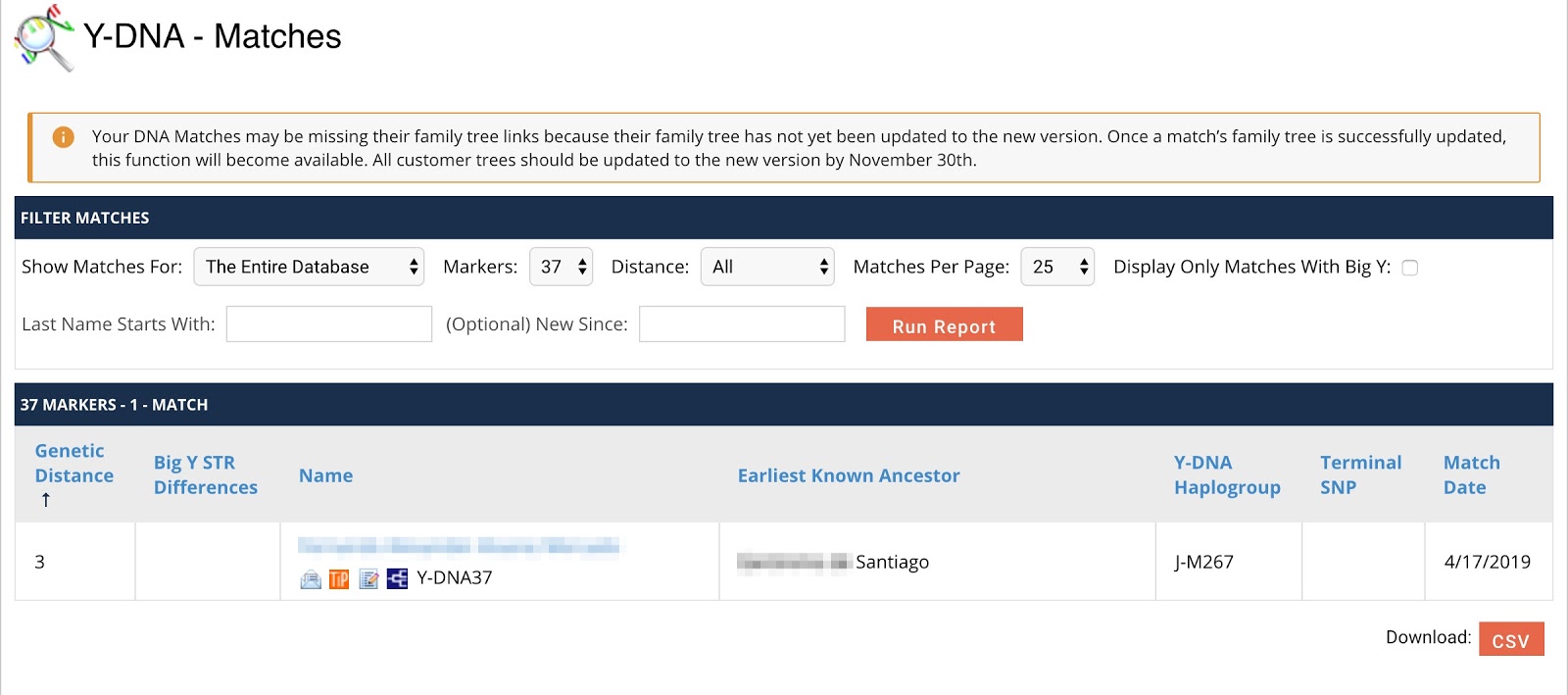
Currently, I have one match from the entire database of FTDNA for my Correa Y-DNA111 test, and it's a genetic cousin who shares another line with me, so it was interesting seeing him match me on the Y-DNA level on another completely different line as well. As you can see the surname for his earliest ancestor is not "Correa", if not "Santiago". So somewhere along our lines there was a NPE, we're not sure who's line it comes from but we're thinking it might be his. Currently, this cousin is tested at Y-DNA37 so their haplogroup isn't as specific as mine. The genetic distance is 3 meaning that our relationship is further back in generations, but I'm not sure if this distance "closes" once they upgrade their Y-DNA test.

Y-DNA Match [FTDNA/Personal Photo]

CONCLUSIONS

I'm hoping that upgrading the test will give some more insight into whether it's more likely to be Arab or Jewish in origin. I have been in contact with some of the administrators of the FTDNA project I am a part of via my results in the J haplogroup. They are also interested to see what comes out of this result since I don't match many other people. This is very fascinating for me and definitely something I am learning along the way with. I'm not super well-versed in Y-DNA analysis so learning via my multiple accounts has been pretty helpful! Hoping my results come faster than I expect!

ARE YOU A CORREA FROM PUERTO RICO? 

HAVE YOU TAKEN A Y-DNA TEST? 

Thursday, July 4, 2019

My 200th Post- 8 Years of Blogging, 15 Years of Genealogy

July 4th, 2019 marks 8 exact years since I began blogging. It all started when I was 21 years old and home from college over the summer. I was inspired by Cece Moore who runs Your Genetic Genealogist and has become a common name in the genealogist household with all the work she has done with DNA, adoptees, and even working on "Finding Your Roots". In June of 2011, she herself had completed her first year of blogging and so I decided to trace my own family via a blog as well. Who would have thought that 8 years and 200 blog posts later, I'd still be on this journey!

Though I don't have many official followers for my blog (as I haven't dedicated myself full-time to running it/putting it out there), I really started doing this for two reasons:

1) Personal Motives - To keep track of my own progress, hurdles, difficulties, breakthroughs, and as of recently analyzing my DNA in conjunction with my paper trail/genealogical searches. In a sense it would serve as a digital journey for which I could refer to and keep track of my finds and brick walls.

2) Visibility - While initially researching my family, I hadn't found too many blogs that covered a wide range of Puerto Rican topics in regards to genetics and genealogy and I ultimately wanted to be a contributor in order to make Puerto Rican Genealogy more visible. There is a big misconception that genealogical records from Puerto Rico have been burned, lost, or destroyed by hurricanes and people give up without even realizing all of the amazing resources available for Puerto Rican research there are out there.

5 years ago, I posted my Post #100 and I actually really liked the style I wrote in so I think I'm going to mimic it for Post #200! Feel free to read post #100 to compare and contrast now that I have 100 more posts and 5 more years added!

What I've Learned

My first blogpost was titled "What Started it all - Part I", where I write about the typical Puerto Rican love story of a "Spanish man" and a "Taíno woman" who had fallen in love in Lares, Puerto Rico - my 2nd great-grandparents. By the time I had written that post I had about 7 years of genealogical research under my belt but I had only just begun to scratch the surface of research. There were many doubts about my tree and definitely many, many ancestors' names yet to be discovered. When I began at the age of 14 there were no known (to me) family trees out there, none created by my grandparents, uncles/aunts, parents, or cousins. All I knew at the time when I began my tree were 2 out of 2 parents, 4 out of 4 grandparents, 6 out of 8 grandparents, and 7 out of 16 great-grandparents - though it's a little, it's also a lot compared to what some people start out with.

My First Blog Post - July 4th, 2011 [Personal Photo]

I've been very fortunate that since I started my research and blog I have come pretty far with my pedigree, which I am both fortunate and blessed to have. Various of my lines reach the early 1700s with a few reaching the 1600-1500s and very few the late 1400s when they came over from Spain. A few lines stop at the 1800s due to the lack of records for slaves - these being my lines from Martinique and Guadeloupe. However, "Rome wasn't built in a day"! It's been 15 long years of painstaking research where I have put in literally thousands of hours to search for my ancestors. I have been blessed to be able to travel to Puerto Rico to continue my searches various times, as well as traveling to Mallorca to research my ancestors. I have also been able to visit towns in Spain where my ancestors lived/were from before heading to the New World. Recently, I have been able to continue to test various family members with DNA and across various companies to help triangulate and find new information about who we are on a genetic level.

I've linked above and below various posts to the different themes I've discussed over the years! 

Advances in Genetic Testing

There have been many advances in genetic testing since I first started researching my family, to believe when I first tested with 23andme back in 2010 the cost was somewhere near $600 for one single DNA test! Nowadays, genetic DNA testing has become much cheaper and fairly accessible to many, not only here in the US but in various other countries. Here are some of the more recent posts that highlight these advancements throughout the years. 

My Favorite Discoveries

Since 2014, there have definitely been some exciting finds! These discoveries are a combination of things: from DNA testing, finding new genealogical documents, to discussing/receiving help from other genealogists. There were a wide range of discoveries made, from very intimate ones to discovering my Dávila line's origin in Spain in the 1700s. Listed below are some of the recent discoveries I've been able to make! 

Words of Advice

I would tell myself keep doing what you're doing! I have come a long way since my initial searches and there is still a lot to find out! Researching my family has brought me much closer to Puerto Rico and my identity as a first generation mainland American born citizen. To those of you budding genealogists - it's never too late! Ask family members questions, document what they have to say, and search online to see what you can find. If you're interested in genetic genealogy - test those family members (with permission, of course!) who might be willing to help you learn more about your family's past.

Hopes, Dreams & Aspirations


Reading my post from 2014 it was interesting to see where I was amongst my hopes and dreams for genealogy. There are some I have been able to check off and some that are still on my genealogical "bucket list". For example, being able to travel to Puerto Rico and go around the island to discover the towns, barrios my ancestors lived in, and the churches my ancestors would have married in. I have been fortunate to travel to distinct parts of the island and as of recently meet cousins in Lares, Puerto Rico. I have also been able to travel to Mallorca which was amazing. I still haven't become a professional genealogist, though I'm sure there is still plenty of time and I also haven't been able to travel to Martinique and Guadeloupe yet. I haven't brushed up on my French though hopefully that is in the works and I am still interested in bringing genealogy to my everyday life and profession.

I still dream about connecting Eglantine Lautin to a certain country/tribe in Africa and it would be amazing to have DNA cousins that confirm my ancestors are connected to Martinique and Guadeloupe (I have one potential lead with a cousin but nothing solid yet!). I also want to continue collecting stories and record them to have a digital audio database of stories from my current living family members that I could look back on years from now and listen to. A genealogist's work is never done as you can see!

Here's to 2024 when I complete 20 years of genealogy! Let's see what's in store! 

Wednesday, April 24, 2019

A Puerto Rican Look at: Y-DNA67 (Avilés/Magraner)

***Si eres descendiente de los Magraner de Sóller, Mallorca, especialmente a través de Damián Magraner Morell o uno de sus hermanos, me gustaría hablar con usted para ver si podemos establecer una conexión genética. Puedes dejar un comentario aquí en este blog para contactarte conmigo. ¡Muchísimas gracias!***

While in Puerto Rico for Spring Break, one of my goals was to test various family members through various companies. Since I don't have easy access to men who carry Avilés and Correa Y-DNA like I do the Rivera line (myself being a carrier of this Y-DNA group) since those members live in Puerto Rico, I decided I would focus on getting a male cousin from my Avilés family and my Correa grandfather to test. I decided to buy two Y-DNA67 exams for them from FTDNA. Recently, they had a DNA day sale and I decided to myself a Y-DNA111 exam to test my Rivera branch as well. So those are boxes I can check off on my genealogical goals for 2019! This blog will focus solely on my Avilés Y-DNA results.

Buying a FTDNA Y-DNA test is not cheap! I would recommend to get these tests if you are an experienced genealogist interested in learning more about your Y-DNA group or an amateur genealogist trying to crack a wall in your direct paternal family. I have been fortunate to test various branches and I have done so for genealogical purposes such as: Establishing whether I have an African or European Guadeloupean Y-DNA group (Charles family), potential Jewish/Arab Y-DNA group (Correa family), Mallorcan connection to the Magraner family (Avilés family), and trying to establish a stronger connection for a relatively uncommon haplogroup (Rivera family). 

Family Tree DNA Home Page [FTDNA]

Background

For anyone that has been following my blog (thank you kindly!), you have probably seen the surnames Avilés and Magraner various times throughout many old posts. My trying to solve this family's mystery dates back to the beginning of my blog in 2011, wondering about my 2nd great-grandfather's origins. I spent time researching and writing about José Avilés Magraner in 2014 for the 52 Ancestors Challenge. I learned the name of my potential 3rd great-grandfather, Damián Magraner Morell, and traveled to Sóller, Mallorca a year later in 2015, his hometown, to learn more about the man who made his way to Río Prieto, Lares, Puerto Rico. The closest I've gotten to confirming this on paper has been José's brother Lorenzo Avilés who mentions Damián Magraner  on his Social Security Application as his father. I stepped on Lares land for the first time in many years in 2017 but didn't make it up to Río Prieto. This year though I did! 

Also, having a DNA match with a fellow genealogist with a grandmother  from Sóller, Mallorca through various family members connected to the Avilés family helped me to help prove that genetically there is something there! 

Collecting DNA

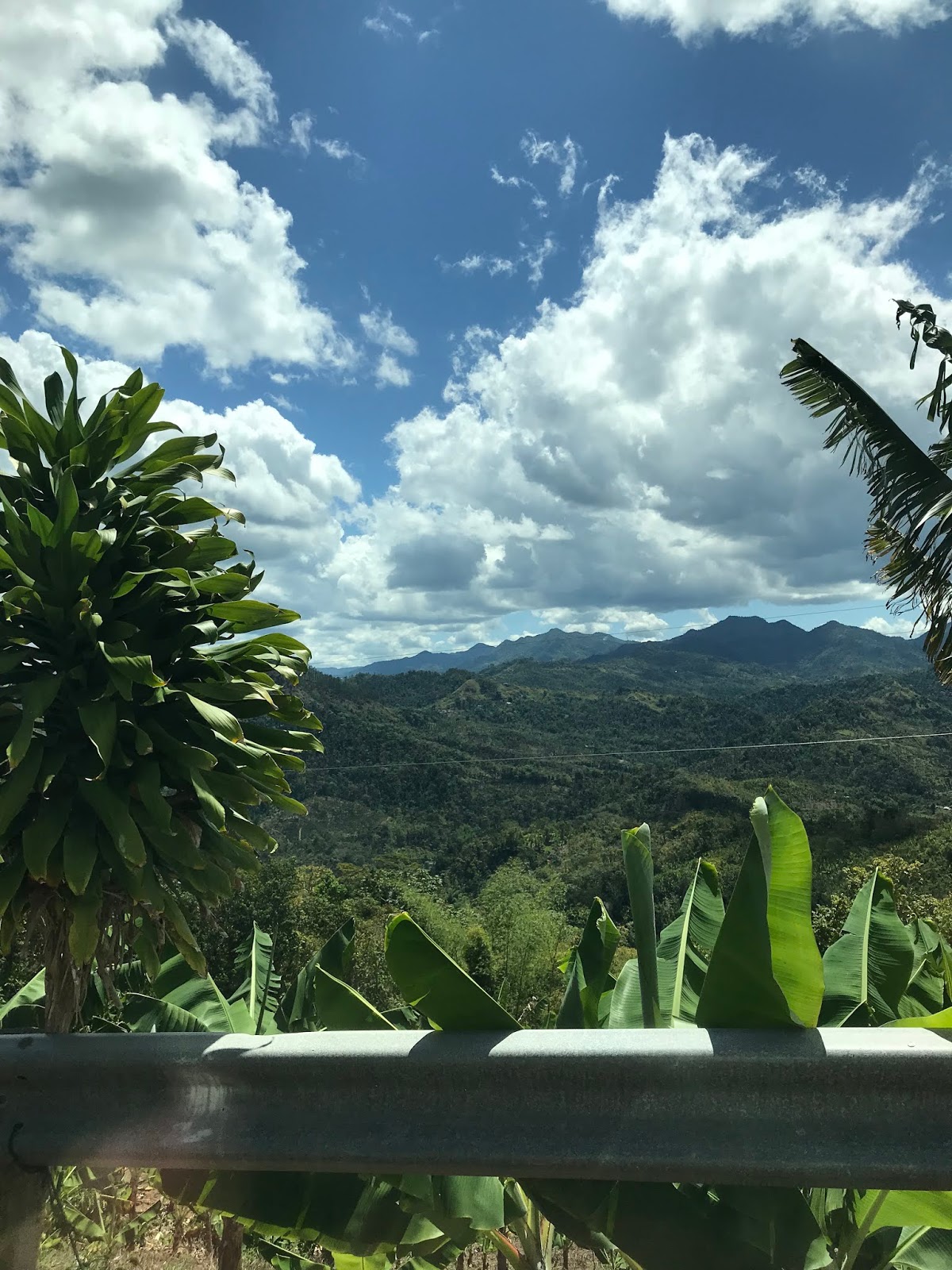
With my grandmother and great-aunts in tow we headed over to Río Prieto by car, my great-aunt wasn't too comfortable driving up the steep and narrow roads so I took charge of getting us there. The ride ended up not being too bad and I got to visit a few members connected to my paternal grandmother and great grandmother, I was introduced to the family as "el nieto de Carmen" (the grandson of Carmen) since they had never met me before and my dad spent his childhood between San Juan and New York and not in the mountain town of Lares. The ride over was amazing and here are some photos of getting to and being in Lares, it was amazing to see the land transform as we made our way up the mountain! 

Driving up the mountain [Personal Photo]


Nature at its best! [Personal Photo]

The view from my cousin's land [Personal Photo]

The "two way road" near my cousin's land [Personal Photo]

Our first stop was the house of my 1st cousin 2x removed. After seeing his land, talking about the effects of Hurricane María, and being gifted many fruits, I gathered up the courage to ask if he was willing to take two DNA tests for me. I was a bit scared he would say "no" for fear of not knowing what the test would do, but he was very willing to help out. I collected his DNA, wrote down some important information, and when we got back to San Juan mailed off the DNA test. 

My reason to test this line was because I wanted to know where in the world it was connected to and whether or not it could prove that my family was related to the Magraner family. The test results came back pretty quickly and so I took a look at them!

Interpreting results

Magraner Haplogroup? [Personal Photo]

Getting a Y-DNA67 gave me basic results, in the sense that R-M269 is a fairly common group and doesn't give too many specifics into the smaller, more recent branches of this Y-DNA branch. My next step would be to upgrade the test to get more detailed results and potentially make more educated results of my connection in R-M269. Under matches, I currently have 2 matches at the Y-DNA67 level but at a genetic distance of 5 and 7, this would mean that our connection is much farther back in history versus having a genetic distance with a smaller number which would mean having a closer relationship in generations. My genetic cousin at the "genetic distance 5" reached out to me and we quickly chatted and noticed our relation was too far to discover at the moment but interestingly noticed that our surnames both had to deal with fruits - Magraner being a surname connected to the pomegranate tree! Lowering my markers to 37 for example gives me more matches but again, at a pretty far distance. The cousins seem to be wide spread across various countries in Europe, I do have some matches from Puerto Rico but they are at Y-DNA12 which is fairly distant as well. As you can see below my Y-DNA67 match has recent roots in the US but he said his family has older roots in southern France.

Y-DNA67 Match [Personal Photo]

My goal is that by hopefully writing about this branch and taking a Y-DNA test I'll be able to confirm my connection to the Magraner family of Sóller, Mallorca. If you descend from this branch, I'd love to chat and see if we can figure out our potential connection!

Conclusion

Though in a sense my results were "inconclusive", there still is hope! Y-DNA usually takes longer from what I know to establish stronger connections because it's such a specific group that is being tested versus for example autosomal DNA. 23andme has given me a bit of a deeper glance into the R-M269 group and hopefully as I upgrade to Y-DNA111, I will have stronger/clearer results and hopefully a Magraner descendant tests as well. This will in turn allow me to make a genetically educated guess about my Avilés family and whether our roots really are in Mallorca. 

Haplogroup R-Z209 [Personal Photo]

Here's to hopefully solving a 128 year mystery in the making! 

Sóller, Mallorca [Google Images]

Saturday, May 10, 2014

A Puerto Rican look at: FtDNA's myOrigins

FtDNA myOrigins [FtDNA Email]

Recently I received an email about the release of FtDNA's myOrigins; this would replace the old version of the calculations given for ancestry breakdowns. I was pretty excited about this upgrade because it would add another view of my ancestral breakdown by another company. Currently I have 23andme's Ancestry Compositon as well as Ancestry's AncestryDNA. I have also used DNATribes for myself and a couple of other family members. So let's take a look through a Puerto Rican lens of the myOrigins release!


23andme Ancestry Composition
For comparison's sake let's look at my 23andme Ancestry Composition. Here on the left is what my percentages look like in Standard View. I go back and forth between the Standard View and Speculative View, but for this comparison sake let's stick to the main one. You can see that in solid, raw numbers I am approximately: 54% European, 15% Sub-Saharan African, 12% East Asian/Native American, 1% Middle Eastern/North African, and 18% Unassigned. I don't like the large amount of unassigned here in Standard View but we can't live in a perfect genetic genealogical world (Not yet at least!).  

FtDNA myOrigins 
Now take a look at my recently released myOrigin percentages! There are definitely a few similarities and some differences. Here on myOrigins you can see that I am slightly more European at 58%, which is only a ~4% difference from my Ancestry Composition. My African is listed as 21%, a good ~6% higher than 23andme. The Native percentage called here "New World" is a solid 10%. Here on myOrigins there is a Jewish Diaspora breakdown where I score 7% and then a Middle Eastern group where I score 3%. On AncestryDNA I do score 5% on their category of "European Jewish" but 0% on their "Middle East". 

The categories can then be expanded to show a more in-depth look at the main category. For example, my European breaks down into: North Mediterranean Basin, European Coastal Islands, and European Costal Plains. My African breaks down into: Niger-Congo Genesis, and East-African Pastoralists. While my Middle Eastern breaks down into: North African Coastlands (Which if you look at it that way I score a 4% on AncestryDNA). Here are the pictures of the breakdowns for my main categories. Note: New World is Bering Expansion which covers North, Central, and South American while the Jewish Diaspora hovers/radiants over and near Poland. 

European Ethnic Makeup [FtDNA myOrigins]
African Ethnic Makeup [FtDNA myOrigins]
New World Ethnic Makeup [FtDNA myOrigins]
Jewish Diaspora Ethnic Makeup [FtDNA myOrigins]
Middle Eastern Ethnic Makeup [FtDNA myOrigins]

It was definitely interesting looking at these numbers especially at the African and European scores. My African on myOrigins is at 21% while on AncestryDNA it's at 23%, the highest 23andme places me is at 15.7%. Also AncestryDNA predicts that 12% of my DNA is from the Mali region and here on myOrigins 17% of it is labeled as "Niger-Congo Genesis". I was also surprised that I scored 24% on the European Coastal Islands portion and I wonder if that has anything to do with the potential connection through Gustave Jean-Charles and also potentially through my great grandfather's Irish/English paternal haplogroup. 

All in all, I didn't think the ethnic breakdown was too far of from what I have seen with other companies. Whether or not it's true to my family is a completely different story! Since my family is pretty mixed for the last past 200+ years I don't really know where certain parts of Native, European or African come from -- rather it's coming probably from all my lines. I can only guess that my 4th great grandmother was 100% African because she was born on a sugar plantation in Martinique. I'm really interested to see if myOrigins develops a bit further and adds more specific breakdowns for African like AncestryDNA has done. 

Sunday, January 12, 2014

52 Ancestors – #2 Jean Charles Gustave (1819-1891)

This second post will be about a challenging ancestor of mine who I have mentioned a lot before but I
want to dedicate a post to him since he has been a troubling ancestor to pinpoint. This post will be about my 4th great grandfather Jean Charles Gustave.

Jean Charles Gustave has been very elusive since the first moment I set eyes on his name in a birth certificate of his grandchild, Julio Correa Gustavo (my 2nd great grandfather). When Jean Charles was registered in Puerto Rico with his wife, he was registered as living in Fajardo, Puerto Rico as a "domestico" from Martinique, married, and 55 years old. They were registered on the 30th of May 1874 as domiciled in Fajardo but were still French subjects. In his registration his name became "Juan Carlos Gustavo" and in subsequent documents his name remained in the Spanish form. Yet every time Jean Charles Gustave signed his name in documents he consistently used the French form of his name.

Jean Charles Gustave's Signature

We also know that by the time he was registered in 1874, he was already living at least 7 years in Puerto Rico because his first child and my 3rd great grandmother, María Paulina Gustavo Lotten, was born in 1867 on the island of Vieques, a municipal of Puerto Rico. Jean Charles and his wife "Juliana Balbina Lotten" who I later came to learn was Julienne Malvina Lautin, a native from Rivière Salée, Martinique had 7 children (to date) that I know of. I've decided to use the surnames "Gustavo Lotten" because it is the most similar to its original form, Gustave Lautin. There have been many variations of both surnames used throughout documents and the family eventually switched over to the surname "Charles". Here are the children in order:

1) María Paulina Gustavo Lotten 1867 – 1948
2) Tomás Octavio Gustavo Lotten 1869 – 1957
3) Valentina Gustavo Lotten 1878? – 1938
4) Areopajita Gustavo Lotten 1879 – 1900
5) Dionisio Gustavo Lotten 1880 – 18??
6) Alberto Fermin Gustavo Lotten 1882 – 1953
7) Martina Isabel Gustavo Lotten 1886 – 1888

Gustave Lautin Family


I have been able to track five out of the seven children from the Gustave Lautin line but I don't know what ever happened to Dionisio and Martina Isabel. Dionisio was born in Fajardo while Martina Isabel was born in Santa Isabel yet they never appear in census records and I have not found death records for them yet.

Something very interesting that I have noticed (and probably literally just right now), is that the family has always stuck by the ocean. For whatever reason, in whatever town they lived in, it was always by the coast. Vieques, Fajardo, Santa Isabel, Salinas, Guánica, Ponce – all coastal towns of Puerto Rico. Jean Charles Gustave was a carpenter by trade, so wouldn't he have found better work in San Juan? The family would later become fishermen with some carpenters here and there but I think it's interesting that they were always near water (most of their children and grandchildren were born in parts of the town called "playa" – in Santa Isabel, Ponce, and Salinas). Could Jean Charles Gustave originated from a coastal town in Martinique?

Despite knowing where Jean Charles Gustave has lived I have yet to find his death certificate. I know that his death had to have taken place between November 1887 – August 1891, with the help of his grandchildren's records. The question is where?! This span of 4 years is a pretty small gap to look for someone yet I have had no luck finding his death record in Salinas, Yauco/Guánica or Ponce (I'll be double checking again shortly!)

Jean Charles Gustave always seemed to me to be of a créole background for various reasons. 1) He didn't appear in the Actes D'individualités in Martinique – This could mean he was born free or freed before 1848. 2) He was able to sign his name in 1885 – which I think is a big feat for a black man in the mid-1800s from a colonial island. 3) His wife was much younger than him which makes me think she married "up" for a better life – either love brought them together or his status did.

After researching the Gustave line for quite a while, I was able to find a cousin who shared a connection with me. Her great grandfather, Alberto Fermin, and my 3rd great grandmother, María Paulina, were brothers and sisters. This 3rd cousin, 2x removed is more connected to the Charles family and thus was able to find a male descendant of Jean Charles Gustave who was willing to take a Y-DNA test to figure out our Martinican male haplogroup.

I was able to get a Y-DNA test through FTDNA from a 2nd cousin, 3x removed, the grandson of Alberto Fermin Gustavo Lotten. I was very excited when the results started coming in this week. I was caught between hoping it was an African haplogroup and a European haplogroup, but my gut feeling was that it would come back European – due to the créole theory. The group came back R-M269 (shorthand) also known as R1b1a2, which turns out to be part of one of the biggest European haplogroups. Hopefully I'll be able to pinpoint a surname through FTDNA which would give me a clue for my male ancestor in Martinique!

Haplogroup R1b Distribution [Wikipedia]

Take a look at this new blog post called "A New Piece to the Puzzle! The Jean Charles Gustave Mystery Continues…" with some new information regarding my 4th great grandfather!