Showing posts with label immigration. Show all posts

Wednesday, October 9, 2019

Genetic Connections to Guadeloupe

Connecting to DNA Cousins from Guadeloupe [Google Maps] 

DNA testing is something I initiated about 10 years ago, and I was fortunate to have stumbled upon it when I did. With testing, I have been able to make great discoveries - some of them thanks to the DNA itself and others to the people I have met and interacted with along the way. If you have been following my blog (Thank you & ¡Gracias!), then you know a few years back (8 actually to be exact!) I begun to unravel a previously unknown discovery in my family about a connection to the islands of Martinique and Guadeloupe via my maternal grandfather's side of the family. At the time I knew very little about this branch but thanks to digging through documents and connecting with French Caribbean genealogists throughout these recent years, I was able to discover much more about this side of my family.

My research up until now has revealed two distinct sides in my 3rd great-grandmother's family, one side (her father's) comes from Guadeloupe while the other (her mother's) comes from Martinique. 

María Paulina Charles Lautin - 3rd Great-grandmother [Personal Photo]

Unfortunately, there is not much information past María Paulina's grandparents. It seems that on the Jean-Charles side, the family might have been mixed-creole seeing as how her parents were enslaved themselves, yet a Y-DNA test points to European origins for the "Charles" line. It is important to note that this side of the family received their freedom from slavery before 1848, unlike most of the enslaved peoples did in the French owned Caribbean islands at the time, this allowed María Paulina's paternal Guadeloupean grandparents a chance to marry before they passed away. Meanwhile, the "Lautin" side is probably all African in origin. Julienne was born a slave (noted as "negresse" on her birth certificate in 1844) and Eglantine herself was brought over from Africa. Unfortunately, we have no idea who the father of Julienne was. We only have a potential clue - in Puerto Rico the father's surname was written down as "Pedro" and searching the records in Martinique has allowed me to identify a family with the surname "Pitroo" who worked on the slave plantation as the Lautin clan; there might be a possible connection to that family and only time and DNA will tell.

Charles-Lautin Family Tree [Personal Photo]


One of my genetic goals was to potentially one day find a cousin who descends via their maternal line all the way down to Eglantine Lautin, this would allow for a MtDNA test to potentially identify a region in Africa she would have originally been from. I have been able to find a genetic cousin via AncestryDNA but they haven't logged into their account for over a year so I haven't heard back from them. The question now became were there segments in my DNA linking me back to potential cousins in Guadeloupe and Martinique? If not, would my grandfather's DNA contain segments? Luckily I have been able to test myself and my maternal grandfather on 23andMe and AncestryDNA along with our Y-DNA line on FtDNA. Thanks to the suggestion of David (a French Caribbean genealogist), I migrated my grandfather's DNA to MyHeritage - which seems to be more popular in France. 

After breaking up my DNA in DNA Painter into segmented colors of who gave me what, you can clearly see all the yellow segments below belonging to my grandfather. 

DNA Painter [Personal Photo]


This DNA in turn comes from his parents, grandparents, great-grandparents, etc. meaning that though those segments cover much of my maternal DNA, I would have inherited genetic material from one out of eight 2nd great-grandparents on that side of the family with ties to Martinique and Guadeloupe. And since it is far back, the odds of me receiving many segments is low as well, but having my grandfather tested means there are more odds of him having more segments as well. Recently in my DNA, I have been able to identify two matches on AncestryDNA and one match on MyHeritage with clear connections to the island of Guadeloupe. 

AncestryDNA

My first match shares DNA with my grandfather but not myself or my mother. Though they share 3 segments across 49cm it's possible that my grandfather was the last generation to inherit these segments. In their "shared matches" list they only share three matches, which is very uncommon for Puerto Rican matches to share such low and limited cousins, so I can probably rule out the fact that this cousin as remotely Puerto Rican. This cousin does however have on their shared matches a cousin who is Puerto Rican but connected to my grandfather via his Correa family which is tied to Martinique and Guadeloupe via María Paulina Charles. The first match I have no idea how they are connected and the third match is a cousin with is mixed Guadeloupean and I think African American. Since AncestryDNA does not share where they match on their DNA, I have no idea how to "chart" this for my grandfather on DNA Painter. The cousin I think is not on Gedmatch either, and I have reached out but no return message so far. 

Guadeloupean Cousin [Personal AncestryDNA]

This 2nd cousin shares DNA across 3 segments as well with my grandfather but this time at 38cm, my guess is that these 3 segments are probably the exact same ones as the first cousin from above. However with this cousin, my mother and myself are said to share DNA with as well. Unfortunately, I have no way of knowing where on my DNA these segments are located.

Cousin with Guadeloupean Ancestry [Personal AncestryDNA]

MyHeritage

This was my grandfather's first official Guadeloupean cousin to first appear for him which was very exciting, since it helped to solidify all the research I had done in the past 8 years. As you can see below I was able to find this cousin by filtering his DNA matches by geographic origins and selecting "France". The segment is listed as only one shared segment but also at 38.3cm like one of my grandfather's AncestryDNA matches. You can also see that based on our trees we both have "Guadeloupe" as an ancestral place for our families based on the trees we have built. I have gotten a chance to chat with this cousin and our families both have ancestry from Les Saintes, which are a set of smaller islands belonging to Guadeloupe! It is possible that there are more matches amongst my grandfather's DNA matches who have a connection somehow to Guadeloupe but so far this is the only one I have been able to find on MyHeritage. 

Guadeloupean Cousin [Personal MyHeritage]

Luckily, on MyHeritage you can see where in your DNA you share the segments. For my grandfather and this match, the segment is located on chromosome 11. 

Shared Guadeloupean DNA [Personal MyHeritage]

My own personal chromosome 11 is inherited mainly in the same spot from my grandfather as the Guadeloupean match comes from but doesn't mean that I would necessarily share that same piece of DNA with that cousin, in order to better know I would probably have to transfer my own DNA into MyHeritage and see if I match this cousin as well.

My Chromosome 11 divided into Grandparent Inheritance [DNA Painter]

Interestingly enough, the region my grandfather shares with this cousin on Chromosome 11 is European on one side and African on the other and specifically the DNA on that side is registered as Nigerian. In a previous post, I took a look at inherited African DNA and I analyzed a bit the fact that Nigerian DNA was much higher on my grandfather's side of the family and potentially connected to María Paulina Lautin. If I had to put some money on it, I wouldn't be surprised if their shared DNA was on the Nigerian side via a slave(s) brought over to Guadeloupe. I'll have to read up on the African influx of slaves to Guadeloupe and see if any studies have been completed on which regions these slaves specifically hailed from.

My grandfather's Chromosome 11 [Personal 23andme]

Why no genetic connections with Martinique? 

I'm not sure why I originally expected genetic connections from Martinique over Guadeloupe. Maybe because I discovered the former side first versus the latter, I expected that my genetic connections would happen in the same order. But taking a closer look it kind of makes sense why I might not have Martinican connections right away, we know that Eglantine was from Africa and Julienne's father probably was as well. Out of Eglantine's five children (one of them being my own 4th great-grandmother), only three (two siblings) went on to have children and who knows if they were were full or half siblings (I'm guessing half over full). 

Next Steps

Nonetheless, this is exciting stuff! The next step would be to try and figure out how we're all related! It doesn't seem like we have any surnames overlapping with each other, but at the same time, knowing that my 5th great-grandparents from Guadeloupe were slaves means that they didn't carry surnames in the traditional sense we have come to know. My 5th great-grandmother only went by "Marie Lucie" and used no surname on documents while my 5th great-grandfather was known as "Jean-Charles Chaleau" and the children passed on both "Chaleau" and "Jean-Charles" as surnames depending on the time period. 

Recently, a document was discovered on Terre-de-Bas (merci beaucoup David!) which mentions Jean-Charles as an uncle in a death record in the year 1853, which would mean he would be related to one her parents. As you can see, there is still much to be discovered and I'm hoping that our DNA will reveal more about our connections. This is also why it is important to explore various companies of DNA and search within your matches! 

Nº 1 Françoise - Décès 1853 [ANOM]

I also can't wait to visit Guadeloupe one day!

Terre de Bas, Guadeloupe [Guadeloupe Le Guide]

Saturday, January 28, 2017

Guadeloupeans in Puerto Rico

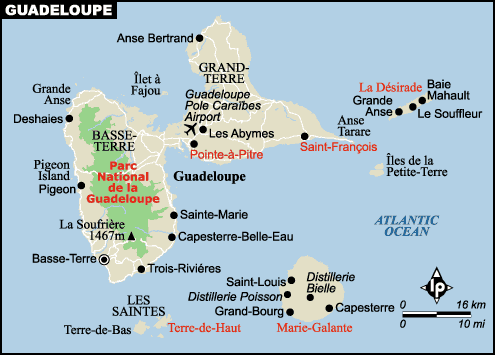
After having found out that my 4th great-grandfather from Guadeloupe, I was interested in seeing who else came to Puerto Rico from that island. Maybe there were other people from the same town or (smaller) island as my 4th great grandfather. I was also interested in seeing how surnames changed once they came to Puerto Rico and seeing if there was a way to track the immigrants via records and ship manifests. I was able to track a good number of people in Puerto Rico and I imagine there are many more who can be traced with some more leg work. So here I want to talk about some Guadeloupeans in Puerto Rico and just open up that conversation especially for those interested in finding out how to establish connections with their ancestors back to Guadeloupe.

Guadeloupe [Google]

Many of the people I traced back to Guadeloupe was easily down back of ship manifests showing their town or city of origin on their native Guadeloupe. Without that the search can be quiet difficult, like how it was finding my 4th great-grandfather and this can be for various reasons. Guadeloupe is quiet a big island, similarly set up to Puerto Rico, in the sense that there are various towns and even other smaller islands that make up part of the whole of "Guadeloupe". Taking that into consideration and the fact that many surnames were changed, it can take quiet a while to trace someone to their original town.

To start the search, I began creating Excel sheet with the names, dates, and any information available in the Puerto Rican records. With that information I could see where I could head my search. Some death or marriage records of the Guadeloupeans provided information and even birth records of children, though mainly their ship manifests recorded their origins. Guadeloupeans and even Martinicans who appear in Puerto Rico mostly before 1910 are sometimes hard to trace because those ship manifests from that time for Puerto Rico aren't online. 

It's interesting seeing how many people from the island married others who immigrated from Guadeloupe and even though who came from Martinique, which is the same case with my 4th great-grandparents. So far I found one woman marrying a Spaniard in Puerto Rico, her name was Emilia Duteil and I will focus on how I found out more information about her. 

Emilia Duteil first appears on the 1910 Census living in Vieques, Puerto Rico, widowed and says that 6 children were born but 0 are alive at the time of the census. It says her birthplace is Guadeloupe while her parents are listed as "France", and says that Emilia immigrated in 1870. Interestingly enough the it says she is white which I haven't seen too many of since many are mixed, mulatto, or black. Emilia was living in the 1910 census with two "criadas" one being a servant and the other a cook, Leocadia was listed as mulatto while Ana Colberg who was also from Guadeloupe was listed as "N" for negra. 

1910 Census [Ancestry]

Emilia would die in Santurce, living in Miramar on the 29th of April 1918. Here was listed as Emilia Duteil Rosseaux, widowed of Juan Lujan and the daughter of Juan A. Duteil and Adela Rousseaux. The person who came forward to report her death was Salvador Giuliani, listed as sobrino or nephew of the deceased.

Emilia Duteil Rousseaux - Death [Ancestry]

It seems that Emilia wasn't the only one from her family to make it to Puerto Rico. There is a Rose Alsina Duteil Rousseaux who passed away in Vieques, Puerto Rico in 1909 also the daughter of Juan Duteil and Adela, most likely her sister. Both are said to be from Point-à-Pitre, Guadeloupe where I will need to search for a birth record -- which I haven't found yet. This can be because the years listed as their birth years are incorrect and so I have to expand my search to other years. Also, their town of origin can be listed incorrectly and isn't where they were born if not where they last lived before coming to Puerto Rico.

But this is for the most part the process - using documents to trace backwards their origin. Sometimes some cases are easier than others. Coming from a white béké family can help make the search easier while those were mulatto or black might come from families that were previously slaves and so the search can be harder depending on when they were released and how far into Guadeloupe their time as slaves goes. Also those who didn't know how to spell their name ended up received warped Spanish-ifed names which makes the surname harder. I noticed that more Martinicans received small name changes while though from Guadeloupe necessarily didn't.  In the meantime I'll keep collecting information about those who came from Martinique and Guadeloupe to Puerto Rico and trying to piece together the information. 

If you need help searching or have any of these surnames in your family, give me a shout and I don't mind sharing the information I have! These are the surnames I have for Guadeloupe, I'll probably create another post but dealing with those that came from Martinique. 

Guadeloupe: Ballet, Baptiste, Benjamin, Cognet, Duteil, Harris, Guiougou, Lastor, Manceau, Saint-Paul

Tuesday, June 24, 2014

Emigration/ Migration / Immigration (Book of Me -- Prompt 43)

I bumped into this topic from the Geneabloggers emails which posts prompts (amongst other links) from a blog by Anglers Rest. Pretty much the prompts are created for you to fill out, that way you are building up some genealogical information about yourself as well! I think it's a great idea, especially since we focus so much on the past that sometimes we forgot -- one day we'll be a part of that past! And prompt #43 is a great prompt for me for many reasons, so I decided to give it a go!

Here are the questions for the prompt. I've reorganized a bit to my liking since I want to tackle them in a certain way. 
  1. Have you ever lived overseas from your place of birth? Would you want to? Could you?
  2. Did your ancestors or even a more recent generation?
  3. Do you feel akin to another country from that in which you were born?
  4. If so have you found any ancestral links in your research that perhaps explains those feelings?
The process of emigration, migration, or immigration have always been completely interesting to me -- And I think mostly because my parents are Puerto Rican. When they came to this country they technically weren't "immigrations", yet a lot of the experiences we share are those of "immigrants" (The language barrier, custom/cultural differences, etc.). I never saw my family as immigrants but more so as emigrants. Yet, I can't fathom the courage it takes to uproot your family (or yourself) and completely move away from everything you know, love, and cherish. 

I've experienced living abroad through my experiences from study abroad. I was able to spend a semester in Yaroslavl, Russia as an exchange student. And those four months changed my outlook on life completely. Being disconnected from the outside world (barely any internet to Skype back home properly) and the complete change of culture and language was definitely hard on me. Don't get me wrong, I thoroughly enjoyed my time in Russia yet I had the luxury of emails, Facebook, and occasionally Skype. I can't imagine how my mom came here at the age of 18 and her only communication with her own mother was through the occasional phone call and letters (and she 'migrated' in the late 1980s). I definitely think living abroad (even for just a short period of time) definitely makes you a stronger, more independent, and just overall livelier person. Now with my next adventure of living abroad on the way, I'm excited to compare and contrast how living abroad in Spain will be to Russia. Obviously, language, locality of country, and similarities in culture will play a huge role in my "easing" into the country but I wonder how easy it will be in Spain. I actually didn't suffer from culture shock in Russia but will I in Spain? 

Before my parents coming to the USA, pretty much every generation dating back to the 1800s/mid 1700s had been living in Puerto Rico. I can't imagine the jump from (A) to (B) being easy, both in the case of A being Puerto Rico and B being the United States. But also the jump of A being Spain and B being the new territory of Puerto Rico. Did the fears and concerns my family had in the 1980s mirror those of my ancestors in the 1600s/1700s? Leaving family and friends behind for a new land which they had only heard about through stories. 

My fourth great grandparents are currently super, über intriguing to me -- they immigrated (since they were crossing territories of countries) respectively from Guadeloupe and Martinique. I can't even begin to imagine their journey from a land of French/Créole to that of Spanish. A least when I went to Russia I had an idea of what Russian sounded like; I could read, write, and speak in the language pretty well by the time I landed in Moscow. But what about Gustave Jean-Charles and Julienne Malvina Lautin? Where did they muster up the courage to travel from their home islands and make their way to Vieques (a small island of Puerto Rico on its eastern coast). Were they scared they wouldn't fit into the culture there? Had they heard such wonderful stories of Puerto Rico and its people that they had to see, experience, and live it for themselves? 

How well did they 'mold' into the culture when they first arrived and in their first years? Living on Vieques probably wasn't an issue, they must have known some other immigrant families settling themselves in the island. But were they nervous when the appeared before the church in 1869 to get married? Or when they had to baptize and register the birth of their children? Did Julienne whisper songs in créole to Paulina and Tomás as small children? Did she feel the need to preserve her Martinican traditions, words, and mannerisms? Did she lug them from Martinique to Vieques and finally to Río Jueyes, Salinas or did they stay behind in Rivière Salée?

I often wonder and worry that as time continues I'll begin to lose my "Puerto Rican-ness". That I won't teach my children Spanish, how to sing La Borinqueña, or share with them the traditions, customs, and superstitions my family passed down to me. (Never walk with one shoe off and one shoe on, it means you want your mother to die!). Yet, deep down I know (and hope) this won't happen. My ties to the island, my culture, and the way I was raised are too strong and too important to just let go. But yet I still worry -- did Julienne and Gustave feel the same way? In just three generations, it seems that the ability to speak French/ Créole was lost (my great grandfather being one of the few who I was told spoke French). Will three generations after me not care what their 4th great grandfather Luis Rivera talked and preached about culturally? 

Hopefully, living in abroad in Spain will give me some more insights. Remind what it is to be in a land that isn't your own (no matter how similar they might seem). I wish to learn more about the immigrants who came from El Puerto de Santa María, from Huelva, and from Pastrana and made their way to Puerto Rico. To learn the stories of those who came from unknown towns to the beautiful island of Borikén and settled there. To learn the stories of those who against the odds made the various towns of Puerto Rico their home, their nest, their humble abode. Did other people in my family move to Puerto Rico without knowing Spanish? Or maybe those of different religious backgrounds into a Catholic territory? 

I don't know where I'll end up -- where I ultimately will set up my own nest and home. But I do hope that wherever that may be (either here in the USA or else where), that I bring along my heavy yet important Puerto Rican bags. That I open them up, air out the contents inside, and let them breathe old yet new life into my home. That my children and grandchildren will run around saying "Bendición papi, bendición abuelo". That most importantly, they'll know and care what it feels like to be Puerto Rican. Because I know I definitely do!

Friday, November 2, 2012

When You Least Expect It...

I took a little hiatus from searching for my ancestors after I started working and since I was stuck at home due to Hurricane Sandy I decided to give it go again. (I can't stay away from my tree for that long anyways!) I decided to glimpse through my line of potential Martinique ancestors. There's one document which I've always found extremely helpful and this time it helped me out once again. The document is the birth certificate of my 2nd great aunt, Luisa Correa Gustave (Gustavo). She was born in Salinas, Puerto Rico on the 2nd of June 1885. She is the first child born to Manuel Correa and Paulina/Octavia Gustavo at the start of the civil registry and I'm pretty sure the only child to be registered as Gustave rather than Gustavo. I've posted about the surname here and the changes it has gone through throughout the years.

Luisa Gustave being registered in Salinas, PR
I've always looked at this document because it states that her grandfather, Juan Carlos Gustavo was still alive, was from Guadeloupe and was a carpenter (I believe that he was from Martinique from all the other evidence I have). He was also listed as one of the 'testigos' or witnesses to her birth. But it wasn't until yesterday that it clicked! Most of the witnesses sign their names at the end of the certificate. Could Juan Carlos Gustavo, my 4th great grandfather been able to write and sign his name as a witness? Lo and behold, his signature was there to my surprise!! Also he signed his name the way it was before the Spanish-fication of it. Therefore he signed his name as Jean Charles Gustave.

1885 Salinas, PR- Juan Carlos' signature
Now I had a new piece of evidence that I could use. Sadly, in 1887 when his 2nd grandchild Cruz Correa Gustavo was born he was not present and neither was he for any other's birth. From the certificates, we know that Jean Charles died some where between 1885-1890 but we don't know where. I've checked Salinas where his daughter lived, my 3rd great grandmother, and he was not there. Jean Charles' wife is said to have lived in Ponce, but I haven't found her death certificate and Jean Charles also was not there.

Yesterday I decided, for whatever reason, to check the town of Santa Isabel. I decided to check the index for births from 1885-1931. There I checked for any possible Gustavo/Charles families. There I came across a birth registered as "Martina Isabel Gustavo Pedro" in 1886 and decided to check it out. Despite the fact that I wasn't aware of any "Pedro" surnames in my family I suspected that this could be a possible connection.

Martina Isabel registered along with others in 1886- Santa Isabel,  PR
When I found her birth certificate I was very surprised! The father who appeared to make the declaration of her birth was named JUAN CARLOS GUSTAVO! From Martinique and a carpenter! I was so excited to find this! But I had to keep in mind that this could be someone else, especially since it was Gustavo Pedro, rather than Gustavo Lotten (and all its variants). I kept looking at the document and found more interesting things. The wife was Juliana Pedro, also from Martinique. It also matched! Juan Carlos' wife has gone by many names and Julia/Juliana is one of them along with Balbina and Barbara. This was the first document to mention parents for Juan Carlos and Julianna, which was interesting to see.

Juan Carlos' parents according to the document were Juan Carlos Gustavo and Maria Lucia both from Martinique and had passed at the time of Martina's birth. Juliana's parents were Pedro Pedro and Eleuteria Eglantin, both from Martinique. He had passed and the mother was alive, a widow, a washerwoman, who was still alive [from what it seems she lived in Martinique still. At first I thought it said in Santa Isabel but it says in Spanish "de la misma naturaleza y domicilio", which would mean from the same origin/nature and address.] This was one of the most interesting parts of the document. Pedro Pedro most likely doubled his name or took his dad's first name (Pedro) as a surname. Eleuteria Eglantin is probably most of the interesting pieces to this puzzle. Her last name when pronounced sounds VERY similar to the name Lotten which was what passed to my 3rd great grandmother. This,  probably real last name brought over from Martinique (probably somewhat distorted from its original spelling) and worked better than Pedro. The 'Eg' part could have been dropped and when pronounced was written simply as Lotten. Feel free to write "Lantin" into French>English Google Translate to see what I mean. [I would later learn that 'Eglantin' was her first name.] Interestingly enough, I can't find Martina Isabel in the 1910 Census as well so she might have died as a child.

The Maternal Grandparents of Martina Isabel
Lastly, I decided to check for a signature! This could be the confirmation that I needed to prove whether or not they were related to my Charles/Gustave(o) line. Here are both signatures. I believe that they are the same man. Despite the small differences such as neatness and depth of the ink, etc. I believe that this is the same man's signature.

Salinas, Puerto Rico 1885
Santa Isabel, Puerto Rico 1885
Both for some reason it seems are spelled "Jeain" with the "J" having the bottom looped hook. Both Charles have the "Ch" connected then "ar" and then "les" connected. Then "Gustavo" has the same bottom looped hook in the "G" and then "gus" in connected and then "tavo" with the "o" connecting to the line beneath it. Also, notice that all three are lower case while I've seen other people capitalize their first and last name. I do believe that both of these are the same people. Also, Santa Isabel and Salinas are actually both southern towns and here you can see that they're both neighbors to one another.

Santa Isabel, Puerto Rico
Salinas, Puerto Rico
Hopefully I'll find out more about this family and keep extending this line. I would love the opportunity to be able to find where in Martinique they would have been from and actually visit the town they lived in and figure out the historic background to their lives. Of course, it might not be possible if they didn't mention where they were from in Martinique but with the records from that island I hope that hopefully it'll be possible!