Saturday, December 8, 2012

A Puerto Rican Look at: Ancestry Composition

This week, after much anticipation and excitement the new version of 23andme's Ancestry Painting was released! This new version, which replaced Ancestry Painting, is now known as Ancestry Composition. Ancestry Painting lacked populations which only used three main populations Asian (from China/Japan), European (which I think were US-European samples), and then African (using Yoruba samples from Africa). The issue with this was that many people for example that got Asian, couldn't differentiate between Native American Asian and East/South Asian. Ancestry Composition on the other hand has 22 populations which includes samples from all around world. Ancestry Composition is still in its infancy, seeing as it how just came out a few days ago, and there will be much to sort out and update. For example, currently Ancestry Composition can only separate West African and North African. This is unfortunate for many African gene-carrying individuals like myself who have no idea where specifically in Africa their genes came from. 23andme did state that the current African cluster will be broken down further but they are running tests to make sure everything will be in order. So without further ado, here is a Puerto Rican look into Ancestry Composition! [Note: results are still changing around, so these numbers and values are only applicable right now. Things may reflect differently later on.]

My Ancestry Composition

So this is who I am; at least as of a few days ago! Percentages have gone up and down compared to the old Ancestry Painting. We see that my European is significantly lower than what it used to be (75%) and my other levels pretty much stayed the same. 16.1% of me is still unassigned which means that as more samples are collected, hopefully this 16% can find a home for itself amongst the colorful bars. As you can see there are a few tabs on top. The first one called "Map View" allows you also to see "Split View" and "Chromosome View" which I'll show in a bit. Split view only works if you have tested either both or one of your parents and Chromosome View is similar in appearance to the old Ancestry Painting. Also you can see a tab called "Global Resolution" which allows you to hone in more on the various populations which are included. Then you see my name, which you can choose to see other people you're sharing with then you see "Standard Estimate". If you click on that tab, you get "Speculative Estimate", "Standard Estimate", and "Conservative Estimate". I'm not too sure on what exactly the defining difference is between them but I'll show you images of Standard and Speculative so you can see how they differ. Now, I'll show you a more in-depth Global Resolution:

My Ancestry Composition- Standard Estimate
Here you can see various populations which can be found in my DNA. There are some interesting and some expected ones. With European you can see that I'm further broken down into Southern and Northern European, and then from there even more. So 20.1% is Iberian which is very expected and 0.5% Italian which is also sorta expected. Then I get 0.2% British and French, which is interesting since in AncestryDNA I get 13% British Isles. Also I want to point out the "Nonspecific Southern European" and "Nonspecific Northern European". These mean that segments of my DNA can be found amongst these groups yet are widely distributed amongst them that they can't pinpoint exactly which subgroup it belongs to. So there could be more British in there somewhere amongst the 19.9% but isn't specific to just the British Isles. Interestingly enough I get Ashkenazi at 0.5%, I've seen cousins in my Ancestry Finder who claim Ashkenazi Jewish roots so I knew somewhere far back I'd have to have some too. It most likely comes from old Spanish Jewish roots or maybe a Eastern European ancestor which is also very possible. Then you can see I have 16.1% Sub-Saharan African which includes all of West, Central, Eastern and Southern Africa- my ancestry from there most likely comes from Western Africa due to the slave trade. Next you can see 11.1% East Asian and Native American, with a 8.6% further divided into Native American- definitely real and most likely from my Taino ancestors (there were also Arawaks, Caribs and even Mayan from Mexico present in Puerto Rico (Mayan through labor trades), then a <0.1% East Asian which I'm guessing is just noise and then you can see 2.5% Nonspecific East Asian and Native American. Lastly, you can see 0.1% which arrives from Northern Africa. My Speculative Estimate tells a little bit of a different story!

My Ancestry Composition- Speculative Estimate
I tend to lean more to this estimate which to me hopefully fits more of my ancestry. I say this because with my Martiniquan ancestors, there should have been some French estimated into my percentages (of course, if no French ever mingled with my ancestors that could be possible as well, but in those times slaves were mistreated as well as raped). I'll let you glance at it, I don't want to make this post too long. You can see some numbers have gone up while others have gone done. But still, 100% me :) Next I'll show you the Split View option which I can see since I've test at least one parent.

My Ancestry Composition- Split View
So here you can see how I've inherited from my mother's and father's side. My mother's side gave me more unassigned as well as much more Sub-Saharan African yet less European. You can also see that the 0.1% North African I receive earlier in my Map View comes from my mother's side of the family. Interestingly, both sides gave me roughly 5-6% East Asian & Native American. Split view is an awesome option for those who might have tested only one parent or wants to figure out which side of the family gave them what. The next few shots will include different "Chromosome View"snapshots.

My Ancestry Composition- Chromosome View
So I'll begin of course with my Standard Estimate of the Chromosome View. As you can there are a ton of nice colors flowing in and out throughout my chromosomes, this is my gene's artwork. Here you can see two bars for each chromosome, except the X which I received one of from my mother. The DNA has also been phased with smoothes out a lot of the colors allowing it to flow easier instead of looking like this (the old Ancestry Painting image with spliced chunks of colors):

My Ancestry Painting 
Now I want to show you my Speculative Estimate with all the previous populations from the Map View. Here is how they change up my DNA colors:

My Ancestry Composition- Speculative Estimate
Here you can see all the further divided colors and what's cool about the new Ancestry Composition is that it's a bit interactive. Meaning that if I want to see where in your DNA a certain population appears you can click on the population and that color becomes isolated while the others fade a bit away allowing you to see those pieces of your genes. For example, I did it twice with my Ashkenazi genes as well as my French and German genes:

My Ancestry Composition- Ashkenazi Population
My Ancestry Composition- French/German Population
What's very interesting is that practically one of my pairs from Chromosome 19 is practically all French/German. Interestingly none of my other family members receive such a huge chunk. Also, you can see the spread out pieces of Ashkenazi genes, one of them on Chromosome 1. Interestingly enough, I match a German/Polish cousin who has Ashkenazi genes on that same chromosome and most likely on that same spot. (I'll probably dedicate another post to that match). Lastly I want to show you my grandfather's Chromosome View with Sub-Saharan African highlighted. He is who has received genes from his 2nd great grandparents from Martinique. You can see he has received a lot of long African segments due to his relatively close ancestry with slaves.

Abuelo's Ancestry Composition- Sub-Saharan African Population
You can also see he has French/German ancestry (I want to point out this is the Speculative View which I feel is more correct to my family history). I'm no expert on DNA and genes but I'm learning a lot from these results about my family and what I carry and hopefully one day pass to my children. You can see that there are a lot of populations/ areas of the world which contribute to who I am and hopefully one day I'll know more stories of my African ancestry as well as my Native and European ancestry. Hopefully soon enough Sub-Saraharan will be divided further but until then I'm happy so far with these results! I'll keep posting about interesting finds with the new Ancestry Composition!

Thursday, December 6, 2012

Early Christmas Miracle!

Two days ago I got a really nice Christmas miracle. Ironically or coincidentally,  every time I help someone out with something genealogical, I get, or rather gave myself, something back in return. I never do anything expecting something back, rather I love genealogy and love providing help whenever I can squeeze myself in. I do believe everything happens for a reason and there is some sort of system of Karma set into place in our world. But enough about that, and onto genealogy!

A couple of days ago I was chatting with my grandmother about her dad's family. My great grandfather is still alive at 90 years old but due to his health he isn't very knowledgeable about genealogical queries. I was looking into one of his dad's sibling's family who relocated to Vega Alta from Vega Baja. [This isn't too important but provides the background]. So I attempted to find some children born in Vega Alta with the last name Calderon and came across something completely different by chance. Another spark!

I came across someone born with the surname Charles! Seeing as this name isn't too common due to its foreign introduction, I decided to track down the person's birth certificate. On the child's birth certificate, it stated that her father was from England and her mother from Vieques, Puerto Rico. Seeing as how Vieques is where my Charles family most likely passed by, I decided to follow up on Jorge Charles, the father of the registered child. Typing Jorge Charles into the Ancestry search bar gave me something very interesting.

Ever since I discovered my Charles/Gustave(o) family I've searched these surnames throughout the various census records, family trees available and another other possibility where they might pop up. Yet, for whatever reason something new appeared yesterday. A passport registration appeared for a Tomas Charles. My heart jumped!! If this man was somehow related to me, then there would be a picture attached and I could get a glance of a child of Juan Carlos Gustavo and Juliana Lotin.

Looking at the Passport Application so many things jumped out at me: Tomas Charles was born in Vieques, his profession was a carpenter, he was living in Guanica before heading out to La Romana, Dominican Republic before his re-entry into Puerto Rico and lastly his deceased father's name was Gustavo J. Charles. I was beyond sure that he was a 3rd great granduncle. Many things matched and overlapped with the information I previously had, but I needed more solid proof.

Luckily Tomas re-entered Puerto Rico to reside, providing me with his wife's name as well as his childrens'. I headed over to the Yauco and Guanica records to find information to help me prove his relation to me. The main record which I'll talk about is his marriage record to Ramona Cortes which mentions his last names as Charles Lotin! Here we see the surname which appears first in 1885 as Lotten and here in 1918 as Lotin. Interestingly since most of the other children (or rather the writers) by this year were providing very different variations. I'm glad to see that Lotin is SO close to Lautin which to me proves that there was just a small discrepancy between the Spanish and French spellings. Here is a clip of the marriage certificate:

Tomas Charles Lotin, and his parents listed in the marriage certificate
Here we also see that his father appears as Juan Charles, natural from Guadeloupe and his mother Juliana B. Lotin, natural from Martinique. I wonder why Juan appears sometimes from Guadeloupe, did he arrive from Guadeloupe to Martinique and then later they traveled to Puerto Rico? Or was there just some confusion on some of the information? So much to still discover about him!

So he definitely is related to me! Also, Tomas was still living in Puerto Rico in 1910 so he appears in the census and interestingly enough a nephew is listed as Jose Rosado Charles. So turns out there is another sister named Alejandrina who also lived in Ponce and had this child with Pedro Rosado!! Alejandrina most likely died between 1897-1910 seeing as how Jose was living with Tomas in 1910. 

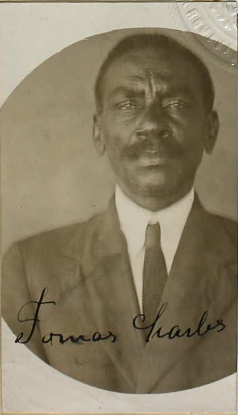
Back to the passport! So now that I had my confirmation I could accept this new branch to my tree. And with it came pictures which literally were a gold mine! I was able to look back five generations to how my ancestor's sibling looked phenotypically and also giving me a small glance into how Maria Paulina Gustavo would have looked like. 

Tomas' description in the passport goes as follows: Age: 48 years; Stature: 5 feet, 8 inches; Forehead: High; Eyes: Black; Nose: Large; Mouth: Large; Chin: Round; Hair: Black-grayish; Face: Round. And finally here is his picture!

Tomas Charles Lotin
I couldn't believe it and as I stare at the picture I still can't. If you look at my profile picture you can see that I'm pretty light, actually very light. I'm able to tan and get some color and it can be noticeable, but it takes me being out under the sun to tan. But nonetheless, a lot of people probably wouldn't believe that this was a relative of mine by blood. Yet if you look at my grandfather and then his father (Manuel Correa- who's picture is here in the blog), you'll notice that each generation further back gets progressively darker and not just 'native' darker but African darker. Also, his wife registered for a passport and his children were photographed as well so it shows another generation closer to me. Here it is: 

[Family Charles Cortes] Ines (left), Hipolito (top), Juan (bottom) and Ramona (right)   
You can also see that Ramona is much lighter than Tomas yet their children are pretty dark, Ines darker than Juan and Hipolito.

I'm to happy to have extended my Charles/Gustavo Lotin family collaterally to include 6 children in total. So far I've only found one death certificate so there's still a lot of searching to be done! I'm hopeful that I'll found some cousins along the way you can add sometime to these families. I'm just waiting for another little miracle to happen ;) 

Sunday, November 25, 2012

Sorting, Waiting and Hoping

With my sudden potential discover of a definite Martinique connection, my brain has been yelling "Full Steam Ahead!!!!" I've been searching the internet for Martinique books, websites and even videos to find an insight to what my ancestors would have gone through. David Quénéhervé recommended to me  a book titled "Black Shack Alley" written by Joseph Zobel which he says gives a good look into the life of Martinique (the book is set in the 1930s). I've found some other books which sound pretty interesting such as: "Sugar and Slavery, Race and Family", "The Diligent", and "Sweet Liberty". I'm pretty sure I'm going to buy at least 2 or maybe 3 of them to do some more in-depth reading of Martinique. I even looked into Martinican Creole or Créole Martiniquais which was really cool to look at and listen to.

With this new intense focus on my Martinique connection, I've been trying to figure out how I could learn more about Jean Charles Gustave through records. I searched in the Record of Foreign Residents, 1815-1845 but figured that the years were too far back for him to have arrived in Puerto Rico. I searched for Charles, Gustave(o), Pedro, Lotten/Lautin but found none, which I expected. In the Catalog of Foreign Residents from Puerto Rico which Estela Cifre de Loubriel wrote she mentions that Juan Carlos Gustavo was living in Fajardo in 1874, so I knew there had to be some other record available with more recent years. After typing many things into Google and trying to figure out if another register existed I was finally able to find the one I was looking for. It is known as the Register of Foreigners, 1870-1875 and is located in the Library of Congress in Washington, D.C. under Puerto Rico Miscellany. I knew that the other registry was housed there but had no idea that another set existed. I don't know if this an extension to the Cedula de Gracias or just a foreigner log but I'm excited to see it! I'm going to have to travel to Washington D.C. to see these records and I'm willing to sit the ride out to see them, I just have to figure out when to go! My hope is that there is a lot more information included in these records such as place of origin in Martinique, the wife's name (which hopefully will be written the French way), maybe some parent names, along with his signature to confirm whether or not I have the right person. Unfortunately the records are not microfilmed by LDS or NARA so I have to travel there to see the documents. 

I sit here hoping the documents will provide me new information, waiting to figure out how to plan this little excursion and sorting through all the information I have and don't have on this family. I'm excited, nervous and ready for this flood of information!

Sunday, November 18, 2012

Sparks, Sparks, Sparks A-Flyin'!!

All you need is a spark to ignite something, right? Well yesterday I received one of my many sparks, which lead me down a new road. I was conversing with fellow genealogist David Quénéhervé who has experience using Martinique records and we began to talk about my 4th great grandparents who immigrated from Martinique to Puerto Rico. You know the ones that I keep mentioning here and there and all the jumbled information I've gotten about them. Well, a link from this member may have helped me to unlock and straighten a lot of the information about at least one side of that family. The family I'll talk about is the Lotten family which is my 4th great grandmother's last name. (Remember there were some variations to the surname). He passed along a link which I'll put HERE for anyone else looking for ancestors from Martinique.

So, the website is called the Portail de la Banque Numérique des Patrimoines Martiniquias, or BNPM for short. This website has what are known as "Actes d'individualité". Simply put, they are acts of registrations which occurred after the emancipation of slaves on the island. The emancipated slaves would go into the local place to register themselves. Here a surname was either chosen or given to the person registering. David Quénéhervé told me that Pedro was a surname given to former slaves during the registration. I got nosy, however, and starting poking around typing in different names after not finding a Pedro Pedro. I tried a few names and one was the name Eglantin (both as Eglantin and Eglantine). Eglantin was supposedly my 5th great grandmother's last name in the Santa Isabel record. I came across a record of a Eglantine being registered with two other people with a common last name. So when I thought before that Eglantin was the elongated version of Lotten I was most likely incorrect and Eglantine would be the first name rather than last name of my 5th great grandmother. And here the spark would begin!

What's In A Name

The name which they were all three given was: LAUTIN! And where have we seen such a similar name? YES! Back in Puerto Rico where my 4th great grandmother used Lotten! Granted the spelling of course is different but we all know that immigration was and is never kind to foreign names. Registered were two girls: one named Pauline (hmmm... sound familiar?), and the other gave me some chills: Julienne Malvina Lotten. I internally almost shouted when I saw this! My 4th great grandmother was recorded as anything from Juliana, Julia, Balbina and I think once even as Barbara. These coincidences were overlapping too much! Julienne Malvina was born circa 1844 according to her Acte D'individualité which is possible seeing as how her daughter, (my 3rd great grandmother) was born around the 1860-1870s. What caught my eye as well was the 17 month old baby Pauline. Interestingly, my 3rd great grandmother would more times than few in records go by the name of Paulina, other times she used Octavia! Thanks to a simple search for a Pedro we've gotten some interesting stuff. [Warning: (For both myself and the reader), this could all just be simple coincidences. However, I'm choosing to believe for now that the evidence is pretty strong for there to be a connection. Things may change later on but only time will tell, for now this is just my theory.] UPDATE: I have solidified this line and these are truly my ancestors!!

Documents

Thanks to David (literally, infinite thanks to him)! Even though at the end if I find that these aren't my family members then I'll have had a good ride and learned so much about records in Martinique that I really can't complain!

So the first three are the Actes D'individualité:

Eglantine Lautin- Acte d'individualité
Julienne Malvina Lautin- Acte d'individualité
Pauline Lautin- Acte d'individualité
For the non-French speakers/readers out there basically these documents are just stating that these three women were coming forth to register themselves, rather Eglantine was registering herself and her daughters. Eglantine Lautin is the mother of Julienne Malvina and Pauline, she is from Africa and was born circa 1820s. Her daughters Julienne and Pauline were both born in Trois Bourgs, section of Rivière Salée in Martinique. Unfortunately, all three were slaves and thus no further records before this date of 21 December 1848 would exist for them. Yet knowing Eglantine is from Africa gives so much power to who this woman was and the life she would have lived.

Pauline would later pass away in 1855 at the age of about 8 years old. This for me also proves why Julienne's first daughter would be named Paulina, a memory of her young sister who sadly passed away at a young age. Julienne would be about 11 when she lost her sister and most likely shaken by having lost her only sister and closest sibling at the time. Eglantine, by 1851 had a son named Jean who would be have been about 4 by the time of his sister Pauline's died, and Eglantine would go on to have another daughter named Rose in 1858. Jean and Rose would be born free since they were born after 1848.

Interestingly enough, Pauline and her family were living in "L'habitation de monsieur Leclerc de Vièvres" in 1855. David enlightened me with the fact that in the West Indies, "habitation" was another way of saying plantation. Which would mean that Eglantine was most likely working on this plantation trying to make a living for her daughters. Earlier in 1851, they would living in "L'habitation du sieur Laroche Garnier and a few years later when Rose was born they were in living in "L'habitation de Saint Catherine Dubocage"in 1858. David tells me that since there was economic hardship throughout this time it was fairly common to jump around from place to place looking for work.

Eglantine would pass away at her home in Petit Paradis in the year 1889. Unfortunately Eglantine was written down as "célibataire" and so there is no hint to a father for any of the Lautin children. This would make sense as to why Julienne would stay with the surname Lautin from when her, her sister and her mother were registered. What I found interesting that connected was that when Martina Isabel was born in Santa Isabel, Puerto Rico in 1886, it was mentioned that Eleuteria Eglantine was still alive [...y Eleuteria Eglantin, de la misma naturaleza y domicilio, mayor de edad, vuida, y lavandera.]

Eglantine Lautin- Décès 1889
Conclusions

Are these the records of my 4th and 5th great grandmothers? Truly who knows. Until I find a record in Puerto Rico that will solidly point to Rivière Salée, Martinique or whether other town the "Lotten" family came from I'll never know for sure. Funny that this Lautin family lived in Rivière Salée and would later settle in Salinas, Puerto Rico both dealing with "sal" or salt. I hope and pray that these are them. The last name doesn't match 100% due to spelling changes but they are similar in pronunciation and I can't just whisk away the fact that my 4th great grandmother was Juliana Lotten and one of the actes d'individualité is for a Julienne Lautin. I won't know for sure right away but I'm excited about the prospect of discovering more and if these are them, then hopefully one day going to Rivière Salée to find out more about the Lautin family. [UPDATE]: These are my ancestors and I am happy that I have able to piece this all together with the help of others!

Friday, November 2, 2012

When You Least Expect It...

I took a little hiatus from searching for my ancestors after I started working and since I was stuck at home due to Hurricane Sandy I decided to give it go again. (I can't stay away from my tree for that long anyways!) I decided to glimpse through my line of potential Martinique ancestors. There's one document which I've always found extremely helpful and this time it helped me out once again. The document is the birth certificate of my 2nd great aunt, Luisa Correa Gustave (Gustavo). She was born in Salinas, Puerto Rico on the 2nd of June 1885. She is the first child born to Manuel Correa and Paulina/Octavia Gustavo at the start of the civil registry and I'm pretty sure the only child to be registered as Gustave rather than Gustavo. I've posted about the surname here and the changes it has gone through throughout the years.

Luisa Gustave being registered in Salinas, PR
I've always looked at this document because it states that her grandfather, Juan Carlos Gustavo was still alive, was from Guadeloupe and was a carpenter (I believe that he was from Martinique from all the other evidence I have). He was also listed as one of the 'testigos' or witnesses to her birth. But it wasn't until yesterday that it clicked! Most of the witnesses sign their names at the end of the certificate. Could Juan Carlos Gustavo, my 4th great grandfather been able to write and sign his name as a witness? Lo and behold, his signature was there to my surprise!! Also he signed his name the way it was before the Spanish-fication of it. Therefore he signed his name as Jean Charles Gustave.

1885 Salinas, PR- Juan Carlos' signature
Now I had a new piece of evidence that I could use. Sadly, in 1887 when his 2nd grandchild Cruz Correa Gustavo was born he was not present and neither was he for any other's birth. From the certificates, we know that Jean Charles died some where between 1885-1890 but we don't know where. I've checked Salinas where his daughter lived, my 3rd great grandmother, and he was not there. Jean Charles' wife is said to have lived in Ponce, but I haven't found her death certificate and Jean Charles also was not there.

Yesterday I decided, for whatever reason, to check the town of Santa Isabel. I decided to check the index for births from 1885-1931. There I checked for any possible Gustavo/Charles families. There I came across a birth registered as "Martina Isabel Gustavo Pedro" in 1886 and decided to check it out. Despite the fact that I wasn't aware of any "Pedro" surnames in my family I suspected that this could be a possible connection.

Martina Isabel registered along with others in 1886- Santa Isabel,  PR
When I found her birth certificate I was very surprised! The father who appeared to make the declaration of her birth was named JUAN CARLOS GUSTAVO! From Martinique and a carpenter! I was so excited to find this! But I had to keep in mind that this could be someone else, especially since it was Gustavo Pedro, rather than Gustavo Lotten (and all its variants). I kept looking at the document and found more interesting things. The wife was Juliana Pedro, also from Martinique. It also matched! Juan Carlos' wife has gone by many names and Julia/Juliana is one of them along with Balbina and Barbara. This was the first document to mention parents for Juan Carlos and Julianna, which was interesting to see.

Juan Carlos' parents according to the document were Juan Carlos Gustavo and Maria Lucia both from Martinique and had passed at the time of Martina's birth. Juliana's parents were Pedro Pedro and Eleuteria Eglantin, both from Martinique. He had passed and the mother was alive, a widow, a washerwoman, who was still alive [from what it seems she lived in Martinique still. At first I thought it said in Santa Isabel but it says in Spanish "de la misma naturaleza y domicilio", which would mean from the same origin/nature and address.] This was one of the most interesting parts of the document. Pedro Pedro most likely doubled his name or took his dad's first name (Pedro) as a surname. Eleuteria Eglantin is probably most of the interesting pieces to this puzzle. Her last name when pronounced sounds VERY similar to the name Lotten which was what passed to my 3rd great grandmother. This,  probably real last name brought over from Martinique (probably somewhat distorted from its original spelling) and worked better than Pedro. The 'Eg' part could have been dropped and when pronounced was written simply as Lotten. Feel free to write "Lantin" into French>English Google Translate to see what I mean. [I would later learn that 'Eglantin' was her first name.] Interestingly enough, I can't find Martina Isabel in the 1910 Census as well so she might have died as a child.

The Maternal Grandparents of Martina Isabel
Lastly, I decided to check for a signature! This could be the confirmation that I needed to prove whether or not they were related to my Charles/Gustave(o) line. Here are both signatures. I believe that they are the same man. Despite the small differences such as neatness and depth of the ink, etc. I believe that this is the same man's signature.

Salinas, Puerto Rico 1885
Santa Isabel, Puerto Rico 1885
Both for some reason it seems are spelled "Jeain" with the "J" having the bottom looped hook. Both Charles have the "Ch" connected then "ar" and then "les" connected. Then "Gustavo" has the same bottom looped hook in the "G" and then "gus" in connected and then "tavo" with the "o" connecting to the line beneath it. Also, notice that all three are lower case while I've seen other people capitalize their first and last name. I do believe that both of these are the same people. Also, Santa Isabel and Salinas are actually both southern towns and here you can see that they're both neighbors to one another.

Santa Isabel, Puerto Rico
Salinas, Puerto Rico
Hopefully I'll find out more about this family and keep extending this line. I would love the opportunity to be able to find where in Martinique they would have been from and actually visit the town they lived in and figure out the historic background to their lives. Of course, it might not be possible if they didn't mention where they were from in Martinique but with the records from that island I hope that hopefully it'll be possible!

Friday, October 26, 2012

A Puerto Rican look at: AncestryDNA

What seems like already a long time ago, mean while it was probably only a month ago, I ordered and sent off my spit to be analyzed by AncestryDNA. Seeing as how I've already tested with 23andme and Genetree (Y-DNA exam), I decided to try another exam as well. The price was only $99 since I had put myself on the mailing list and was quiet excited about getting my results. I activated my account and patiently waited for my results!

Activating my DNA testing kit
Adding information to my account 
The time it took to get my results back was very short! Before I knew it I had gotten an email saying that my results were ready to see. Below is the picture of my genetic ethnicity according to AncestryDNA. I was kind of nervous about what I would get!! Since I heard that a lot of people were getting very high amounts of Scandinavian percentage; also since I don't know from where exactly all my ancestors are from, I thought I would get a high amount of "Uncertain"- which occurs when your DNA comes from groups that might not be well represented in the exam for the lab to be completely sure where to assign it.

My Genetic Ethnicity by AncestryDNA
As you can see my top hit was Southern European at 37% which makes sense seeing as how I am Puerto Rican and have mostly a bunch of Spanish ancestors in my tree. Then came West African at 20% which as makes sense due to the African slaves brought in from West Africa. Then came British Isles at 13% which I find super interesting. Then Native South American at 9% which makes sense due to the natives of the island. Interestingly, some people I match with have both Native South and North American which I find interesting to have just one of them-- I wonder what that means? Next came Finnish/Volga-Ural at 9%, followed by Eastern European at 6% and finally Uncertain at 6%. 

I was quite happy with my results. Nothing seemed too off and everything fell into place from what I had known about my family's genetic background due to 23andme's analysis as well as other third party tools. I am intrigued by the Finnish/Volga-Ural which according to Ancestry's explanation comes from modern-day Western Russia and Finland. I think it would be quite funny to find a connection to Russia seeing as how I studied the language and went abroad there. In my 23andme ancestry finder I do match people with 4 grandparents born in Russia, so who knows!!

Hopefully my 6% Uncertain one day will find its way into other categories or even new ones. I'm still trying to connect with the other members who have taken the AncestryDNA exam but I haven't been able to confirm any matches yet. It's a continuous learning process and I'm excited to see what else will come of it!

Sunday, September 23, 2012

Painting A Clearer Picture

I've gotta say, I've been pretty fortunate when it comes to finding out some random things and getting clues- which then get confirmed. I guess it's because I'm young and still have the older generation around that can answer some of questions, its just finding who knows the answers and hold the key to these secrets.

For example, I was lucky to find a cousin (she actually found me through this blog) who knew where my paternal great grandparents were buried in Puerto rico and even had pictures of them. Had I decided to do this research years later, who knows what the outcome would have been.

Recently, a half grand uncle was able to confirm a line that I've been unsure of since I started researching it. This is my Correa line which I had begun to build but didn't know if it was based off the right person. This grand uncle has a brother who was able to tell me that my great grandfather Manuel Correa Rivera's father was Julio Correa- which is exactly what I had! This goes back to the post about how I ordered my great grandfather's social security application and on it were his parents' names. At the time I was unsure if it was the right man but his signature was nearly exact to the one on my grandfather's birth certificate so I ruled that it had to be the same man. And I'm so glad it was!

Interestingly though there is a tale that Julio's wife was from Spain. From what I have, Julio's wife was Amalia Rivera Rodriguez from Patillas, Puerto Rico. I asked my grand uncle whether Julio had remarried at any point in his life and he said from what he knows of no. None of the records I have point to a second wife so this tale of a Spanish woman is interesting. I wonder if he means Amalia's mother who I posted about with the weird surname of Masantini.

It was nice talking to him because he was able to tell me stories which I hadn't heard. He told me that my great grandfather left for San Juan to look for work. He ended up becoming of the first drivers of the AMA buses in Puerto Rico and stayed at that job for most of his life. Also he mentioned that Manuel and his brother and sisters were left orphaned, which I hadn't realized. Their father Julio died in 1929 and Amalia passed away in 1933. My great grandfather who was 9 at the time of his father's death was the oldest. From the looks of it they were sent to uncles/aunts to be taken care of.

He said that Julio was very tall with green eyes, trigueño (colored) and strong because he was a fisherman like many of the Correas who lived in Salinas. He said that his wife (who might be Amalia) had long beautiful hair, blue eyes and was beautiful. He said the two of them together were an elegant couple. It was nice getting a physical description of them and trying to visualize their appearance. No one mentioned a possible connection to Guadeloupe or Martinique but at the same time he wasn't raised in Salinas, so maybe he never heard the stories.

I was told that there are many cousins and family members still in that area. I would love to go and meet them and find out more about the family! It's funny how a stroke of luck can open all these doors for you. I thought I would have never been able to confirm this line since I virtually knew no one from it. Now I know of two grand uncles and many distant cousins living were the family began.