Showing posts with label slaves. Show all posts

Saturday, February 22, 2014

52 Ancestors – #8 Bernardina Sepúlveda Román (1803-1893)

I've noticed that I haven't focused too much on my ancestresses that are scattered through out my tree, so I'm going to try and make more attempts to properly include them in this 52 Ancestors series. Especially seeing as they too are a part of my ancestry!

My 4th great grandmother Bernardina Sepúlveda Román was born in Mayagüez around 1803 to her parents, Remigio Sepúlveda Montalvo and María de la Cruz Román Irizarry. Bernardina's family had been in Mayagüez for close to 200 years through her paternal line for three generations going back to her great grandfather Juan Lorenzo Sepúlveda who was born about 1685. Parts of Bernardina's family have been traced to families and towns in Spain thanks to the work of various genealogists who have come before me. Despite being born in Mayagüez, Bernardina would marry and eventually pass away in Adjuntas, Puerto Rico. Adjuntas was founded around 1815 and it is possible that Bernardina and her husband were one of the first families to inhabit and help found the town.

We know that in 1829, Bernardina and her husband José María Vélez Pérez were getting married at the church of San Joaquín – they married on the 7th of October.

Parroquia San Joaquín de Adjuntas [Wikipedia]

Bernardina's husband José María was from San Sebastián, Puerto Rico; another town found in the eastern part of Puerto Rico. They could have very likely met in Adjuntas seeing as both of José María's parents died in Adjuntas despite being born in San Sebastián themselves as well. Here is the distance between Mayagüez and Adjuntas, they might have taken a less modern route to get to Adjuntas.

Distance from Mayagüez to Adjuntas [Google Maps]

So far I have that Bernardina's marriage produced 10 children all born in Adjuntas and living in the area of Guaynabo Dulce (which will serve as an important tidbit). Eight of the ten children were daughters and interestingly I descend from one of the two sons; my third great grandfather was named José Severo Vélez Sepúlveda and he was born in 1837 in Adjuntas. I wonder a lot about the social status of these families. Seeing as how Bernardina's family has been on the island of Puerto Rico since the early 1600s I wonder if she was of a higher social caste which was mainly white and well off.

Ward 4- Guaynabo Dulce, Adjuntas, Puerto Rico [Wikipedia]


Bernardina lived well into her eighties and outlived her husband by three years. Her son and my 3rd great grandfather came forth to declare her death. What interests me most about her life isn't about what happened towards the end of it but what happened while she was in her 70s. In 1872, Bernardina Sepúlveda appears as owning 4 slaves on the Registro Central de Esclavos – a year later slavery would be abolished on the island. I was completely shocked by this when I found this out! I couldn't believe that my 4th great grandfather had slaves!! The fact that the slaves were registered in the same barrio where Bernardina lived sealed the deal for me that they were the same women. 

Listed on the registry are four slaves of various ages: The first is Lorenzo (4yrs 2mos.), then Juan (22 ys.), María Tomasa (26 yrs.) and lastly Felipa. (40 yrs.) Felipa is the oldest of the slaves and actually Lorenzo and Juan are listed as two of her children (they seem to be fathered by two different men). Felipa is listed as being 6 feet tall and as a "mulata amarilla", could be she be mixed with Taíno? Only María Tomasa is listed as "negra" while Lorenzo and his brother Juan are listed as "mulato claro". 

Lorenzo, esclavo de Bernardina Sepúlveda [Ancestry]

Juan, esclavo de Bernardina Sepúlveda [Ancestry]

Ma Tomasa, esclavo de Bernardina Sepúlveda [Ancestry]

Felipa, esclavo de Bernardina Sepúlveda [Ancestry]

What would have been their duties? Lorenzo being the youngest and listed as "growing" had no job listed but the rest were listed as "laborers", could they all have worked on land my family owned? Which I imagine wouldn't have been a big plot of land since they had only a few number of slaves? Maybe they had more and little by little gave them their freedom? Some of Bernardina's children were around the same age as María Tomasa, Juan and Felipa; were the children of Bernardina on good terms with the slaves or were they hostile and demanding of them? I wonder a lot about the moral fiber of my family and what type of people they were. Did it ever bother Bernardina that she owned slaves, did her husband agree with it? So far Bernardina is the only ancestor of mine with documented slaves that I have so far, but I imagine there are more out there in my family.

Documents can only teach us so much about our ancestors and their lives. If only we had some diaries or journals to see their thoughts about the times they lived in. We must also read about the history of that period and look at it through a nonjudgmental lens of what the people at the time thought was considered "normal". I'm not justifying slavery and never will, but many fell victims to the institutionalized belief of the system it created and knew no better (luckily there were those who fought the system!). I can neither defend nor justify Bernardina but I can only educate myself about my family's past and learn about the good, the bad and the ugly parts of it. Ultimately, that is genealogy!

Monday, December 30, 2013

A Change in the Past, A Change for the Future

I haven't blogged in a while and with the holidays being both a busy yet relaxing time, I've decided to write a post!

Recently, a day passed in December that wouldn't have meant anything special to me until recently. December 21st would have been any other day for me this year; it was a Saturday, the first official day of vacation for me and a marker that Christmas was only four short days away. Yet, this year it meant much more to me. It was the day my 4th and 5th great grandmothers were officially recognized as French citizens (or people for that matter) after receiving the surname Lautin and being freed from slavery. This year marked 165 years of freedom between my 5th and 4th grandmothers and myself.

Anse Cafard Slave Memorial - [Britannica.com]

Slavery's end came to the island of Martinique in 1848 in various stages. A decree is signed on April 27th but was only publicly announced on the 3rd of June, about a month and a half later. Guadeloupe also at this time was becoming an island free of slavery, thanks to it being a territory of France as well. Emancipation Day is celebrated on both islands in late May (the 22nd and 27th).

As the slaves became free, they were to receive last names- something which many didn't previously have since they were to work fields rather than be identified in high ranking positions. Each person was to report to registrars which had been set up in their towns in order to document the "new" people. These documents are known as Les Actes D'Individualités.

Luckily for me these documents have been placed online and I have blogged before about using these records to discover my 4th great grandmother who immigrated to Puerto Rico and her mother who was originally from Africa and brought over to Martinique as a slave. My 5th great grandmother appeared before Charles Fouchet to register herself and her two daughters, Julienne Malvina and Pauline - the former my 4th great grandmother and the latter my 4th great grand-aunt who sadly passed away in 1855. Their acts were taken on the 21st of December 1848, where they all received the last name "Lautin" most likely from Charles Fouchet himself. The previous slave owners were not surnamed Lautin but this was the surname they received for whatever reason.

Here are their Actes D'Individualités again:

Eglantine Lautin- 5th Great Grandmother

Julienne Malvina Lautin- 4th Great Grandmother

Pauline Lautin- 4th Great Grand-Aunt

I wonder a lot about my ancestors, their thoughts, their moods, their aspirations. I wonder what was running through my 5th great grandmother's mind the morning of 21st December 1848.

I imagine her raising early at the crack of dawn from having to work the fields so early after so many years. She stretches by the door of her home as she stares out onto the plantation has worked on for many years. She would take a deep breath and muster in her best French: Aujourd'hui nous sommes françaises. (Today we are French!) She would wake her daughters from their slumber, today they longer would be considered slaves but free people. Would Eglantine remember a past life in Africa when she was free and went by another name? Would she dream of returning to that land or would she look forward to her daughters' futures? Would she find this a joyous occasion or one of hard ship as she would have to look for work elsewhere now?

I am blessed to have a strong ancestress who physically and mentally prepared herself each day for the work that was to come, not knowing when it would end. This single event in history changed the future of her family and ultimately mine as well; who knows what sort of freedom Julienne would have been allowed if she would have to had live the rest of her life as a slave rather than a free woman. She probably would have never taken the journey to Puerto Rico.

Always remember those that came before you and their stories, their struggles and their lives for one day you shall join that chain of ancestors. 

Tuesday, January 8, 2013

A Year in Review: 2012

Since I wrote about my 2013 New Year Resolutions I decided to review 2012 and all of the genealogical achievements, discoveries and even unanswered questions that came with that year. That way I'll have a summed up version of all the posts of that year and can aspire to learn even more about myself, my family and their journey from all parts of the world to make me who I am today.

2012

April
  • Talked about the cousin I was able to meet through my blog. 
  • The release of the 1940 Census!!
  • Discussed the Y-DNA results I got from GeneTree.
  • Got to see for the first time the 1940 Census after its release and found some ancestors.
  • Posted about being able to visit the grave of my great grandparents (Alejandro Rivera González and Mercedes Ortiz Marrero) as well as some great-aunts. 
  • Talked about some potential slave owning ancestors in my family- Juan de Dios Marrero and his wife Rosa de Rivera from Corozal, Puerto Rico).
  • Delved into the topic of race and its perception after receiving my grandfather's 23andme results. 
May
  • Discussed the 'evolution' the surnames Gustave and Lotten went through in Puerto Rico. 
  • Posted various times about the Finding Your Roots series and its guests. 
  • Began my first series of "An Ancestor's Story Through Records". 
August
  • Discussed the possibility of "Manolo Correa Rivera" being my great grandfather Manuel Correa Rivera in the 1940 Census. 
  • Talked about 23andme's new ability to break down cousins by maternal and paternal sides. 
  • Did some research on the surname Masantini and its potential connection to Tuscany, Italy. 
September
  • Analyzed my results from DNA Tribes. 
  • Categorized and discussed the Antonetti family slaves from Salinas, Puerto Rico. 
  • Posted the second part of my "An Ancestor's Story Through Records" series. 
  • Talked about my chat via telephone with one of my great uncles. 
October
  • Looked at AncestryDNA through the lens of a Puerto Rican. 
November
  • Discovered a sister to my Gustave Lotten ancestor who was born in Santa Isabel, Puerto Rico- would lead to many new discoveries!
  • Probably the best moment in my genealogical year-- discovered documents for a Julienne Malvina Lautin, Eglantine Lautin and Pauline Lautin in Martinique which pretty much coincide with Julianna Balbina Lotten ancestor in Puerto Rico. Learned a lot about Martinique, those ancestors, and what those documents helped show. 
  • Discussed my future plans about learning more about Martinique and my ancestors. 
December
  • Talked about another Gustave Lotten ancestor I was able to find except this time I was able to find a picture of him, his wife and children due to their applications for a passport being ancestry.com. Couldn't believe my luck and considered myself lucky many-a-times. 
  • Analyzed my Ancestry Composition results through the lens of a Puerto Rican. 
  • Discussed my previously unknown connection to the Ashkenazi Jewish population. 
  • Explored my slave roots in Martinique a bit more and how I was able to find Julienne Malvina's birth record. 
  • Explored my slave roots some more but this time focused on the family which owned the Lautin women in Martinique. 
  • Talked a bit about the topic of genetic memory and its correlation to my Martiniquan ancestors. 
  • Lastly, discussed the book Texaco and what I learned from novel. 
In total, I posted 30 times last year which I think is pretty high! Its nice going back and seeing what I felt while discovering those documents and the process I underwent to find what I was looking for. I'm excited for this year to start rolling and for me to start my discoveries!!

Friday, December 14, 2012

Exploring my Slave Roots in Martinique, Part II

If you haven't read the first part click HERE to read it!

So now I had some new names surrounding Eglantine, Julienne and Pauline. In 1844, there was a Dame Lapierre, née Forget and in 1847, there was a Dame Laroche, née Lapierre. So I turned to David Quénéhervé with this new found information to see what we could figure out. David, who is so awesome, cranked out a bunch of information. He first told me I was really luckily to find these slave records (count my blessings- check! check!). He pointed out that in 1851, when Jean Lautin (Eglantine's son) was born, they were still living on a Monsieur Garnier Laroche's habitation (which I totally forgot about!). With his magic he was able to link me to the Garnier-Laroche family as well as the Lapierre family. At first it was a bit confusing so I created a family tree diagram for them to keep everything organized which I'll post up in a bit. David also found the death certificate for Jean Jacques Catherine Lapierre who passed away in 1845, he was married to Alexandrine Forget. They had a daughter named Rose Hélène Lapierre who married Louis Garnier Laroche. So here we have the two women who appeared in 1844 and 1847. The interesting thing is the death in 1845! This means that when Jean Jacques Catherine Lapierre died he left Eglantine and her daughters to Rose Hélène Lapierre and her husband seeing as how she appears in 1847 to declare the birth of Pauline Lautin. So here is the family tree diagram. I've included other information, such as parents, grandparents, years, etc. to get a better picture of this family:

Updated Famille Garnier-Laroche Lapierre Tree

So here you can see Alexandrine Forget and her daughter Rose Hélène Lapierre who appeared in the birth records of Julienne Malvina and Pauline. The Garnier-Laroche family seems to be well established in Martinique appearing in a book David Quénéhervé forwarded to me titled "209 Anciennes Familles Subsistances de la Martinique". It's in French but hopefully you'll be able to see it and poke around. The line seems to start with Thomas Garnier born circa 1510 in St. Malo (a town found in Brittany, France). Thomas and his wife Jeanne had about 8 children and one of their sons, Thomas Garnier dit Laroche born in 1648 would travel to Martinique, marry there and stay there until his death. The Lapierre side I haven't really looked into too much but hopefully I'll be able to fill in this tree a little more. Even though they aren't my ancestors their family owned Julienne, her sister and mother and so knowing about them would be a way to get a glimpse into their lives. They (at least the Garnier-Laroche) would be considered part of the Béké community in Martinique who were early French settlers in the Antilles.

The chances are high that the Garnier-Laroche Lapierre family were the owners of the Lautin seeing as how before and after the abolishment of slavery, the Lautins were living with them. I'm not sure however if they would be the original and only owners. We don't know when Eglantine was brought over a slave, maybe in her 20s, or maybe younger. So Eglantine could have been sold right away to the Garnier-Laroche family. What's interesting which David pointed out is that there might exist a record like a notary or will explaining his (Jean Jacques Catherine Lapierre's) property and the slaves he had and what went to Rose Hélène Lapierre and anyone else. Finding this would be a gold mine! Not only because it would hopefully list the Lautin but also because it might provide a clue to the father of Julienne and Pauline. Also in Julienne's and Pauline's birth certificate it mentions that Eglantine was registered under number 192, in Registry C. If only that existed!! It would be amazing to find out where in Africa Eglantine originated from and see what age she would have arrived in Martinique and whether by herself or with other family. There's so much to learn and still figure out about the Lautin family. But I'm grateful for what has been figured out already and very excited to unravel more about these ancestors from Martinique.

Église Saint-Jean-Baptiste, Rivière Salée (BNPM, Bourgade)

Exploring my Slave Roots in Martinique, Part I

Map of Martinique
Part I

So a lot has happened in these last couple of days! Hopefully this post isn't too longwinded but I want to make sure I have everything written down! So it started on Tuesday, when I figured out that the LDS center I go to, to view microfilm records from Puerto Rico, has records available from Fajardo's church. I headed downtown to see those records because I couldn't wait, there could potentially be someone from my Gustave/Lautin line being baptized in Fajardo. So when I got there I asked for two microfilms, one containing an index of baptisms around the late 1800s and another covering baptisms from the years 1860-1884. The indexes didn't yield any Gustave or Lautin children and I was a bit discouraged, but I decided anyways to check to the baptisms from 1860-1884. Luckily most of the years themselves had indexes so I checked without hesitation. The roll was running out and I was becoming discouraged. The last year indexed was 1881 and it was all or nothing. I looked under "C" for Charles just in case-- nothing. Then I looked at "G" for Gustave/Gustavo-- my heart jumped!! There was a Dionisio Gustavo Gustavo being baptized that year. It had to be my family!! I jotted down the number and head backwards to the folio (page), and there he was! Luckily he matched!


"...nombre de Dionicio a un niño que nació el día nueve de Octubre del año pasado hijo legitimo de Carlos Gustavo y Balvina Gustavo. Abuelos Paternos Carlos y Maria Merianga (Morianga) y los abuelos maternos Pedro Gustavo y Eleantina Loque..." [sic]

So here we got to see the parents which matched and got some grandparents and a new surname! So Carlos Gustavo's parents according to this were Carlos Gustavo (which another document mentioned was him as well, there is some consistency there) and his mother was María Merianga or Morianga. I'm betting the name was warped into something Spanish sounding and that isn't the original spelling as we say with Lotten<Lautin. In the Portail I found some people with the surname Mérange, so it could be something along those lines. Then for the maternal grandparents it mentions Pedro (again) except this time with the surname Gustavo and "Eleantina Loque" which looks super similar to Eglantine Lotten (Lautin). This looks like a mixed formed of Eleuteria and Eglantine which was what another document used. So to me, this is stronger evidence that it wasn't just an error! I was pretty happy with that find, bringing up the number of children from Jean Charles Gustave and Julienne Malvina Lautin to 6! Weirdly a couple of the children don't appear on the 1910 census. (Paulina, Tomás, Alberto and Valentina do appear). What happened to Martina Isabel, Dionisio and Alejandrina (she most likely died in Ponce between 1897-1910).


Unofficial "snake flag" of Martinique
Part II

Yesterday, I was looking around the website which I mentioned before called the Portail de la Banque Numérique. There, I found Julienne Malvina's, Pauline's and Eglantine Lautin's actes d'individualités. When you first open the website there is a map of Martinique with a bunch of little dots on different sections of the map. I decided to zoom in on Rivière Salée and see just what these dots meant. Some held pictures of streets, buildings, and other things in the area but the one that caught my attention said "Esclaves Commune" which held records of slaves from 1830-1841. I was excited at first to search for Julienne and Pauline and potentially find their birth certificates seeing as other slaves were being recorded. I was then saddened to see it only covered from 1830-1841 and another section called "Esclavage Greffes" from 1840-1843, I still looked around and read some of the birth certificates. Then it hit me! In the actes d'individualités, it mentions that they were living in Trois Bourgs, section of Rivière Salée. I decided to type Trois Bourgs into the little search engine in the left corner and got hits stating "Commune de Trois-Bourgs (Rivière Salée/ Trois-Ilets)- populations esclave: naissances, mariages, décès. Copie réglementaire du précédent registre¨. I was ecstatic!! The years 1844 and 1847 were there! I crossed my fingers and first searched in 1844, if I found Julienne and not Pauline I could live- Julienne was my direct line and adding another document to her would be exciting (sounds selfish, but at this point I was desperate for something)! I jumped to the back and found an index. Okay, now let's look under J. Jean Baptiste? No. Julie? Maybe? OMG! Julienne dite Malvina!!!! That's her! (That's what ran through my mind when I found her name in the index). I was so happy to have found her record. Here is her record for those francophones, or even non-francophones,who want to check it out:

Julienne dite Malvina- Naissance
I was also able to find Pauline's birth record in 1847! I was happy to see the years were so exact that I was able to find them easily, whereas in Puerto Rico there were many estimated years and dates of births, deaths and marriages-- even for whites. What's interesting is that Julienne is noted as "négresse" which David Quénéhervé (who helped me spark all this) told me that is an indicator for her dad most likely being a black man himself. So this probably means, that a man on the plantation she was born in, was her father. Probably named Pedro seeing as how that's what is being put on records in Puerto Rico. What's interesting that the person who came forward to declare her birth was "...par la Dame Lapierre, née Forget âgée de soixante quatre ans, sans profession, propriétaire de Sucrerie." So we see that the woman was married to a Lapierre and was born with the surname Forget, she was about 64 years old (born circa 1780) and was a owner of a sugar factory. Then in 1847, in Pauline's birth record we see, "...par la dame Laroche née Lapierre, âgée de quarante sept ans, sans profession, propriétaire, domiciliée dans cette commune Rivière Salée...". Hmm, so this woman was BORN a Lapierre circa 1800s  and married a Laroche. Who could these women be? Have I unlocked the family who owned my Lautin ancestors? More in another post...!

Saturday, December 8, 2012

A Puerto Rican Look at: Ancestry Composition

This week, after much anticipation and excitement the new version of 23andme's Ancestry Painting was released! This new version, which replaced Ancestry Painting, is now known as Ancestry Composition. Ancestry Painting lacked populations which only used three main populations Asian (from China/Japan), European (which I think were US-European samples), and then African (using Yoruba samples from Africa). The issue with this was that many people for example that got Asian, couldn't differentiate between Native American Asian and East/South Asian. Ancestry Composition on the other hand has 22 populations which includes samples from all around world. Ancestry Composition is still in its infancy, seeing as it how just came out a few days ago, and there will be much to sort out and update. For example, currently Ancestry Composition can only separate West African and North African. This is unfortunate for many African gene-carrying individuals like myself who have no idea where specifically in Africa their genes came from. 23andme did state that the current African cluster will be broken down further but they are running tests to make sure everything will be in order. So without further ado, here is a Puerto Rican look into Ancestry Composition! [Note: results are still changing around, so these numbers and values are only applicable right now. Things may reflect differently later on.]

My Ancestry Composition

So this is who I am; at least as of a few days ago! Percentages have gone up and down compared to the old Ancestry Painting. We see that my European is significantly lower than what it used to be (75%) and my other levels pretty much stayed the same. 16.1% of me is still unassigned which means that as more samples are collected, hopefully this 16% can find a home for itself amongst the colorful bars. As you can see there are a few tabs on top. The first one called "Map View" allows you also to see "Split View" and "Chromosome View" which I'll show in a bit. Split view only works if you have tested either both or one of your parents and Chromosome View is similar in appearance to the old Ancestry Painting. Also you can see a tab called "Global Resolution" which allows you to hone in more on the various populations which are included. Then you see my name, which you can choose to see other people you're sharing with then you see "Standard Estimate". If you click on that tab, you get "Speculative Estimate", "Standard Estimate", and "Conservative Estimate". I'm not too sure on what exactly the defining difference is between them but I'll show you images of Standard and Speculative so you can see how they differ. Now, I'll show you a more in-depth Global Resolution:

My Ancestry Composition- Standard Estimate
Here you can see various populations which can be found in my DNA. There are some interesting and some expected ones. With European you can see that I'm further broken down into Southern and Northern European, and then from there even more. So 20.1% is Iberian which is very expected and 0.5% Italian which is also sorta expected. Then I get 0.2% British and French, which is interesting since in AncestryDNA I get 13% British Isles. Also I want to point out the "Nonspecific Southern European" and "Nonspecific Northern European". These mean that segments of my DNA can be found amongst these groups yet are widely distributed amongst them that they can't pinpoint exactly which subgroup it belongs to. So there could be more British in there somewhere amongst the 19.9% but isn't specific to just the British Isles. Interestingly enough I get Ashkenazi at 0.5%, I've seen cousins in my Ancestry Finder who claim Ashkenazi Jewish roots so I knew somewhere far back I'd have to have some too. It most likely comes from old Spanish Jewish roots or maybe a Eastern European ancestor which is also very possible. Then you can see I have 16.1% Sub-Saharan African which includes all of West, Central, Eastern and Southern Africa- my ancestry from there most likely comes from Western Africa due to the slave trade. Next you can see 11.1% East Asian and Native American, with a 8.6% further divided into Native American- definitely real and most likely from my Taino ancestors (there were also Arawaks, Caribs and even Mayan from Mexico present in Puerto Rico (Mayan through labor trades), then a <0.1% East Asian which I'm guessing is just noise and then you can see 2.5% Nonspecific East Asian and Native American. Lastly, you can see 0.1% which arrives from Northern Africa. My Speculative Estimate tells a little bit of a different story!

My Ancestry Composition- Speculative Estimate
I tend to lean more to this estimate which to me hopefully fits more of my ancestry. I say this because with my Martiniquan ancestors, there should have been some French estimated into my percentages (of course, if no French ever mingled with my ancestors that could be possible as well, but in those times slaves were mistreated as well as raped). I'll let you glance at it, I don't want to make this post too long. You can see some numbers have gone up while others have gone done. But still, 100% me :) Next I'll show you the Split View option which I can see since I've test at least one parent.

My Ancestry Composition- Split View
So here you can see how I've inherited from my mother's and father's side. My mother's side gave me more unassigned as well as much more Sub-Saharan African yet less European. You can also see that the 0.1% North African I receive earlier in my Map View comes from my mother's side of the family. Interestingly, both sides gave me roughly 5-6% East Asian & Native American. Split view is an awesome option for those who might have tested only one parent or wants to figure out which side of the family gave them what. The next few shots will include different "Chromosome View"snapshots.

My Ancestry Composition- Chromosome View
So I'll begin of course with my Standard Estimate of the Chromosome View. As you can there are a ton of nice colors flowing in and out throughout my chromosomes, this is my gene's artwork. Here you can see two bars for each chromosome, except the X which I received one of from my mother. The DNA has also been phased with smoothes out a lot of the colors allowing it to flow easier instead of looking like this (the old Ancestry Painting image with spliced chunks of colors):

My Ancestry Painting 
Now I want to show you my Speculative Estimate with all the previous populations from the Map View. Here is how they change up my DNA colors:
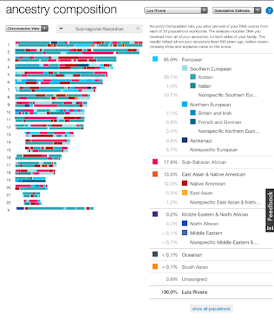
My Ancestry Composition- Speculative Estimate
Here you can see all the further divided colors and what's cool about the new Ancestry Composition is that it's a bit interactive. Meaning that if I want to see where in your DNA a certain population appears you can click on the population and that color becomes isolated while the others fade a bit away allowing you to see those pieces of your genes. For example, I did it twice with my Ashkenazi genes as well as my French and German genes:

My Ancestry Composition- Ashkenazi Population
My Ancestry Composition- French/German Population
What's very interesting is that practically one of my pairs from Chromosome 19 is practically all French/German. Interestingly none of my other family members receive such a huge chunk. Also, you can see the spread out pieces of Ashkenazi genes, one of them on Chromosome 1. Interestingly enough, I match a German/Polish cousin who has Ashkenazi genes on that same chromosome and most likely on that same spot. (I'll probably dedicate another post to that match). Lastly I want to show you my grandfather's Chromosome View with Sub-Saharan African highlighted. He is who has received genes from his 2nd great grandparents from Martinique. You can see he has received a lot of long African segments due to his relatively close ancestry with slaves.

Abuelo's Ancestry Composition- Sub-Saharan African Population
You can also see he has French/German ancestry (I want to point out this is the Speculative View which I feel is more correct to my family history). I'm no expert on DNA and genes but I'm learning a lot from these results about my family and what I carry and hopefully one day pass to my children. You can see that there are a lot of populations/ areas of the world which contribute to who I am and hopefully one day I'll know more stories of my African ancestry as well as my Native and European ancestry. Hopefully soon enough Sub-Saraharan will be divided further but until then I'm happy so far with these results! I'll keep posting about interesting finds with the new Ancestry Composition!

Sunday, November 25, 2012

Sorting, Waiting and Hoping

With my sudden potential discover of a definite Martinique connection, my brain has been yelling "Full Steam Ahead!!!!" I've been searching the internet for Martinique books, websites and even videos to find an insight to what my ancestors would have gone through. David Quénéhervé recommended to me  a book titled "Black Shack Alley" written by Joseph Zobel which he says gives a good look into the life of Martinique (the book is set in the 1930s). I've found some other books which sound pretty interesting such as: "Sugar and Slavery, Race and Family", "The Diligent", and "Sweet Liberty". I'm pretty sure I'm going to buy at least 2 or maybe 3 of them to do some more in-depth reading of Martinique. I even looked into Martinican Creole or Créole Martiniquais which was really cool to look at and listen to.

With this new intense focus on my Martinique connection, I've been trying to figure out how I could learn more about Jean Charles Gustave through records. I searched in the Record of Foreign Residents, 1815-1845 but figured that the years were too far back for him to have arrived in Puerto Rico. I searched for Charles, Gustave(o), Pedro, Lotten/Lautin but found none, which I expected. In the Catalog of Foreign Residents from Puerto Rico which Estela Cifre de Loubriel wrote she mentions that Juan Carlos Gustavo was living in Fajardo in 1874, so I knew there had to be some other record available with more recent years. After typing many things into Google and trying to figure out if another register existed I was finally able to find the one I was looking for. It is known as the Register of Foreigners, 1870-1875 and is located in the Library of Congress in Washington, D.C. under Puerto Rico Miscellany. I knew that the other registry was housed there but had no idea that another set existed. I don't know if this an extension to the Cedula de Gracias or just a foreigner log but I'm excited to see it! I'm going to have to travel to Washington D.C. to see these records and I'm willing to sit the ride out to see them, I just have to figure out when to go! My hope is that there is a lot more information included in these records such as place of origin in Martinique, the wife's name (which hopefully will be written the French way), maybe some parent names, along with his signature to confirm whether or not I have the right person. Unfortunately the records are not microfilmed by LDS or NARA so I have to travel there to see the documents. 

I sit here hoping the documents will provide me new information, waiting to figure out how to plan this little excursion and sorting through all the information I have and don't have on this family. I'm excited, nervous and ready for this flood of information!

Sunday, November 18, 2012

Sparks, Sparks, Sparks A-Flyin'!!

All you need is a spark to ignite something, right? Well yesterday I received one of my many sparks, which lead me down a new road. I was conversing with fellow genealogist David Quénéhervé who has experience using Martinique records and we began to talk about my 4th great grandparents who immigrated from Martinique to Puerto Rico. You know the ones that I keep mentioning here and there and all the jumbled information I've gotten about them. Well, a link from this member may have helped me to unlock and straighten a lot of the information about at least one side of that family. The family I'll talk about is the Lotten family which is my 4th great grandmother's last name. (Remember there were some variations to the surname). He passed along a link which I'll put HERE for anyone else looking for ancestors from Martinique.

So, the website is called the Portail de la Banque Numérique des Patrimoines Martiniquias, or BNPM for short. This website has what are known as "Actes d'individualité". Simply put, they are acts of registrations which occurred after the emancipation of slaves on the island. The emancipated slaves would go into the local place to register themselves. Here a surname was either chosen or given to the person registering. David Quénéhervé told me that Pedro was a surname given to former slaves during the registration. I got nosy, however, and starting poking around typing in different names after not finding a Pedro Pedro. I tried a few names and one was the name Eglantin (both as Eglantin and Eglantine). Eglantin was supposedly my 5th great grandmother's last name in the Santa Isabel record. I came across a record of a Eglantine being registered with two other people with a common last name. So when I thought before that Eglantin was the elongated version of Lotten I was most likely incorrect and Eglantine would be the first name rather than last name of my 5th great grandmother. And here the spark would begin!

What's In A Name

The name which they were all three given was: LAUTIN! And where have we seen such a similar name? YES! Back in Puerto Rico where my 4th great grandmother used Lotten! Granted the spelling of course is different but we all know that immigration was and is never kind to foreign names. Registered were two girls: one named Pauline (hmmm... sound familiar?), and the other gave me some chills: Julienne Malvina Lotten. I internally almost shouted when I saw this! My 4th great grandmother was recorded as anything from Juliana, Julia, Balbina and I think once even as Barbara. These coincidences were overlapping too much! Julienne Malvina was born circa 1844 according to her Acte D'individualité which is possible seeing as how her daughter, (my 3rd great grandmother) was born around the 1860-1870s. What caught my eye as well was the 17 month old baby Pauline. Interestingly, my 3rd great grandmother would more times than few in records go by the name of Paulina, other times she used Octavia! Thanks to a simple search for a Pedro we've gotten some interesting stuff. [Warning: (For both myself and the reader), this could all just be simple coincidences. However, I'm choosing to believe for now that the evidence is pretty strong for there to be a connection. Things may change later on but only time will tell, for now this is just my theory.] UPDATE: I have solidified this line and these are truly my ancestors!!

Documents

Thanks to David (literally, infinite thanks to him)! Even though at the end if I find that these aren't my family members then I'll have had a good ride and learned so much about records in Martinique that I really can't complain!

So the first three are the Actes D'individualité:

Eglantine Lautin- Acte d'individualité
Julienne Malvina Lautin- Acte d'individualité
Pauline Lautin- Acte d'individualité
For the non-French speakers/readers out there basically these documents are just stating that these three women were coming forth to register themselves, rather Eglantine was registering herself and her daughters. Eglantine Lautin is the mother of Julienne Malvina and Pauline, she is from Africa and was born circa 1820s. Her daughters Julienne and Pauline were both born in Trois Bourgs, section of Rivière Salée in Martinique. Unfortunately, all three were slaves and thus no further records before this date of 21 December 1848 would exist for them. Yet knowing Eglantine is from Africa gives so much power to who this woman was and the life she would have lived.

Pauline would later pass away in 1855 at the age of about 8 years old. This for me also proves why Julienne's first daughter would be named Paulina, a memory of her young sister who sadly passed away at a young age. Julienne would be about 11 when she lost her sister and most likely shaken by having lost her only sister and closest sibling at the time. Eglantine, by 1851 had a son named Jean who would be have been about 4 by the time of his sister Pauline's died, and Eglantine would go on to have another daughter named Rose in 1858. Jean and Rose would be born free since they were born after 1848.

Interestingly enough, Pauline and her family were living in "L'habitation de monsieur Leclerc de Vièvres" in 1855. David enlightened me with the fact that in the West Indies, "habitation" was another way of saying plantation. Which would mean that Eglantine was most likely working on this plantation trying to make a living for her daughters. Earlier in 1851, they would living in "L'habitation du sieur Laroche Garnier and a few years later when Rose was born they were in living in "L'habitation de Saint Catherine Dubocage"in 1858. David tells me that since there was economic hardship throughout this time it was fairly common to jump around from place to place looking for work.

Eglantine would pass away at her home in Petit Paradis in the year 1889. Unfortunately Eglantine was written down as "célibataire" and so there is no hint to a father for any of the Lautin children. This would make sense as to why Julienne would stay with the surname Lautin from when her, her sister and her mother were registered. What I found interesting that connected was that when Martina Isabel was born in Santa Isabel, Puerto Rico in 1886, it was mentioned that Eleuteria Eglantine was still alive [...y Eleuteria Eglantin, de la misma naturaleza y domicilio, mayor de edad, vuida, y lavandera.]

Eglantine Lautin- Décès 1889
Conclusions

Are these the records of my 4th and 5th great grandmothers? Truly who knows. Until I find a record in Puerto Rico that will solidly point to Rivière Salée, Martinique or whether other town the "Lotten" family came from I'll never know for sure. Funny that this Lautin family lived in Rivière Salée and would later settle in Salinas, Puerto Rico both dealing with "sal" or salt. I hope and pray that these are them. The last name doesn't match 100% due to spelling changes but they are similar in pronunciation and I can't just whisk away the fact that my 4th great grandmother was Juliana Lotten and one of the actes d'individualité is for a Julienne Lautin. I won't know for sure right away but I'm excited about the prospect of discovering more and if these are them, then hopefully one day going to Rivière Salée to find out more about the Lautin family. [UPDATE]: These are my ancestors and I am happy that I have able to piece this all together with the help of others!

Monday, September 10, 2012

Series I, Part II: An Ancestor's Story Through Records

The second person I decided to focus on was someone that doesn't have too many documents per se but I'm interested in her life and so I decided to include her here since it is an ancestor I discovered through documents. 

I decided to focus on my 4th great grandmother, Bernardina Sepúlveda Roman, who was born around the beginning of the 19th century in Mayagüez, Puerto Rico. She was the daughter of Remigio Sepúlveda and Maria de la Cruz Roman both also from Mayagüez. At one point in her life, probably around her 20s, Bernardina moved to Adjuntas, Puerto Rico where her children would be born. She lived the rest of her in Adjuntas until her death on the 10th of March 1893. Bernardina had married Jose Maria Velez Perez from San Sebastian, Puerto Rico who passed away three years before she did. Their marriage produced a good number of children: Maria Eugenia (1830), Margarita (1834), Ines (1836), Maria de la O. (1836),  Jose Severo (1837), 
Isidora (1840), Maria Remigia (1841), Maria Leonor (1843), and Maria Monserrate (1845) Vélez Sepúlveda*. Jose Severo was my 3rd great grandfather. 

*Thanks a member on one of the genealogical groups I'm in, she was able to help provide baptismal dates for my 3rd great grandfather and his siblings from the church's records of Adjuntas. 

The most interesting part of Bernardina's life I found by accident and was a shock because I wasn't expecting to run into it. In the latter part of Bernardina's life, she was a slave-owner. There's no way to defend it or deny it or do anything I guess except take it in. Around this time it was common practice to have slaves for domestic or labor purposes. I don't agree with slavery and hate what kind of system and treatment of humans it created but sadly nothing can be done except to educate ourselves of this dark past. 

I found Bernardina as a slave-owner while I was searching the Registro Civil de Esclavos, 1872; a registry for slaves taken a year before the abolition of slavery. I've considered that it might be someone else but it matches all of things I have of her to the "T". The same first name which I haven't seen too often as well as being in the same town, Guaynabo Dulce in Adjuntas, Puerto Rico where all her children were baptized were signs that me that this was my 4th great grandmother. 

At the time of the registry she had only 4 slaves that belonged to her. It's also interesting that she was the one who was noted as the owner rather than her husband who was still alive at the time. Maybe since the number of slaves was small see oversee them while he did something else like tend to overseeing the farm. Just as I did with the Antonetti slaves I'm going to list the names of them here except I'll add the physical descriptions attached to them. 

LORENZO: Natural from Puerto Rico, registered in the barrio of Guaynabo Dulce. Son of Ramon and Felipa. Age: 4 years 2 months. Stature: Growing. Color: Light mulatto. Hair: Black. Eyes: Black.  Nose: Flat. Mouth: Big. 


JUAN: Natural from Puerto Rico, registered in the barrio of Guaynabo Dulce. Son of Geronimo and Felipa. Job: Laborer. Age: 22 years. Stature: Regular. Color: Light mulatto. Hair: Apasado (?). Eyes: Brown (Pardo).  Nose: Regular. Mouth: N/A. 


MARIA TOMASA: Natural from Puerto Rico, registered in the barrio of Guaynabo Dulce. Son of Pedro Jose and Teresa. Job: Laborer. Age: 26 years. Stature: 5 feet 8 inches. Color: Black. Hair: Pasa (?). Eyes: Black.  Nose: Flat. Mouth: Big. 


FELIPA: Natural from Puerto Rico, registered in the barrio of Guaynabo Dulce. Son of Martin and Petrona. Children: 3- Manuel Jesus, Juan and Lorenzo. Age: 40 years. Stature: 6 feet. Color: Yellow mulatto (Mulato Amarillo). Hair: Black Apasado (?). Eyes: Black.  Nose: Short. Mouth: Small. 


As we can see, Bernardina owns Felipa along with two of her children. I wonder if the others named mentioned such as Ramon, Geronimo, Pedro Jose, Teresa, Martin and Petrona were all once slaves of Bernardina before they passed away. I wonder what kind of lives they lead. With only three laborers I can only imagine they didn't have such a big plot of land. Did they live in the same house? How were they treated? Were Juan and Maria Tomasa allowed to interact or play with Bernardina's children who were similar in age as them? Interesting that Felipa is noted as a yellow mulatto, was she part Taíno? Did Puerto Ricans use yellow to describe natives? How were things after slavery was abolished? Did they use the last name Sepúlveda and stay in contact with Bernardina and her family? Was Bernardina and her husband prominent member of Adjuntas' society?

There's obviously a lot of unanswered questions that I can not begin to unravel. Maybe they left behind a will that could lead me to more clues about their lives. Hopefully a trip to Puerto Rico will teach me more about my ancestors and the kind of lives they lived. 

Saturday, September 8, 2012

Antonetti Slaves in Salinas, Puerto Rico

So being home all day bored leads you to a lot of genealogy. So a couple of days ago, I decided to write down all the slaves the Antonetti family owned according to the 1872 Central Registry of Slaves which can be found on ancestry.com. And boy did they have a good number of slaves; 97 to be exact that were registered! It seems that these brothers might have owned some type of sugar or coffee farm/plantation which was were these slaves were keep, probably a prominent family in the area. I decided to jot down the names, where they were from, their parents' names if they were mentioned, their age, a guesstimate for the year they would have been born, their profession (which was mainly just laborer), the names of their children if they had any and their martial status (which most were single), and lastly the page they were found on.

Just a few side-notes:

  • You'll notice that some are highlighted yellow and that's because they were found on the 1910 Census still alive. 
  • The list will probably keep evolving and changing in some type of way. Whether that be including more concrete dates or names, I'll probably go back to add more details about who these slaves were. 
  • Some names appear with an "@" followed by another word. My theory is that these might be other names the slaves went by. From the looks of it, some had other names they were known by. I could easily be wrong, so if someone knows what it stands for please do tell!
  • The list is not ordered alphabetically but by who their parents were. This way the children appear together as best as they could so that I can start developing a pattern of who was who's offspring and what not. 
  • Some names might be followed by a (?), this means that the name wasn't really clear and so I took a stab at what it most resembled. 
Here's the list!


Monday, April 23, 2012

ReConstructing/DeConstructing Race

So this post was inspired by my grandfather's results from 23andme and my conversation with him while I had him taking the test.

During Spring Break, I visited my grandfather in Puerto Rico who I rarely see and built up the courage to ask him to take the DNA test. I had to semi-explain (and I say "semi-" because he was semi-listening to what I had to say) about how the exam would help me with my genealogical research. Interestingly, he kept bringing up that he was 'negro' (Spanish for black) whenever I talked about ancestry and our family. My grandfather isn't all THAT black (he does have features similar to that of an African American but a much little complexion in my opinion) and so I found his statement interesting. In many of the photos he sent his mother in Puerto Rico of himself in Georgia during his military training, he always ended with 'tu negrito', an endearing term which translates clumsily to 'your little black one'. Unfortunately, I never got to meet any of my grandfather's parents, and he only had one sister who passed away when he was younger.

Here is one picture that I have of all three of them (my grandfather, his sister and his father) below:

From Left to Right: Luz Correa (great-aunt), Manuel Correa (great grandfather),
Carlos Correa (grandfather)

I would say that my grandfather's family is probably the darkest side of my family from what it seems. My grandmother's would come second with a lot of her ancestors written down as dark, mulatto, etc. But for me what was most interesting is how we decide to construct race or even identity for that matter.

I was raised Puerto Rican in New York and it is what I heavily identify with. I'm not too sure how my grandfather was raised but he always says that he's 'negro'. Who would I be to tell him what he should say? He isn't aware of his genealogy from what I've gathered but maybe he's onto something. My grandfather's line for a long time remained a puzzle shrouded in mystery. With my recent discoveries it seems that his great great grandparents were immigrants to Puerto Rico from Martinique/Guadeloupe (I'm still trying to figure out exactly where they were from and who they were). Maybe they were former slaves looking for a better life or descended from slaves themselves? So maybe my grandfather wanted to keep their stories alive by recognizing that he was 'negro'.

As of today I got my grandfather's 23andme results, which I was super excited to see! Some of the numbers are off because since the database has only a certain number of samples, sometimes the African and Asian percentages of slightly skewed, but here they are none the less:

My grandfather's results

His breakdown by percentage

His African percentage reached 32% which is the highest I've seen so far in my family and his European is at 59% which is the lowest I've seen in my family as well. Granted, from some of the lines I've traced and have gotten helped from others, trace back to ties in Spain like most Puerto Rican families but what interests me the most are the African and Asian percentages. Could his great great grandparents really be descendants from slaves/former slaves in the French islands of Guadeloupe/Martinique? Could they have some other European mixes they are adding to his percentages (from the looks of it there might be some German mixed in there)? What are the stories they carried with them on their voyage to Puerto Rico.

I wish I could show him these results and talk to him more about his family. I image deep down somewhere he has stories he never realized where related to his ancestors. I also hope that what I've found in the paper trail is correct and adds to the story that I have so far. So back to the notion of race, who are we to say where someone fits in? I never thought of my grandfather as 'negro' but he surely does think of himself like that. Which makes me think of how I identify with Puerto Rican rather than American because of where my heritage and identity lies. None the less I'm learning a lot about family and identity through the stories of my ancestors and the paper trails and DNA they've left behind. 

Saturday, July 9, 2011

The Importance of Other Branches- Part I

When researching your family, I think it's important to research other branches that have married in. Each of them can carry a unique story that adds to your overall ancestry and can give you more of an insight to how your family and their siblings lived. The family I'm going to focus on today is Luisa Correa Gustavo but more so her husband Francisco Antonetti.

Luisa and Francisco got married on the 5th of June 1902 in Salinas, Puerto Rico. Luisa is the daughter of Manuel Correa Ortiz and Maria Paulina Gustavo, who's family immigrated from Guadeloupe/Martinique. Francisco Antonetti is the illegitimate son of Catalina Antonetti, the father is unknown but might have ties with the family Sécola (more on that in the next post). Their family history is interesting; Catalina in the 1910 Census appears as born in Puerto Rico while her parents were born in Africa. Looking for documents I found a Catalina Antonetti in the 1872 Slave Registry living in Salinas at the age of 16 as a laborer to what I believe says "brothers Antonetti". Therefore Antonetti would not/is not her original family name but from her master. Catalina is the daughter of Fabiana, who was either born in Africa or Puerto Rico and was also a slave to the Antonetti family at the same time Catalina was.

Catalina Antonetti, living in Salinas, Puerto Rico
Going one more generation back, Fabiana "Antonetti" was the daughter of Florina/Flora "Antonetti" who was also a slave at the time her daughter and granddaughter were. My guess is that Flora was originally bought by the Antonetti family, she definitely is reported being from Africa, sadly it doesn't say from where in Africa. Then either intentionally or not, Fabiana and then Catalina were born. Later after slavery ended, Catalina remained with the name Antonetti and remained in Salinas, Puerto Rico. Florina, her grandmother, later died in Talas Viejas, Salinas, Puerto Rico on October 17th 1894, having seen freedom.

Pictured below should be three generations: Catalina, Fabiana and Florina of daughters and mothers all slaves in 1872 to the Antonetti family. Note: Catalina at the time is said to be 16 while her mother is written down as 23. My guess is that the ages were not exact for obvious reasons. At the time of Catalina's death she was written down to be 125 years old which to me is exaggerated.  

Catalina as a slave to the Antonetti family, 1872.

Fabiana as a slave to the Antonetti family, 1872.

Florina as a slave to the Antonetti family, 1872.


The Antonetti family owned a good number of slaves at the time of the registration in 1872. I don't know if they have any relation to Vicente Antoneti who was from Salinas, Puerto Rico as well and was robbed by Roberto Cofresí, a Puerto Rican pirate. I wonder what were the names of the brothers so that I could research them and learn more about this family; Antonetti is said to be a name of Corsican ancestry. I also wonder from where in Africa Florina came from, many Africans were brought over from Western Africa but I wonder what country. The next best documents to look at would be to check if they were baptized in Salinas, Puerto Rico.