Showing posts with label Puerto Rican. Show all posts

Saturday, February 1, 2020

Searching My "Lamboy" Branch

In the summer of 2018, I clocked in a lot of hours looking into my Yabucoa side of the family. Discovering the church death record of my 4th great-grandfather Manuel de Santiago fortunately unlocked for me new names of ancestors to search. These searches ultimately took me from Yabucoa to the towns of Humacao and Las Piedras, and what was once a dry well of information became a well filled with new surnames, dates, and ancestors. In this maternal line, I discovered a 7th great-grandfather with the surname "Lamboy" and this is who I want to focus on today. Below you can see how I descend from Feliciano Lamboy via my mother's side of the family.

Feliciano Lamboy - 7th great-grandfather [Personal Photo]

As you can see above, my 6th great-grandmother was the last member of my line to hold Lamboy as a paternal side where afterwards it gets daughtered out, meaning that the descendants of this line changed names based on the fathers, men who were not Lamboy. Here you can see it jumps to Ramos, Santiago (2 generations), Orozco, Dávila, and finally down to me as a Rivera - this is because if most of my ancestors in this line were women.

My 6th great-grandmother Lucrecia Lamboy Rabelo/Rivera was one of many children from her parents Feliciano Lamboy and María Rabelo/Rivera (she jumps from one or the other depending on record and year). In total, Lucrecia was a part of 13 children in total from this couple (so far) and interestingly enough, her mother's death record in 1803 states that Lucrecia along with Bernarda were born before her marriage with Feliciano. Which means two things: 1) Feliciano and María married and recognized their two first daughters thus giving them the surname "Lamboy" or 2) Lucrecia and Bernarda are from another relationship and Feliciano gave them his surname to protect the girls and the family from being social outcasts. Nonetheless, here we are, searching into this line my family - only DNA will tell if we are genetically "Lamboy", and even then being 7 generations far from me dilutes the amount of DNA I would inherit from this branch of my family. 

3 generations of Lamboy [Personal Family Tree]

Why are am I so interested in my Lamboy family you may ask? 

Lamboy - ¿Español?... ¡No!

Every time I come across a new surname in my family that I haven't heard of before, I jump on INE to find out its potential roots. For example, finding the surname "Magraner" in my family and seeing that the surname wasn't too common or popular in Puerto Rico lead me to search the INE and find out the surname is mainly concentrated on the east of Spain and mainly on the islands of Mallorca. 

And so I eagerly typed in the surname, only to discover... 

Lamboy Results... Or lack thereof [INE]

There were ZERO hits! No one (currently) in Spain uses the surname Lamboy (or less than 5 in total), which means that this surname probably isn't Spanish! I'm not too surprised though, the surname doesn't really have a Spanish ring to it and the -mb- combination feels a bit weird. The surname however has another variation on the island - Laboy.

What about Laboy?! 

I decided to type in this surname variation and see what hits I would get... and again, NOTHING! With this one it's also not too surprising since it seems that Laboy probably stems from Lamboy, whether as an orthographic mistake or an intentional doing... I'm not sure. Another branch of my family has the surname "Laboy" also from the southern area of the island but I haven't been able to search that line further yet. 

So this begs the question, who were the Lamboy? Where they one contacted branch of various arrivals? Where were they from? And how did they arrive in Puerto Rico?

Breadcrumbs

Searching for the Lamboy in Humacao, I was able to start putting some information together to see how many branches there might be and if/how they interacted with one another. If there were a ton, then this name was more common than what I thought. If there were a few, then there was likely a familial relationship between them. It seems that my family was in Humacao since the town's inception and so they were some of the first settlers to arrive. Where from? Well let's see what we know!

Working our way backwards up the tree, Marcelina Ramos Lamboy (my 5th great-grandmother) was baptized in 1799 in Humacao and her godparents were Feliciano Lamboy and his daughter María Magdalena. We can assume that this Feliciano Lamboy is her maternal grandfather and María Magdalena her aunt (my 7th great-aunt). Later in 1801, María Magdalena Lamboy appears again at the godmother of Juana Ramos Lamboy, my 6th great-aunt. Lastly, she serves as madrina (godmother) of José Ramón Ramos Lamboy in 1805.

María Magdalena Lamboy would go on to marry Toribio Solís Rodríguez in May 1806, mentioning that her parents were Feliciano Lamboy deceased and María Rivera. That record confirms that María Magdalena was the aunt of all of these children in their baptism.

In Las Piedras we find that the family was here before settling into Humacao's records, finding a baptism in 1788 for Florencio and his padrinos were Juan Lamboy and Isabel de los Reyes.

Since Humacao has an index for most of their baptism records I was able to document all of the Lamboy children born within 1793-1825, similarly I was able to document deaths in the town as well. See below for the excel I created with green marking baptism records and red-orange marking death records.

Lamboy Baptisms in Humacao, Puerto Rico


Lamboy Deaths in Humacao, Puerto Rico


Many of the records point to Feliciano Lamboy and María Rabelo/Rivera though there are other couples as well and one specifically caught my eye: Vicente Lamboy and his wife Bernarda Rabelo. As you can see both have the surname combo of "Lamboy Rabelo" which makes me think that Vicente and Feliciano would be brothers while Bernarda and María were sisters, respectively. Though I have no evidence to tie them together yet I decided to explore this couple and see if they had crossed paths with my 7th great-grandparents. 

Vicente Lamboy & Bernarda Rabelo

To begin, I was able to find their marriage record in Humacao, Puerto Rico - they were married in July 1796. Notice the information about Bernarda that struck me as interesting!

Vicente Lamboy & Bernarda de Rivera - Matrimonio 1796 [FamilySearch]

In the record above you can see that Vicente Lambo[i] (first time I saw Lamboy as "Lamboi", a typo I imagine) was a native of Guayama and the son of Marcos Lamboy and Baltazara Rodríguez while Bernarda was the daughter of María de Rivera. Did you catch what I caught?!

Here you can see that Bernarda appears as "Bernarda de Rivera" while in her children's baptism indexes above she appears as "Bernarda de Rabelo"... where have we seen this before? With my own 7th great-grandmother who sometimes as "María de Rivera" and "María de Rabelo"... leading me to think they are sisters! Equally, in various records Feliciano Lamboy and his daughter Lucrecia for example appear as natives of Guayama and here we see the same thing with Vicente Lamboy. 

From there marriage I have been able to identify four children born in Humacao: 
  • Lorenza (1797) 
  • Juan Evangelista (1800)
  • María del Carmen (1802)
  • Nicolasa (1804) 

If we take a look at their godparents we get to learn a bit more about who the family was surrounded by: 
  • Padrinos de Lorenza: Feliciano Lamboy & María de Rivera
  • Padrinos de Juan Evangelista: Severino Maldonado & María Magdalena Lamboy
  • Padrinos de María del Carmen: Miguel Berríos & Estefanía Cordovés/Córdoba
  • Padrinos de Nicolasa: Juan Antonio Lamboy & Paulina Rodríguez

From the four children listed above, three have "Lamboy" surnamed godparents and two right away we can identify - the first being Feliciano Lamboy (my 7th great-grandfather) and María Magdalena Lamboy (my 7th great-aunt). 

Lorenza Lamboy Rivera - Bautismo [FamilySearch]

Juan Evangelista Lamboy Ravelo - Bautismo [FamilySearch]

The third record points to a Juan Antonio Lamboy married to a Paulina Rodríguez as the godparents of Nicolasa. I have two Antonio Lamboy brothers for María Magdalena: the first an actual "Juan Antonio" born about 1783 and the second an "Antonio Lamboy" born in 1790. The former option makes the most sense as the latter would have only been 14 years old when Nicolasa was born in 1804.

Nicolasa Lamboy Rivera - Bautismo [FamilySearch]

This Juan Antonio Lamboy (my 7th great-uncle) was born in 1783 was married in 1808 to a "Victoria" mulata libre, though no surname is mentioned their children would go to carry "Lamboy Nazario" or "Lamboy de Matos". Could he have been previously married before 1804 to Paulina Rodríguez? His marriage record doesn't mention him as a widower but we know records often make mistakes. I would have to find a marriage record prior to 1804 to prove him as the same man. 

If this is the case, this would potentially mean that Feliciano Lamboy was a brother to Vicente Lamboy and María Magdalena and Juan Antonio would have been nieces and nephews appearing as godparents for their uncle Vicente. Not further evidence is discovered I can only speculate their relationship. 

Final Clues

A few months ago a kind Puerto Rican genealogist uploaded a list of foreigners in Puerto Rico in the year 1816, though not an all encompassing list, it mentions various towns and people from other countries along with their profession. Below, we see a Vicente Lamboy listed as French and he seems to be a carpenter. Now, could this be the same Vicente Lamboy that appears in Humacao? Possible. 

Extranjeros en Puerto Rico, 1816 [Shared by Puerto Rican Genealogist]

Some records point to Vicente Lamboy as being from Ponce or Guayama, both towns in the south and though not directly neighboring towns to one another, it's important to note that town borders have changed over the years and "Ponce" and "Guayama" as we know them now are much smaller than in the past. This historic map shows us how much bigger the borders of these towns were. 

Map of Puerto Rico [Google Images]

Though Humacao's territory lies on the east, it's possible that Vicente Lamboy moved around a bit and/or was officially registered as a foreigner in Ponce. A Google search in the "Books" section provides us another clue of a "Vicente Lamboy" present in Ponce again. 

Actos de Cabildo de Ponce [Google Books]

What's interesting is that the 1816 Register mentions "French" as the origin, which is interesting to consider because in no other records does Vicente Lamboy mention French. Of course, it is possible that these aren't the same men but considering late 1700s-early 1800s in the Ponce/Guayama area... how many Vicente Lamboys could there actually be? One truly doesn't know until you've exhausted all possible theories. 

Conclusions

My current research now lies in Guayama, trying to find any clues or evidence of Vicente Lamboy or Feliciano Lamboy. Could they have been brothers or even cousins themselves? Though Ponce is still on the table, the church's records online aren't as far back as Guayama and the evidence, for now, overwhelming points more to Guayama versus Ponce. I have been able to find some Lamboy in Guayama but so far none that have matched what I have in my tree, nonetheless, it's good to see that the name is present in the town. 

For now, French seems to be the only possible indication of a place of origin and though "specific" it's quite the opposite. I have seen French refer to Haiti, Guadeloupe, Martinique, Corsica, and finally France itself. So there really isn't a clear indication to where exactly he would have been from. Maybe another more detailed registration for Vicente would hold that information. The current 1815-1845 Registry of Foreign Residents of Puerto Rico online on FamilySearch has no entries for "Lamboy" or "Laboy". Hoping to discover more in the Guayama records!

"L" Registrations for Foreign Residents, 1815-1845 [FamilySearch]


Do you have Lamboy ancestors from Guayama/Ponce?

Sunday, January 19, 2020

The Power of Names

I wanted to share this record I found while searching the Toa Alta baptism records again. In all my years of researching, I have rarely come across an entry this detailed for a slave's baptism. Four years ago, I posted "Whispers of the Past" where certain entries for slaves in the Registry of 1872 contained the name of their parents. This is first time I am seeing a church record include so much information for a slave.

Juan Luis Sandoval, negro adulto - Bautismo [FamilySearch]

Below is a transcription of the document above.

Transcription: En la Rivera de Toa Alta el día diez y ocho de mayo del año mil ochocientos y siete yo el beneficiado presbiterio Don Joseph María Martínez Cura Rector de esta parroquia de la Inmaculada Concepción de Nuestra Señora bauticé solemnemente puse oleo y crisma a Juan Luis negro adulto de diez y seis años de edad natural de Guinea en el lugar llamado Gabó, hijo de Ocai y de Gavena y a él lo llamaban Guinbi, esclavo de Doña Manuela Sandoval, fue su padrino el caballero regidor Don Juan Antonio Mexía a quien advertí el parentesco espiritual y sus obligaciones, de que doy fe. [firmado] Joseph María Martínez. 

The main information to discern from above is that on the 18th of May 1807, Juan Luis, a black adult of 16 years of age, native of Guinea from the place of "Gabó" son of Ocai and Gavena who was previously known as Guinbi, slave of Manuela Sandoval, was baptized in the church of Toa Alta, Puerto Rico.

Interestingly enough, three other slaves belonging to Manuela Sandoval are also baptized in 1807 along with Juan Luis, none of them however have as much information to them as Juan Luis. The slaves are as follows: 

Juan Manuel, esclavo de Manuela Sandoval, adulto, natural de Guinea
Andrés Antonio, esclavo de Manuela Sandoval, adulto, natural de Guinea 
Manuel Antonio, esclavo de Manuela Sandoval, adulto, natural de Guinea 

Besides stating that they were "natives of Guinea" no ages or parents' names are mentioned. These type of entries are more common amongst slaves and it's interesting that Juan Luis' entry has so much detail. 

Why only Juan Luis?

It is possible that Juan Luis was quick to learn Spanish and was allowed to share his information when baptized. I'm not sure if Manuela Sandoval was kind enough to let him share this information or if Joseph María Martínez asked him these questions himself when he was baptized. It is likely that Juan Luis was brought to Puerto Rico that year or maybe the previous year and was well aware of who he was, where he was from, and the names of his parents. Potentially even his age is maybe correct seeing as how he was the only slave of four to mention an age. This would mean that Guinbi, later known as Juan Luis, was likely born around the year 1791. 

"El lugar Gabó"

My guess would be that Guinbi was originally from the country today known as Gabon (Gabón in Spanish). From my understanding of the 17-18th century slave trade, most of the western area was known as "Guinea" and so it included various countries that today are: Guinea, Equatorial Guinea, Gabon, Ghana, Togo, Nigeria, Cameroon, and various islands and other countries as well. A map of the times gives us a better idea of the extension of this area known as the "Gulf of Guinea". 

Map of the Gulf of Guinea, 1740-1749 [Bibliothèque Nationale de France]

Unfortunately, this is the closest we are to knowing where Guinbi was from, no town is mentioned and the fact that his baptism includes the actual country and his parents' names is a feat in and of itself.

Guinbi, son of Ocai and Gavena

Since we are dealing with Spanish orthography, we are not sure the correct or accurate spelling of their names. For example, the "u" is used after the "g-" in Spanish but this might not be the case in other languages, the "n" might be a "m" giving us something like Ginbi or Gimbi. His father's name might take a "k" instead of a "c" and the "a" might be a more "e" sound, something along the lines of Okai or Okei. Lastly, his mother's name could take "b" instead of a "v" since Spanish doesn't distinguish the two giving us Gabena. And who's to say these weren't short versions of longer names as well! 

The three main indigenous languages in Gabon are Fang, Mbere, and Sira - all being Bantu languages. I would imagine their names fall under one of these languages but of course there is always the possibility it doesn't. An ethnographic and linguistic analysis of these names and cross referencing other sources of the time which help to distinguish African names in Spanish orthography would be helpful to discover their Gabonese names.

Conclusions

It would be interesting to follow Juan Luis' life and see what became of him in Puerto Rico. How long did he stay enslaved? Does he end up marrying and having children in Puerto Rico? Does he have descendants out there? If only these type of detailed records existed for all of our enslaved ancestors! 

Tuesday, December 31, 2019

Reflecting on my Genealogical Goals of 2019

Time sure does fly! It feels like only yesterday I was setting up genealogical goals for 2019, and yet here I am December 31st, 2019 - ready to close out the year! Similarly to last year, I wanted to take some time to reflect on my goals for the year 2019 and see how far I've gotten. If you're interested in my past goals of 2018 - here's the link! Also like last year, I will be answering each goal with "yes", "some" or "no" and explaining where I am with those goals.

Genealogical Goals of 2019

On a recent trip to Puerto Rico in March, I was fortunate to have visited extended family in Lares, Puerto Rico - the town my Avilés ancestors lived in. Not only did I get a chance to see where my 2nd great-grandfather lived most of his life and some of his lands, but I was also able to meet two men who are direct descendants of my Avilés line. However, this line is said to be "Magraner" and not "Avilés" because my 2nd great-grandfather was born out-of-wedlock, said to be the son of Damián Magraner Morell from Sóller, Mallorca. Their haplogroup falls under one of the most common for European men so no close hits yet. Hoping more will come of these results soon! 

2. Add on my Rivera and Correa lines to FTDNA - Yes
I've recently posted this month about upgrading my Correa line and the current finds the line has... so far there might be some potential Sephardic Jewish origins in this line - hopefully more discoveries to come. I've also added my Rivera line but nothing interesting there so far, currently I have the possibility to upgrade to Big Y-700 for my line and currently considering it though I don't know what will come of it.

3. Continue to learn about my Correa family - No
Besides learning a bit more about my Correa family via DNA, I haven't been able to learn more about my family through records. I've scoured the records in Coamo and San Juan as well as nearby towns but nothing yet. I've also looked at the Carcaño branch and found some other people with the surname in towns near San Juan but I'm also stuck there as well. Hopefully this wall will come crashing down soon!

4. Visit the Archivo Diocesano and AGPR to attain testamentos and dispensas de matrimonio - Yes/Some
Though I was able to find information about my family from both the Archivo Diocesano and the AGPR I placed it under "some" as well because I know that there is probably much, much more to research in both archival places. For example, I was able to find dispensas for cousins marrying in Maunabo that I had no idea about - all related to the Martínez branch of my family that came over from Guayama. This goal is also hard to accomplish within one year because time is limited while I'm in Puerto Rico and there are so many files to search as well.

5. Begin to interview family members - No
I feel like I'm going to beat myself up for not starting this sooner but I need to get on this! My goal is to record older family members talking about their lives and our family and create a digital bank of voices and information before these people are gone. I need to think this goal through next time I am in Puerto Rico!

6. Push all my lines into the 1700s - Some
The generation between my 4th and 5th great-grandparents' would be the branches that be able to reach the 1700s. So far on my paternal side there are many branches that have reached the 1700s, the ones currently stuck at my branches from Corozal and San Sebastián. On my maternal side, my Patillas, Morovis, Vega Baja, and San Sebastián sides of the family haven't been explored into the 1700s - 3/4 of these towns don't have church records online which halts me from exploring deeper into their lineage. I heard Corozal, Morovis, and Vega Baja are becoming available in Puerto Rico via La Sociedad Genealógica de Puerto Rico while San Sebastián hasn't allowed any organization to digitalize their records.

7. Continue reading books about genealogy - Yes
This year I've been fortunate to have read a lot of books but out of the books I've read so far, not many have to do with genealogy. So far I have read: "The Man Who Stole Himself: The Slave Odyssy of Hans Jonathan" by: Gísli Pálsson, a book about a mulatto man from St. Croix who ends up in Iceland via Denmark (worth the read!), "She Has Her Mother's Laugh: The Powers, Perversions, and Potential of Heredity" by: Carl Zimmer, this book was a bit more intense because it dealt a lot with the science of DNA but it was definitely an interesting read. I also read "1491: New Revelations of the Americas before Columbus" by: Charles C. Mann, definitely was an eye-opening book to what life was like in the Americas before the arrival of the Europeans, and "Inheritance: A Memoir of Genealogy, Paternity, and Love" by: Dani Shapiro, which was a very interesting book about a woman's journey of who her biological father is post-DNA testing. So out of 19 books read so far 4 were related somehow to genealogy which isn't too bad. I also read "The Coming" by: Daniel Black and "My 15 Grandmothers" by: Genie Milgrom but the former was more of a historical fiction narrative of a slave's journey through the Middle Passage while the latter was about researching your Sephardic ancestors and I wasn't able to pull too much information for myself, if I count these books this would be 6 books about genealogy!

8. Take a genealogy course - No
For monetary reasons, I decided to hold back on this goal this year but I'm hoping sometime next year or even 2021 to register myself and take a genealogical course. Though so far the courses I've found are not really geared to the Caribbean/Latin America, I figured it's better to start building myself a genealogical resumé which includes a variety of courses. This will give me some more "seriousness" as I continue to make a name for myself as a genealogist.

9. Get savvier with the use of DNA results - Yes/Some
With the use of DNAPainter I have been able to identify pieces of DNA that I share with African Americans with no known connection to Puerto Rico and recently thanks to MyHeritage and AncestryDNA I was able to find genetic connections to Guadeloupe. I'm hoping that this goal extends itself into the next year and I can find out more about my connection to Guadeloupe. I also say "some" because I would like to learn more about Y-DNA testing and how to read more into my results. For example, I recently upgraded my Correa Y-DNA to Big-Y700 and I would like to be able to read more into the results myself.

10. Build stories around my factual evidence - No
Though I set up this goal, I'm not sure exactly how to go about it. Though Ancestry builds a "LifeStory" for your ancestors' lives, it doesn't necessarily touch upon facts based on your country, for me this would be facts from Puerto Rico. For example, one of my ancestor's story shows a fact about the American Revolution and the Declaration of Independence which doesn't really have to with his life in Puerto Rico, especially since this time it was a part of the Spanish crown. I need to figure out a way to build facts about my ancestors - maybe creating some sort of timeline with important Puerto Rican facts based around towns and the island's history and seeing where my ancestors fall within that timeline.

This year also marked for me my 200th blog post, as well as 8 years of blogging and 15 years of genealogy which is definitely a lot of time dedicated to this obsessive hobby! In a few days I hope to create new goals for 2020 and explain why I want to follow this goals! Stay tuned and Happy New Year! 

Sunday, December 1, 2019

A Puerto Rican Look at: Y-DNA111 (Correa)

Like my Avilés/Magraner line, I tested my Correa Y-DNA line while I was in Puerto Rico, this time with my maternal grandfather. Though I originally tested this line at Y-DNA67, I have upgraded the line to Y-DNA111 on FTDNA and with the recent Thanksgiving sales I have finally upgraded the line to Big-Y 700. The results will take a while to upload, especially with what I can only imagine are a bunch of people taking advantage of the sale. So I figured I would write about what I know at this level and see what else comes from the upgrade.

CORREA - SURNAME ORIGINS 

Though I have posted about the Correa surname before (post here and here). I'd figure I cover this quickly again to tie it into the genetic understanding of this line. The Correa surname comes to me via my mother and her father, and from there runs via the paternal line up to the 1700s. This is what the paper trail has shown me at least, remember that there is always the possibility of a NPE (Non-Paternity Event) which are usually not traced on paper. Below you can see me, Luis, at the bottom and my line all the way until my 6th great-grandfather Juan Francisco Correa (I have blurred of people who are still alive).

9 Generations of Correa [Personal Photo]

In an ideal genealogical world, this would mean that my Correa cousins and any other male Correa tied to this line would all descend genetically via their Y-DNA from this same man. Matching other Correa men would help attest to this, but unfortunately so far there haven't been other men in my family or relatives that I know who have tested. Y-DNA testing (and rightfully so due to its cost) is something more serious geneticists/genealogists use to trace lines that either ran dry via paper-trail, experienced traumatic events such as slavery, the holocaust, wars that disconnected them from information, and/or was adopted and not sure of their origins. I personally have not tested all of my Y-DNA possible lines, especially since I would have to find distant males cousins to test for lines that have "daughtered out". So far, I have tested my own Rivera line (since I wanted to know more about it since it's a common surname), my maternal Avilés line (said to be tied to Mallorca via a NPE), the Charles line (arrived to Puerto Rico from Guadeloupe and was previously enslaved), and my Correa line (surname interest/since the paper trail ran out). 

When I mean surname interest, I have always been interested in this name for two reasons. 1) It's not that common of a surname in Puerto Rico, though there is always the mention of Capitán Antonio de los Reyes Correa it's not a surname I often hear when I meet other Puerto Ricans, and 2) I have always heard that the surname is tied to Sephardic Jewish origins in Spain. 

The surname for example appears in Amsterdam via Isabel (Rebecca) Correa, a famous Dutch Sephardic poetess who was born in Portugal.

Isabel (Rebecca) de Correa [Jewish Virtual Library]

It has also appeared amongst those tried for "judaizantes" ("Judaizers") during the time of the Spanish Inquisition. A quick search of Correa + Inquisición gave me various hits. 

Tribunal de la Inquisición en Llerena [PARES]


Tribunal de la Inquisición en Llerena [PARES]

Does this mean that my own Correa family were Jewish as well? Not necessarily but the genetic information is interesting to add. Let's see what my grandfather's genes say about this line!

CORREA - GENETIC ORIGINS

When I got the autosomal and haplogroup results for grandfather on 23andme, I was very interested since it seems that his haplogroup isn't that common amongst men in their database/that have tested. So I wanted to see what it would be like in FTDNA.

FTDNA Landing Page [FTDNA/Personal Photo]

My grandfather's haplogroup is current listed as "J-Z18271", this name is expected to change once I get my Big-Y700 results - expected to arrive sometime in February. Below you can see where this specific SNP (Z18271) has been found in Europe. This specific branch can be found in various parts of the world, but it's interesting to note that it's mainly found amongst Eastern European countries. This is a very different result than expecting to find many "genetic cousins" scattered amongst the Iberian Peninsula and other parts of western Europe.

SNP MAP [FTDNA/Personal Photo]

CORREA - HAPLOGROUP ASSIGNMENT

The main haplogroup my grandfather belongs to is "J" which you can see how it got into Europe below. Further below is an image of my specific haplogroup for my grandfather as well, currently at Y-DNA111.

Migration Map [FTDNA]


Correa Haplogroup [FTDNA/Personal Photo]

This group has its origins mainly in the Middle East amongst the Arab and Jewish populations. This was interesting to me taking into consideration the Sephardic Jewish theory of this surname. Remember that genetics predate current religious, political, geographic divides. It is possible that somehow my Correa family was a part of the Arab/Morsico or Jewish/Sefardí population in Spanish which was later pushed out during the reconquista. It made it's way into Puerto Rico where it has been present for the last 300 years.

Some research places the haplogroup amongst the "Kohanim" or Cohen branch of Jews, which is the "priest" class. If this is the case for my family, this would obviously be very far back and probably not in recent times, though it would be very interesting nonetheless! My family has likely been Christian/Catholic for at least the last 300 years while in Puerto Rico. Since I haven't been able to trace them off the island yet, I am not sure what their history and religious practices were before arriving to Puerto Rico.

J-Z18271 Branch [GenoGenea]

GENETIC MATCHES

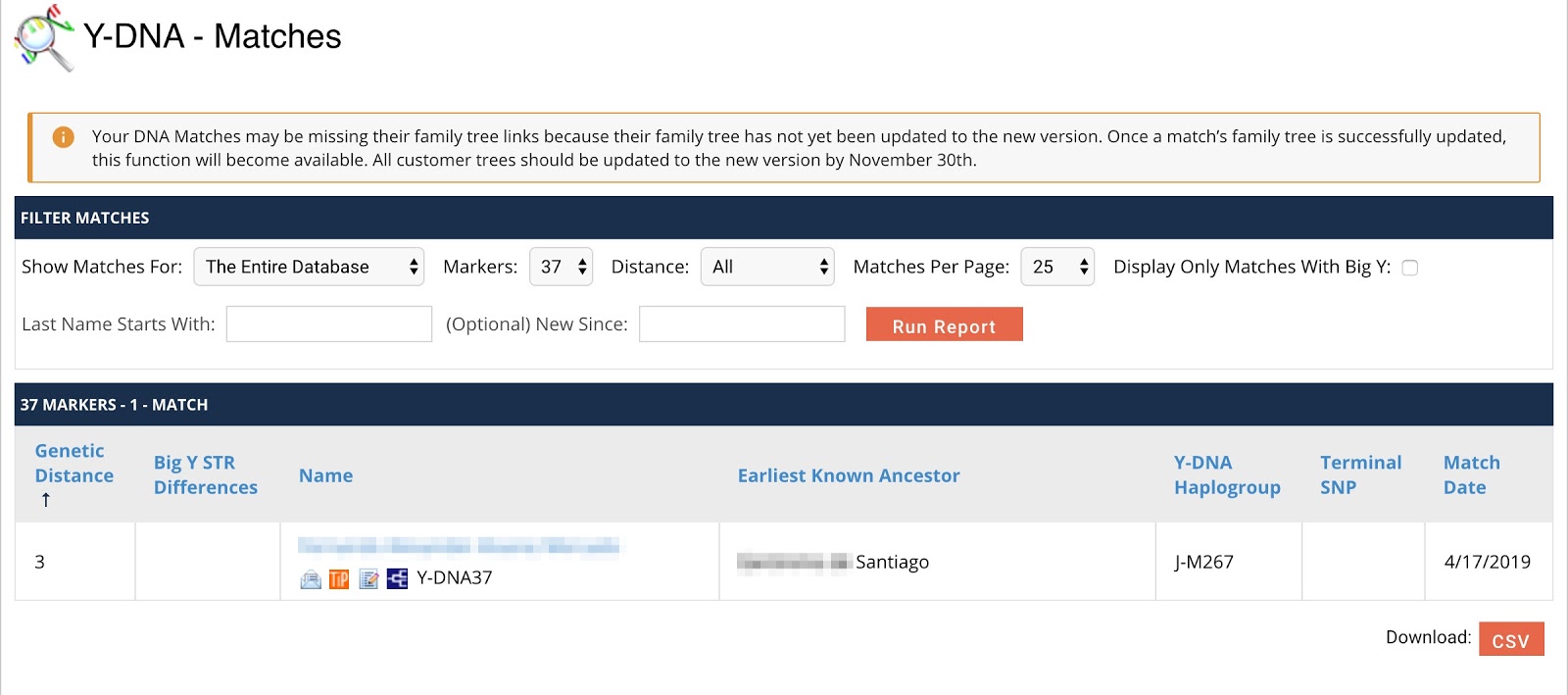
Currently, I have one match from the entire database of FTDNA for my Correa Y-DNA111 test, and it's a genetic cousin who shares another line with me, so it was interesting seeing him match me on the Y-DNA level on another completely different line as well. As you can see the surname for his earliest ancestor is not "Correa", if not "Santiago". So somewhere along our lines there was a NPE, we're not sure who's line it comes from but we're thinking it might be his. Currently, this cousin is tested at Y-DNA37 so their haplogroup isn't as specific as mine. The genetic distance is 3 meaning that our relationship is further back in generations, but I'm not sure if this distance "closes" once they upgrade their Y-DNA test.

Y-DNA Match [FTDNA/Personal Photo]

CONCLUSIONS

I'm hoping that upgrading the test will give some more insight into whether it's more likely to be Arab or Jewish in origin. I have been in contact with some of the administrators of the FTDNA project I am a part of via my results in the J haplogroup. They are also interested to see what comes out of this result since I don't match many other people. This is very fascinating for me and definitely something I am learning along the way with. I'm not super well-versed in Y-DNA analysis so learning via my multiple accounts has been pretty helpful! Hoping my results come faster than I expect!

ARE YOU A CORREA FROM PUERTO RICO? 

HAVE YOU TAKEN A Y-DNA TEST? 

Wednesday, September 25, 2019

A Puerto Rican Look at: Ancestry's "MyTreeTags"

A bit earlier on in the year, around spring/early summer, Ancestry released "MyTreeTags" which can be added to your ancestors in your tree. Hyperlinked above, you will find how to set up the tags and the different types that exist already. Another feature of the tags is that you can create your own "custom tags" which you can make and define to your liking. In this post I want to highlight some of the different ways I've used the MyTreeTags in order to build out specific aspects related to Puerto Rican genealogy. Definitely feel free to play around with the tags and create your own that may fit the specific needs of your tree.

Ancestry's MyTreeTags

When this feature was initially released, I was a bit hesitant in its use. I knew my family pretty well as I work on genealogy basically everyday and so I wondered how it could help me. So I decided to explore some of the pre-designed tags (some pictures below). The tags are broken down to various categories, for example: DNA, Life Experience, Research, and Relationships.

MyTreeTags - Research [Ancestry]

MyTreeTags - DNA [Ancestry]

Right away "actively researching", "brick wall", and "immigrant" stood out to me. These were tags that I could easily attach to some of my ancestors. My Correa ancestors were definitely under the list of actively researching and brick wall while my Guadeloupean, Martinican, and Mallorcan ancestors fell under immigrant. Here's an example of how the tags look on an ancestor's profile, below I've marked my ancestor with two preset tags created by Ancestry.

My 5th Great-grandfather, a brick wall I'm actively researching [Personal Ancestry Tree]

However, these were facts that I knew pretty well - so I thought, how can I make these tags work for me personally? I tried to think of tags that would make sense for my family and aspects that were important when it came to genealogy when suddenly it clicked (hint above). Why don't I create tags that track race and social statuses in Puerto Rico? 

Creating My Own Personal Tags

MyTreeTags - Custom Tags [Ancestry] 

As you can see above I've created the tags: Blanco, Español, Pardo, Slave, Slave Owner, and Twin. Forgive my Spanglish creations, at some point I'll probably switch them all to Spanish as most of my notes on my tree are in Spanish to match documents. The "race" tags reflect what was written on the documents, for example blanco or pardo seem to be the main two I've found so far through my tree. "Negro" hasn't really appeared in my documents besides my ancestors that came from the French islands of Martinique and Guadeloupe but I've categorized them as "slave" since I know both had served as slaves on their respective islands. Below is another example of a custom tag and a preset tag, my 4th great-grandmother Julienne Lautin was an immigrant from Martinique who had previously been enslaved until 1848, she would have been four years old when she received her freedom.

My 4th Great-Grandmother from Martinique [Personal Ancestry Tree]

On the other hand, my 7th great-grandfather Manuel Ruiz had been a slave on the island of Puerto Rico but was listed as 'pardo' on his documents. Linked above is the post about how I traced his enslavement on the island. Below you can see an example of two custom tags on his profile.

Manuel Ruiz, Pardo slave in Puerto Rico [Personal Ancestry Tree]

What's cool about the tags is that you can search in your tree for everyone you've tagged with that specific phrase/word. So for example, if I wanted to see who was enslaved in my family, I could search 'slave' and retrieve a list. Below, you can see a few of my direct ancestors who were slaves at some point of their life. 5 of these 6 ancestors were from outside of Puerto Rico while Manuel Ruiz is currently the only slave I've traced in Puerto Rico. I know there are probably more slave ancestors hidden somewhere in the mid-early 1600s in Puerto Rico but I have yet to identify them.

MyTreeTag - Slave [Personal Ancestry Tree]

Another tag I've created is "Español", this tag is reserved for ancestors who themselves immigrated from Spain to Puerto Rico. Recently, I discovered my 6th great-grandfather Dávila ancestor who came from southern Spain, and thus I tagged him as "Español". Also, my 3rd great grandfather Damián Magraner is also tagged as "Español". 

6th Great-grandfather, Spanish Immigrant [Personal Ancestry Tree]

Finally, another interesting tag I've created is "Slave owner". I don't have many of these in my tree but it is important to know who owned slaves as it influences the narrative and story of my ancestors. One specific ancestor is my 4th great-grandmother who owned slaves in Adjuntas, Puerto Rico. Discovering this information allowed me to better understand her life in the late 1800s in Puerto Rico and how her own mother (my 5th great-grandmother) also owned slaves thus leading me to find her last will and testament. 

4th Great-Grandmother, Slave Owner [Personal Ancestry Tree]

What's next?

As I continue to learn more about my family, my goal is to continue creating tags that will allow me to quickly identify facts about them that might not be obvious from their biographical information. Some of the tags I've recently added include, for example: "twin" and "triplet" as I've had a couple cases of twins and one case of triplets in my family. There are some pre-created tags for DNA such as "common DNA Ancestor", "DNA Match", and "DNA Connection" but I'm not sure if I want to use those yet. We'll see how these keep developing and how I can seamlessly incorporate them into my tree. 

Do you have any special tree tags you've created? 

Thursday, July 4, 2019

My 200th Post- 8 Years of Blogging, 15 Years of Genealogy

July 4th, 2019 marks 8 exact years since I began blogging. It all started when I was 21 years old and home from college over the summer. I was inspired by Cece Moore who runs Your Genetic Genealogist and has become a common name in the genealogist household with all the work she has done with DNA, adoptees, and even working on "Finding Your Roots". In June of 2011, she herself had completed her first year of blogging and so I decided to trace my own family via a blog as well. Who would have thought that 8 years and 200 blog posts later, I'd still be on this journey!

Though I don't have many official followers for my blog (as I haven't dedicated myself full-time to running it/putting it out there), I really started doing this for two reasons:

1) Personal Motives - To keep track of my own progress, hurdles, difficulties, breakthroughs, and as of recently analyzing my DNA in conjunction with my paper trail/genealogical searches. In a sense it would serve as a digital journey for which I could refer to and keep track of my finds and brick walls.

2) Visibility - While initially researching my family, I hadn't found too many blogs that covered a wide range of Puerto Rican topics in regards to genetics and genealogy and I ultimately wanted to be a contributor in order to make Puerto Rican Genealogy more visible. There is a big misconception that genealogical records from Puerto Rico have been burned, lost, or destroyed by hurricanes and people give up without even realizing all of the amazing resources available for Puerto Rican research there are out there.

5 years ago, I posted my Post #100 and I actually really liked the style I wrote in so I think I'm going to mimic it for Post #200! Feel free to read post #100 to compare and contrast now that I have 100 more posts and 5 more years added!

What I've Learned

My first blogpost was titled "What Started it all - Part I", where I write about the typical Puerto Rican love story of a "Spanish man" and a "Taíno woman" who had fallen in love in Lares, Puerto Rico - my 2nd great-grandparents. By the time I had written that post I had about 7 years of genealogical research under my belt but I had only just begun to scratch the surface of research. There were many doubts about my tree and definitely many, many ancestors' names yet to be discovered. When I began at the age of 14 there were no known (to me) family trees out there, none created by my grandparents, uncles/aunts, parents, or cousins. All I knew at the time when I began my tree were 2 out of 2 parents, 4 out of 4 grandparents, 6 out of 8 grandparents, and 7 out of 16 great-grandparents - though it's a little, it's also a lot compared to what some people start out with.

My First Blog Post - July 4th, 2011 [Personal Photo]

I've been very fortunate that since I started my research and blog I have come pretty far with my pedigree, which I am both fortunate and blessed to have. Various of my lines reach the early 1700s with a few reaching the 1600-1500s and very few the late 1400s when they came over from Spain. A few lines stop at the 1800s due to the lack of records for slaves - these being my lines from Martinique and Guadeloupe. However, "Rome wasn't built in a day"! It's been 15 long years of painstaking research where I have put in literally thousands of hours to search for my ancestors. I have been blessed to be able to travel to Puerto Rico to continue my searches various times, as well as traveling to Mallorca to research my ancestors. I have also been able to visit towns in Spain where my ancestors lived/were from before heading to the New World. Recently, I have been able to continue to test various family members with DNA and across various companies to help triangulate and find new information about who we are on a genetic level.

I've linked above and below various posts to the different themes I've discussed over the years! 

Advances in Genetic Testing

There have been many advances in genetic testing since I first started researching my family, to believe when I first tested with 23andme back in 2010 the cost was somewhere near $600 for one single DNA test! Nowadays, genetic DNA testing has become much cheaper and fairly accessible to many, not only here in the US but in various other countries. Here are some of the more recent posts that highlight these advancements throughout the years. 

My Favorite Discoveries

Since 2014, there have definitely been some exciting finds! These discoveries are a combination of things: from DNA testing, finding new genealogical documents, to discussing/receiving help from other genealogists. There were a wide range of discoveries made, from very intimate ones to discovering my Dávila line's origin in Spain in the 1700s. Listed below are some of the recent discoveries I've been able to make! 

Words of Advice

I would tell myself keep doing what you're doing! I have come a long way since my initial searches and there is still a lot to find out! Researching my family has brought me much closer to Puerto Rico and my identity as a first generation mainland American born citizen. To those of you budding genealogists - it's never too late! Ask family members questions, document what they have to say, and search online to see what you can find. If you're interested in genetic genealogy - test those family members (with permission, of course!) who might be willing to help you learn more about your family's past.

Hopes, Dreams & Aspirations


Reading my post from 2014 it was interesting to see where I was amongst my hopes and dreams for genealogy. There are some I have been able to check off and some that are still on my genealogical "bucket list". For example, being able to travel to Puerto Rico and go around the island to discover the towns, barrios my ancestors lived in, and the churches my ancestors would have married in. I have been fortunate to travel to distinct parts of the island and as of recently meet cousins in Lares, Puerto Rico. I have also been able to travel to Mallorca which was amazing. I still haven't become a professional genealogist, though I'm sure there is still plenty of time and I also haven't been able to travel to Martinique and Guadeloupe yet. I haven't brushed up on my French though hopefully that is in the works and I am still interested in bringing genealogy to my everyday life and profession.

I still dream about connecting Eglantine Lautin to a certain country/tribe in Africa and it would be amazing to have DNA cousins that confirm my ancestors are connected to Martinique and Guadeloupe (I have one potential lead with a cousin but nothing solid yet!). I also want to continue collecting stories and record them to have a digital audio database of stories from my current living family members that I could look back on years from now and listen to. A genealogist's work is never done as you can see!

Here's to 2024 when I complete 20 years of genealogy! Let's see what's in store! 

Wednesday, June 19, 2019

A Consanguineous Family: The Martínez of Guayama/Maunabo

Earlier in the year (a few months ago actually), while I visited Puerto Rico I made sure to revisit the Archivo Diocesano in San Juan. Here, my goal is always to try and find marriage dispensas (marriage permissions) given to my ancestors who needed permission to marry cousins of varying degrees. This specific time I was searching for my 4th great-grandmother's marriage record who in Maunabo, Puerto Rico married for a second time on the 19th of July 1860. Her name was Dorotea Ramos Martínez and her second husband's name was Manuel Ruiz Soto. I was interested in finding out more about Dorotea and potentially finding how she and her husband were related.

Matrimonio - Dorotea Ramos Martínez & Manuel Ruiz Soto [FamilySearch]

Searching through the 1860 marriage dispensations of Maunabo I found no mention of Manuel and Dorotea. There could be a few reasons for this: misplacement of the dispensation, it was never actually registered, damaged and tossed, etc. However, I came across the surname Martínez on various dispensations. Since I couldn't find my ancestor, I decided to invest some time looking at these Martínez dispensas a bit. Interestingly enough, I discovered that each of these marriage dispensations all tied back to a family I had in my family tree. Out of the four dispensas in Maunabo with the surname Martínez I had located - all of them tied back to my 6th great-grandparents José Martínez and Águeda de Soto. In this post, I will explore this family's migration, connections, and a theory of consanguinity.

Origins

My connection to José Martínez and Águeda de Soto comes to me via my mother's side of the family. Their daughter, Andrea Martínez Soto, was born in Maunabo in 1804 and the next five generations would live in the Maunabo/Yabucoa area - meaning my family lived in this area at least 145 years! Andrea is only one child of the 13 that I have been able to identify for this couple - sometimes José appears as José Antonio, since I don't have a baptism record for him I haven't been able to confirm his full name though seeing as how the wife constantly appears as "Águeda de Soto" (sometimes just as 'Soto') I think it's safe to assume this is the same couple. Andrea is also not the first born of the bunch, she had a few siblings come before her. It seems that the family has its origin in Guayama based on some baptism records I was able to find, the earliest being in 1795 of their son Felipe Martínez Soto. Another son Pedro Martínez Soto is estimated to have been born in 1792 but so far I haven't been able to find a baptism record for him.  

Later, in 1804 Andrea was born in Maunabo. This means that around that 9 year gap the family was either in Guayama or Maunabo or even in Patillas, a town located between the aforementioned towns. Based on the older map I found of Puerto Rico, you can see that the towns were divided up differently and thus the borders of what was once Guayama are different than what they are today. A few other records help us narrow down where they were and when - For example, in May of 1798 José Martínez and Águeda Soto served as godparents to a child named Marcelina in Guayama, while in December 1801 they were godparents to a child named Saturnino Güisado in Maunabo. 

Family Migration - Guayama to Maunabo [Google Images]

Our timeframe for their move has now shortened to between May 1798-December 1801. This is why documenting other events that occurred in the lives of your ancestors is important, thanks to their service as godparents I can more accurately predict where certain children might have been born!

Family Structure

Through my searches, I have been able to identify 13 children so far for my 6th grand-grandparents, which for the early 1800s isn't too surprising. Attached below is a chart for all of the children of this couple, they include: Florencia, Felipe, Pedro, Justa, Fabiana, María, Victoriano, Andrea, María 2º, Fermín, Hermenegildo, Cipriana, and Juan Martínez Soto. María (1802) and the rest of her younger siblings were born in Maunabo while her older siblings were probably born in Guayama. Fabiana who is guesstimated to have been born in 1798 falls within the cusp of years around their move.

Children of José Martínez and Águeda de Soto [Personal Photo]

I'm not exactly sure however when many of these children died or even when José Martínez and Águeda de Soto themselves died in Maunabo. For whatever reason the Maunabo death records were not digitalized and/or added to FamilySearch. I'm just hoping they actually exist and weren't damaged, lost, or destroyed!! 

Los Dispensados

(1828) Eleuterio Garay Martínez + María Martínez Soto
2º grado de consanguinidad en línea trasversal igual


This first marriage I have was dispensed was between María 2º (I title her with 2º -second- since she was the second María born to my 6th great-grandparents) and Eleuterio Garay Martínez, though I don't have their actual dispensa since most begin the 1840s, it mentions in their church marriage record that they have a 2º grado de consanguinidad en línea trasversal igual. Having their parents' names and looking at their trees, it would seem that Cayetana and José were both siblings seeing as how they're both Martínez and no other surnames overlap - with that being the case, it would seem that Cayetana and José were siblings and both from Guayama. 


August 1872- Manuel de los Reyes Martínez Ban + Gregoria Lebrón Díaz
2º grado con 3º grado de consanguinidad


Manuel de los Reyes Martínez Ban is my 1st cousin 6x removed, the son of Fermín Martínez Soto - my 6th great-uncle. As you can see from the chart below, their relationship stands at a 2nd and 3rd degree of consanguinity by how they're related. Manuel de los Reyes' dad is a brother to his wife's grandmother, meaning Fermín and Justa are brothers and sisters.  


September 1872- Manuel de Jesús Martínez Colón + María Vicente Rivera Martínez  

3º grado de consanguinidad


Manuel de Jesús Martínez Colón is my 2nd cousin, 5x removed. His grandfather was Felipe Martínez Soto while his wife's grandfather was Fermín Martínez Soto, brothers to Andrea Martínez Soto - my 5th great-grandmother. This is the second child of Fermín Martínez and his wife María Josefa Ban to marry a cousin. 


1882- Luis Lebrón Martínez + Ramona Martínez Colón

2º grado de consanguinidad


Both Luis Lebrón and Ramona Martínez are my 1st cousins, 6x removed. Their respective parents, Fabiana Martínez Soto and Juan Martínez Soto, were siblings. Here we have two more of my 6th great-uncles/aunts having their lines intermix. That brings it up to 5/13 siblings that have children marrying cousins - who knows how many others there are!


Another Martínez connection?

1860 Dorotea Ramos Martínez + Manuel Ruiz Soto
2º grado de consanguinidad 


As you saw earlier Dorotea Ramos and Manuel Ruiz were said to have a 2nd degree of consanguinity. This should mean that one of their grandparents was related to their spouse's grandparent. The question though is: who? I'm not sure how tangled this family becomes, is it just the Martínez that are all related or is there a connection through the "de Soto" branch as well? I'm not sure if there's an easier way to find out since I don't have the record to tie these branches together. However, as I continue to discover other relationships I am able to better determine the relationship between all of these cousins. 


The question then becomes: Why was this family constantly marrying into each other's lines? Based off records, it seems that this family was a pardo libre mixed family so there wasn't a need to keep pure lines. Yabucoa and Maunabo were towns full of other families, I have lines from Maunabo that managed to avoid marrying into themselves; so why didn't this Martínez family do the same? 

Truly, what stories are being held between the webs of this complicated family tree?