Showing posts with label Maunabo. Show all posts

Wednesday, August 21, 2019

Researching my Dávila Ancestors in Andalucía, Spain

Back in October 2018 (almost a year ago now), I posted about my Dávila-Cantos family who I had at the time traced via genealogical records on the island of Puerto Rico from Maunabo to Coamo and ultimately back to a town in Spain. That was where my search had ended - with the name of 6th great-grandfather, José de Cantos Dávila, and a yearning to want to discover more about this family in Spain. I was unaware of the possibilities of me actually discovering anything about them there but I figured since I was going to be in Spain this summer I would try and head down to San Juan del Puerto and figure out the archival situation there. This post will detail my experience before heading to Spain and up to the point of searching the archival records there and how I went about it. Hopefully this can be seen as a useful guide for those of you who have discovered ancestors from Spain but aren't fully aware of how to go about searching them in their respective towns.

What I Knew

The first part was laying out all of the information I knew about my ancestor from San Juan del Puerto, a small town (of about 8.5K inhabitants) a part of Huelva, in the southern region of Andalucía. Because his first child was born in Puerto Rico, I figured he probably married there and came alone from Spain. From the information I had attained on him from the parroquial records of Puerto Rico, I had no parent names or sibling names so I knew it wasn't going to be a quick and easy search. However, luckily San Juan del Puerto is a small town and if he actually was from there then I didn't imagine the search would be too difficult.

For simplicity and "direct application's" sake, I am going to use my ancestor's information throughout the post to help provide actual examples to show how this information had grown throughout my searches. This was what I knew so far:

Name: José Cantos/de(l) Canto Dávila
Birth: 1730-1750, San Juan del Puerto, Huelva, Spain
Marriage: Josefa García Rodríguez y Bonilla; Puerto Rico
Death: Coamo, Puerto Rico

Because I have no marriage or death record for José Cantos Dávila I wasn't sure of his parents' names and thus I was going into this search almost blindly.

Before Arriving 

I had read on another genealogical blog that reaching out to the church or diocese was the best move in terms of knowing who you needed permission from and how to go about spending time in the archives. Unfortunately for me this was the hardest part! First, I was able to locate the website for the town, I had sent an email to various people in hopes that I would receive permission to research my ancestors. After about a week and a half I had gotten no response about visiting the church and whether or not I would be able to conduct research there. Fortunately for me, I had a friend "on the ground", a friend who lives in Madrid and who was able to call and figure out the situation. By the time I was in Madrid myself, I had gotten the okay to do research and the phone number for the volunteer in charge of helping people in the church. If it wasn't for my friend I would have had to call internationally and to a different time zone in hopes of catching them at the right time. Given the green light for research, I planned my visit to the town.

Diócesis de Huelva Website


Getting There, Part I - Huelva

When I travel, I use an awesome website called Rome2Rio which gives you various options on how to get to where you're going, the time it'll take, and also the costs. What I like about the website is that you can build a route that includes various cities and countries and see which are the most convenient ways to get there and how much it'll approximately cost you in total. Since San Juan del Puerto is a small town I wanted to see what my options were.

Madrid to San Juan del Puerto Rico [Rome2Rio]

Since there weren't many AirBnB housing options in San Juan del Puerto I could stay in farther away Sevilla and take the train/bus or closer in Huelva and take the bus in - ultimately I decided on Huelva since it was closer to San Juan del Puerto and unlike Sevilla I had never been there before. I decided I would take the train into Huelva from Madrid, stay at a hotel centric enough to the train and bus station, and commute to San Juan del Puerto. Watching the landscape change was beautiful and being in Huelva was very calming, I think there was a combination of small town feel + people being away for summer vacation that gave the town an eerily calm and deserted feeling. After being in Madrid and Barcelona, I didn't mind the calm!

Landscape view from the train - between San Juan del Puerto and Huelva [Personal Photo]

Old Huelva Station [Personal Photo]

¡Llegué!/ I have arrived! [Personal Photo]

Walking around the deserted streets of Huelva [Personal Photo]

Getting There, Part II - San Juan del Puerto

In the town of Huelva there is a local bus company called "Damas" that runs the route from Huelva to San Juan del Puerto various times a day for 1.75€. Since I was going to be researching mainly in the evening I found times close enough to when I wanted to head over to the town and went to the bus station. In San Juan del Puerto the stops are basically one before entering town and the other at the other end of town practically exiting the town. I decided to get off at the first stop and walk into town, that way I could see the entrance sign versus doing a reverse trip into the town.

Bus Stop in Huelva [Personal Photo]

Bus Stop in San Juan del Puerto [Personal Photo]

Town Sign "San Juan del Puerto" [Personal Photo]

Statue dedicated to traditions from San Juan del Puerto [Personal Photo]

Street dedicated to the island of Puerto Rico [Personal Photo]

Iglesia de San Juan del Puerto [Personal Photo]

Researching

Researching the church records in San Juan del Puerto [Personal Photo]

Once I headed to San Juan del Puerto, I grabbed some snacks and water at the nearby Día supermarket and sat in the main square waiting to met the volunteer who would help me with the records. I was fortunate to have his personal number so I was able to call him in advance that day, set our meeting time, and then call when I had reached the town. Also, I was fortunate to have an American phone plan that allowed me to call for only .25¢ for every minute. After our introductions and explaining what I was searching for we settled in the office where the documents are held. Every church and diocese is different so I can't speak for all Spanish churches in regards to genealogy, for example here in San Juan del Puerto the volunteer sat with me while I researched, while other churches will trust you with the records in the room and occasionally check in on you.

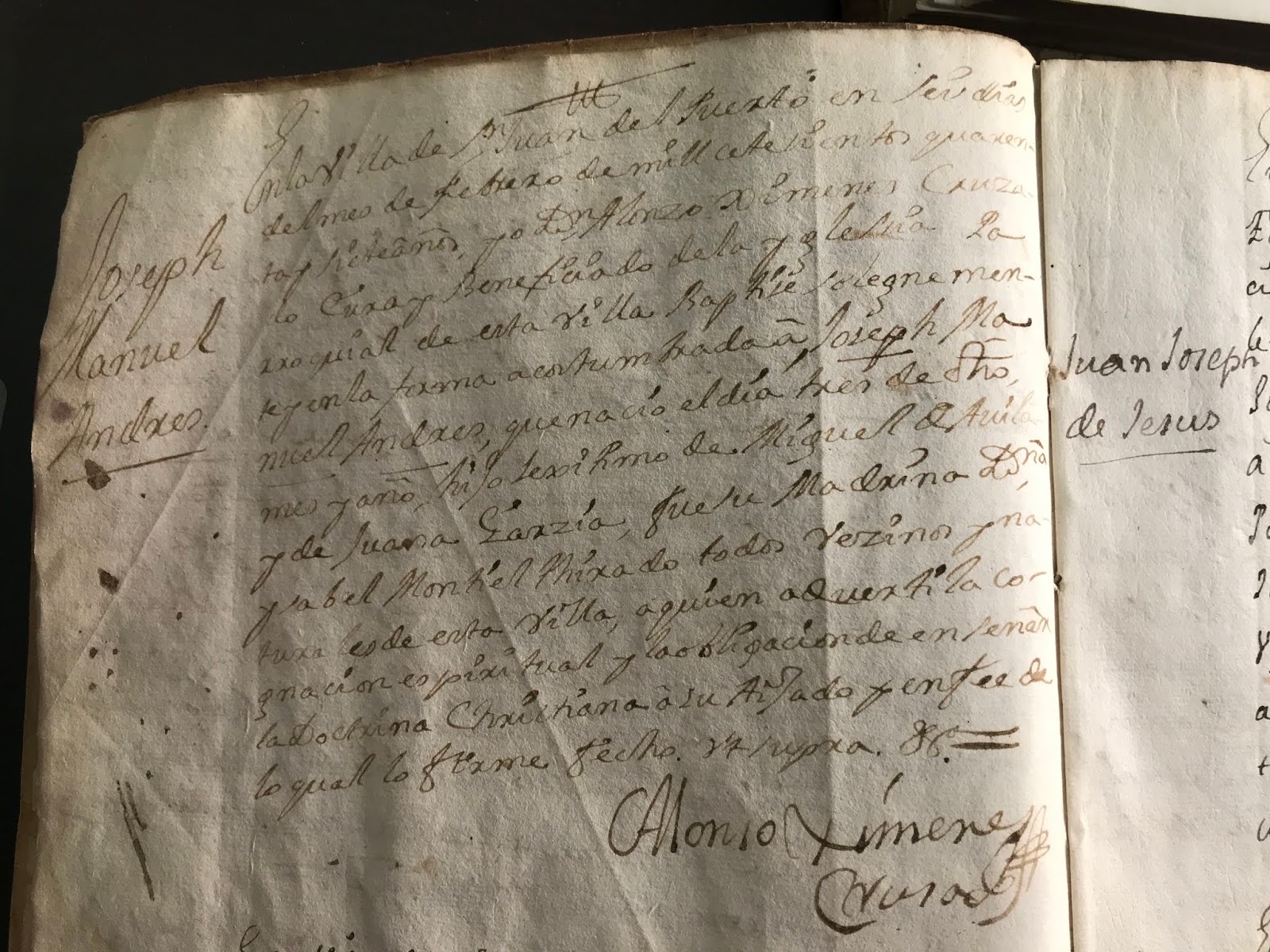
My first quest was using the index (whew, thank God they had one!) to find my ancestor. The index for the town baptisms didn't cover all available years, however, it did cover the range I was searching for, and the index was based on first names which can be a hit or miss. If your ancestor went by their middle name or had a combination of names that wasn't the first one you knew in the New World, then your search could end in nothing - so honestly I was nervous. I jumped to the "J" section and in the mid-1700s looking for a José Cantos or a José Dávila. In the index it mentions the name of the baptized child and the name of his/her parents, so ideally this would be easy I would search for a "Cantos Dávila" "Dávila/de Cantos" combination next to a José and be done, right?! So I set off on my search and didn't find much, a bunch of Josés being baptized, but none had a surname Cantos or Dávila. I looked up at the volunteer from the index book and asked if the surname "de Cantos" was common in the town, he told me he hadn't really heard it before and I then asked about the surname "Dávila", to which he said yes and that there was a well known branch which had been written about. I kept searching and finally came across a "José Ávila García" and shook my head. This couldn't be my ancestor since he was Ávila García and my ancestor was Dávila Cantos. This being my only lead in the mid 1700s (I then searched a little before and after to rule out an older man or lately registered child) so I decided to check it out. I asked the volunteer for the book in the mid-1740s, jotted down the book number and folio (page) number and dove in. I was able to find a record and this was the entry: 

Baptism Entry for José Manuel Andrés de Ávila García [San Juan del Puerto Parroquial Record]

I noticed two things right away when I came across the entry: 1) The full name was José Manuel Andrés and the first two names "José Manuel" was also the name of my 4th great-grandfather born in 1818 in Maunabo, Puerto Rico - son of Bartolomé Dávila Cantos & María Cándida Rodríguez. 2) The father was actually "de Ávila" the symbol between Miguel and Ávila represented "de", also carried over and used in Puerto Rican church records.

So now I had a José Manuel Andrés de Ávila (Dávila) García, son of Miguel de Ávila and Juana García born the 3rd of January 1747. Could this be my ancestor? A few things overlapped: the use of "José Manuel", name given to my 4th great-grandfather, the use of the "de Ávila" surname, and the fact that the age was perfect. Back in Puerto Rico "José de Cantos Dávila" had his first daughter Catalina Dávila around 1765 (baptism not found yet) and the first official documented child my 5th great-grandfather Bartolomé Dávila in 1775, this would make this "José Manuel Andrés Dávila" about 28 when my 5th great-grandfather was born. Could it be him though? Luckily, the volunteer was pretty involved in my search and recommended I check to see if he married or died in the town, I went through the indexes searching for him and came up with nothing. No marriage, no death in San Juan del Puerto. With no other direction to go in, I decided to keep searching José Manuel Andrés' family and see what I could discover. 

My next step was searching for Miguel de Ávila and Juana García's marriage record. Since José Manuel's baptism record said that everyone mentioned were natural and neighbors of the town then technically they should have married in San Juan del Puerto. I searched within the 1742-1775 marriage book searching from 1747 backwards to see if I could find a Miguel de Ávila marrying in the town. 

Marriage Book 1742-1775 [San Juan del Puerto Parroquial Records] 

Bingo! - In the book I was able to find the marriage of Miguel de Ávila and Juana García. When I started reading the record I let out a kind of "oh" - Miguel's father was named "Bartolomé"! If you remember, Bartolomé Dávila was the name of 5th great-grandfather back in Puerto Rico! So here we now had two family names repeating themselves across various generations, the use of José Manuel and Bartolomé. I looked up at the volunteer and told him about the use of Bartolomé as well as José Manuel in my family back in Puerto Rico and that the information was lining up so far and that these were pretty big coincidences. He then told me that some coincidences are too hard to ignore. The next piece of information I would find would seal the deal for me.

Name repetition across various generations in my pedigree [Personal Photo]

I decided to keep searching this "de Ávila" family who had some pretty evident coincidences with my family back in Puerto Rico. My next search was for a marriage record for this Bartolomé Dávila, I was pretty surprised how lucky I was getting with finding records so far, since I was now reaching into the 1600s with this branch. And just like that I found Bartolomé Dávila's marriage record in the late 1600s, and when I read the name of his parents I jumped - his parents were named Miguel de Cantos and Francisca de Ávila. The surname I had seen in Puerto Rico had finally appeared in records! I told the volunteer about finally finding the "de Cantos" surname and he nodded, as if saying "this is it!".

Back in the days the tradition of using surnames wasn't as solidified in Spanish society as it is now, up until the 1600s and maybe even early 1700s surnames were chosen based off status and popularity of a certain surname. In this case, the "de Ávila" family had more status in the town (as I would later learn more about via a book of the Dávila family the volunteer found and copied for me) and thus the children became "Dávila/de Ávila" versus using the father's "de Cantos". Sometimes children even took the name of grandparents such as maternal grandmothers who came from illustrious families making genealogy in this time frame a bit more complicated, sometimes even siblings carried different surnames! However, it seems that years later the children especially José Manuel Andrés was still aware of this "de Cantos" name and would tack it on creating the "de Cantos Dávila" combination I repeatedly saw across various Puerto Rican records - yet 300 years later, Dávila would prevail and stay as the family's surname even up until today. 

As I kept searching throughout the town records, the use of "de Cantos" was very scant - practically no one in the town had the surname besides one other man who could probably be a father, uncle, sibling, or cousin to Miguel de Cantos. I imagine that this family maybe came from a nearby town but unfortunately there were a couple of books missing so finding the marriage for Miguel de Cantos and Francisca de Ávila was not possible.

Conclusions

In the 2-3 days that I was able to visit the church I was able to discover quite a bit. I was able to find a baptism record for a José Manuel Andrés de Ávila García born in 1747, though at first I was hesitant to believe this was my ancestor finding his grandfather's marriage record where it mentions his parents were surnamed "de Cantos" and "de Ávila" was helpful to me to solidify the theory that this man was one and the same to my 6th great-grandfather. I was able to trace about 2-3 generations back from José Manuel Andrés de Ávila and luckily I was given a copy of the Dávila/de Ávila book which traces the family's origins back to the mid-1400s. I have to read through the book again and see where I can find records to back up the family tree presented in the book. 

Before I parted ways with the volunteer, I thanked him for his time and asked how I could reach out to him in the future if I wanted to come back. He told me he worked for the diocese itself and had seen my email before my friend had called, which is good to hear because electronic communication is easiest across countries and time zones, I believe. I had also asked if there was any effort to digitalize documents and he said that since they were a small church the odds of that happening soon seemed little to none, funding would have to come from the church and it seems like too much of a monumental task at the moment for them - especially considering that there is only one volunteer who has a life/job as well. 

I also asked if I could see the inside of the church and leave a 'thank you donation' before I left. Mass had just ended so he went inside to find the parish priest to let him know I wanted to leave a donation. In the meantime I peaked inside the church and took some photos, it's always odd to see places where my ancestors would have stood because their history connects me to this location. To believe that my 8th great-grandfather would have married here in the late 1600s is kind of mind-boggling. 

Inside of La Iglesia Parroquial San Juan Bautista [Personal Photo]

After snapping some pictures I was presented to the priest, I told him I wanted to leave a donation and so he went to the back and got a donation envelope for me to leave behind money. I personally decided on leaving 50€ (about $55 USD), which isn't much but I wanted them to see I was appreciative of their efforts to conserve these documents. 

Thank you note and donation [Personal Photo]

Future Research

There is still much to research! Since I had limited time I basically focused on the main ancestor branches that would be my direct ancestors and tried to follow their trails as quickly as possible. Of course, there is still much desired to discover such as siblings and other records I might have glanced over in my haste to not waste time. Also, there are a few books missing here and there that might hinder my search for ancestors that might have migrated in from other towns. My goal is to hopefully visit San Juan del Puerto sometime in the near future and be able to dedicate enough time to searching without feeling too rushed - of course this would depend on how much time I can stay in the church researching and for how long I will be in Spain as well. So far I have been fortunate enough to research this branch and find out all that I did in the limited time I was there. Of course, with any research that is genealogy based there is the possibility that I've traced an incorrect family and miss associated my ancestor with them. So far, I am going off various elements of my research and I'm hoping that my research is correct and sound. 

For the time being, I will continue to search around the towns of Coamo and Maunabo and see if I can find a mention of "José de Cantos Dávila's" parents in order to help solidify the identity of my 6th great-grandfather. My current hunt is a death record for José Dávila or a marriage record which may shine some more light on my 6th great-grandfather!


Statue in front of Iglesia San Juan Bautista [Personal Photo]

Wednesday, June 19, 2019

A Consanguineous Family: The Martínez of Guayama/Maunabo

Earlier in the year (a few months ago actually), while I visited Puerto Rico I made sure to revisit the Archivo Diocesano in San Juan. Here, my goal is always to try and find marriage dispensas (marriage permissions) given to my ancestors who needed permission to marry cousins of varying degrees. This specific time I was searching for my 4th great-grandmother's marriage record who in Maunabo, Puerto Rico married for a second time on the 19th of July 1860. Her name was Dorotea Ramos Martínez and her second husband's name was Manuel Ruiz Soto. I was interested in finding out more about Dorotea and potentially finding how she and her husband were related.

Matrimonio - Dorotea Ramos Martínez & Manuel Ruiz Soto [FamilySearch]

Searching through the 1860 marriage dispensations of Maunabo I found no mention of Manuel and Dorotea. There could be a few reasons for this: misplacement of the dispensation, it was never actually registered, damaged and tossed, etc. However, I came across the surname Martínez on various dispensations. Since I couldn't find my ancestor, I decided to invest some time looking at these Martínez dispensas a bit. Interestingly enough, I discovered that each of these marriage dispensations all tied back to a family I had in my family tree. Out of the four dispensas in Maunabo with the surname Martínez I had located - all of them tied back to my 6th great-grandparents José Martínez and Águeda de Soto. In this post, I will explore this family's migration, connections, and a theory of consanguinity.

Origins

My connection to José Martínez and Águeda de Soto comes to me via my mother's side of the family. Their daughter, Andrea Martínez Soto, was born in Maunabo in 1804 and the next five generations would live in the Maunabo/Yabucoa area - meaning my family lived in this area at least 145 years! Andrea is only one child of the 13 that I have been able to identify for this couple - sometimes José appears as José Antonio, since I don't have a baptism record for him I haven't been able to confirm his full name though seeing as how the wife constantly appears as "Águeda de Soto" (sometimes just as 'Soto') I think it's safe to assume this is the same couple. Andrea is also not the first born of the bunch, she had a few siblings come before her. It seems that the family has its origin in Guayama based on some baptism records I was able to find, the earliest being in 1795 of their son Felipe Martínez Soto. Another son Pedro Martínez Soto is estimated to have been born in 1792 but so far I haven't been able to find a baptism record for him.  

Later, in 1804 Andrea was born in Maunabo. This means that around that 9 year gap the family was either in Guayama or Maunabo or even in Patillas, a town located between the aforementioned towns. Based on the older map I found of Puerto Rico, you can see that the towns were divided up differently and thus the borders of what was once Guayama are different than what they are today. A few other records help us narrow down where they were and when - For example, in May of 1798 José Martínez and Águeda Soto served as godparents to a child named Marcelina in Guayama, while in December 1801 they were godparents to a child named Saturnino Güisado in Maunabo. 

Family Migration - Guayama to Maunabo [Google Images]

Our timeframe for their move has now shortened to between May 1798-December 1801. This is why documenting other events that occurred in the lives of your ancestors is important, thanks to their service as godparents I can more accurately predict where certain children might have been born!

Family Structure

Through my searches, I have been able to identify 13 children so far for my 6th grand-grandparents, which for the early 1800s isn't too surprising. Attached below is a chart for all of the children of this couple, they include: Florencia, Felipe, Pedro, Justa, Fabiana, María, Victoriano, Andrea, María 2º, Fermín, Hermenegildo, Cipriana, and Juan Martínez Soto. María (1802) and the rest of her younger siblings were born in Maunabo while her older siblings were probably born in Guayama. Fabiana who is guesstimated to have been born in 1798 falls within the cusp of years around their move.

Children of José Martínez and Águeda de Soto [Personal Photo]

I'm not exactly sure however when many of these children died or even when José Martínez and Águeda de Soto themselves died in Maunabo. For whatever reason the Maunabo death records were not digitalized and/or added to FamilySearch. I'm just hoping they actually exist and weren't damaged, lost, or destroyed!! 

Los Dispensados

(1828) Eleuterio Garay Martínez + María Martínez Soto
2º grado de consanguinidad en línea trasversal igual


This first marriage I have was dispensed was between María 2º (I title her with 2º -second- since she was the second María born to my 6th great-grandparents) and Eleuterio Garay Martínez, though I don't have their actual dispensa since most begin the 1840s, it mentions in their church marriage record that they have a 2º grado de consanguinidad en línea trasversal igual. Having their parents' names and looking at their trees, it would seem that Cayetana and José were both siblings seeing as how they're both Martínez and no other surnames overlap - with that being the case, it would seem that Cayetana and José were siblings and both from Guayama. 


August 1872- Manuel de los Reyes Martínez Ban + Gregoria Lebrón Díaz
2º grado con 3º grado de consanguinidad


Manuel de los Reyes Martínez Ban is my 1st cousin 6x removed, the son of Fermín Martínez Soto - my 6th great-uncle. As you can see from the chart below, their relationship stands at a 2nd and 3rd degree of consanguinity by how they're related. Manuel de los Reyes' dad is a brother to his wife's grandmother, meaning Fermín and Justa are brothers and sisters.  


September 1872- Manuel de Jesús Martínez Colón + María Vicente Rivera Martínez  

3º grado de consanguinidad


Manuel de Jesús Martínez Colón is my 2nd cousin, 5x removed. His grandfather was Felipe Martínez Soto while his wife's grandfather was Fermín Martínez Soto, brothers to Andrea Martínez Soto - my 5th great-grandmother. This is the second child of Fermín Martínez and his wife María Josefa Ban to marry a cousin. 


1882- Luis Lebrón Martínez + Ramona Martínez Colón

2º grado de consanguinidad


Both Luis Lebrón and Ramona Martínez are my 1st cousins, 6x removed. Their respective parents, Fabiana Martínez Soto and Juan Martínez Soto, were siblings. Here we have two more of my 6th great-uncles/aunts having their lines intermix. That brings it up to 5/13 siblings that have children marrying cousins - who knows how many others there are!


Another Martínez connection?

1860 Dorotea Ramos Martínez + Manuel Ruiz Soto
2º grado de consanguinidad 


As you saw earlier Dorotea Ramos and Manuel Ruiz were said to have a 2nd degree of consanguinity. This should mean that one of their grandparents was related to their spouse's grandparent. The question though is: who? I'm not sure how tangled this family becomes, is it just the Martínez that are all related or is there a connection through the "de Soto" branch as well? I'm not sure if there's an easier way to find out since I don't have the record to tie these branches together. However, as I continue to discover other relationships I am able to better determine the relationship between all of these cousins. 


The question then becomes: Why was this family constantly marrying into each other's lines? Based off records, it seems that this family was a pardo libre mixed family so there wasn't a need to keep pure lines. Yabucoa and Maunabo were towns full of other families, I have lines from Maunabo that managed to avoid marrying into themselves; so why didn't this Martínez family do the same? 

Truly, what stories are being held between the webs of this complicated family tree? 

Wednesday, May 8, 2019

A Puerto Rican Look at: My X-Chromosome

With Mother's day being this Sunday here in the United States, I decided to take a different and closer look at my DNA - I wanted to see how my X-Chromosome and those of my grandmother, grandfather, and great-grandfather were passed down; all exclusively inherited from my maternal side of the family. Since I am fortunate to have these members tested on 23andMe, I can visually see how this inheritance how trickled down via 4 generations. 

X-Chromosome Inheritance [Personal Photo]

Above you can see how I get my X-DNA through various generations and ultimately down to me. Having used DNAPainter (I've posted about it before) to trace my matches I have been able to trace which segments belong to which ancestors along potential my X-chromosome inheritance ancestors. It is important to note that as a male I have one X-chromosome inherited from my mother BUT from various ancestors including my BOTH maternal grandparents, both great-grandmothers, one great-grandfather, etc. This is demonstrated below:

X-DNA Male Inheritance [The Genetic Genealogist]


This would mean that by understanding which pieces of DNA came from which sets of ancestors I could have a better idea of part of their cultural inheritance passed down to me via my X-chromosome.

My X-Chromosome Inheritance [Personal Photo]

You can see above that mainly my maternal grandmother's DNA is the one I carry while my maternal grandfather's DNA "bookends" my grandmother's genes. Looking at my ancestors that have contributed to my X-Chromosome, I can start to unravel a bit of a story for my ancestors. It's also important to note that various siblings can inherit in similar but different patterns a X-chromosome, so while I may have a smaller amount of my grandfather's DNA my brother's may have inherited different segment start and end points along their X-Chromosome.

Genetic Breakdown


North African & Arabian; Broadly European
These two pieces of DNA here were inherited from my maternal grandfather's ancestors. I'm not sure from which specific ancestors these are from yet but these ancestors were from the areas of Toa Alta and Barranquitas/Morovis in Puerto Rico. The Toa Alta side includes surnames such as Santos and Chéverez while the Barranquitas/Morovis side includes Rivera and Rodríguez - these are the surnames from 7 generations back of my 4th great-grandparents.


Native American
The first Native American chunk seems to come from my maternal grandmother while the second Native American piece of DNA is from my maternal grandfather. Interestingly on the first native segment I have two matches from my dad's side of the family that match me on my X-chromosome. This would mean that somewhere along my 2nd-great-grandmother's line there is a shared ancestor that comes from my great-grandfather, to my grandmother, and to me who is tied to my paternal Rivera side. 


Surnames on the first Native DNA segment include Arvelo, Flores, Sánchez, Vera and were from the area of Quebradillas and San Sebastián in the 1700-1800s. The second DNA segment include the same ancestors from the previous "North African & Arabian; Broadly European" which where ancestors from the areas of Toa Alta and Barranquitas/Morovis. The Toa Alta side includes surnames such as Santos and Chéverez while the Barranquitas/Morovis side includes Rivera and Rodríguez.


Broadly Southern European; Spanish & Portuguese
This whole blue segment basically comes from my grandmother. The beginning broadly Southern European segment I think is tied to my great-grandfather while the Spanish & Portuguese I think is tied to my great-grandmother. Deducing that, that would mean that the Spanish and Portuguese DNA is mainly from my Maunabo and Yabucoa side of the family. Surnames on this side of the family include Burgos, Dávila, Orozco, Ramos, Ruiz, and Santiago. These family branches have been in this area for hundreds of years with some lines stretching back to Las Piedras and Humacao back in the 1700s. It be interesting to try and see if I can find more matches to try and parse down genealogically which of these Spanish & Portuguese segments are attributed to whom. Having recently discovered my Dávila line from Spain it would interested in seeing which of these segments could potentially come from that family. Also, these ancestors were mixed between identifying as "white" and "pardo" so it's interesting that such a big chunk is specific to Europe - it makes me wonder if it's specifically from a certain set of white ancestors. 

Conclusion

Studying my X-Chromosome has only given me a look into certain ancestors along my family tree. The more matches I have on my X, the better I will be at trying to triangulate which ancestors contributed to those segments and understanding their mixes. Of course, autosomal DNA and matching on other non-X-chromosomes is helpful as well but it's interesting to see that certain ancestors carried for example North African DNA to Puerto Rico and potentially those ancestors also contributed North African DNA to other chromosomes in my DNA as well. It's also amazing to see how the colors showcase the diversity of my family as well.

Monday, October 22, 2018

Tracing a Line to Spain - The Cantos Dávila Family

Recently, I've been out of the "blog game". And to be honest, with school starting up again I always find it hard to balance personal time and work time, though I try to continue searching here and there when I can. I also want to continue cataloguing towns as I was doing this summer and I'm hoping to crank out some more when I can soon.

And so for my first post back (and a rather long one!), I want to talk about a line I've recently starting digging into again, and this is my maternal Dávila line. In the past I have blogged about this family various times, recently I talked about this family in the post "A Family's Move Through Paper Trail" where I traced my 5th great grandparents from Maunabo back to the town of Coamo. 4 years ago (wow, time flies!) I posted about my 5th great grandfather Bartolomé Dávila Cantos (one of the ancestors I traced back to Coamo).

Back when I posted about Bartolomé I knew that he lived in Maunabo, probably died there as well and that was it. Fastforward 4 years later I found him in records, along with his wife Cándida Rodríguez in Coamo where their first four children were born. Because the surname Dávila was tied to "Cantos" I figured it would be easy to distinguish them from other Dávila families - though mine go back and forth dropping and adding the "Cantos" bit. So I started digging around Coamo to see what I could fine.

A Family Presence in Coamo

One of the most important things when researching your family is paying attention to who else the family was surrounded by in records. For example, who declared a birth or death? And especially important, who were the child's godparents? While researching the children of Bartolomé Dávila and Cándida Rodríguez, I took note of who the godparents were. In chronological order, these where the godparents that were either "Dávila" or "Cantos". These are godparents that both appeared in Coamo and Maunabo:

1808- Bernardino Ramos + Marcelina Cantos Dávila (Coamo)
1809- Hilario José + Josefa Gracia Cantos (Coamo)
1814- José Hilario Cantos + Inés García (Maunabo)
1820- Félix Rodríguez + Catalina Dávila (Maunabo)

Notice the usage of Cantos, Dávila, and Cantos Dávila - as you can see there was a lot of back and forth with the surname, which wasn't too uncommon for double-barreled surnames of the time. From this you can see that there were other Cantos Dávila living in Coamo besides Bartolomé.

Equally, Marcelina was married in 1806 to Bernardino (Aponte de) Ramos, and it states her parents were José Cantos Dávila and Josefa García Rodríguez Bonilla, which is interesting to see all of these surnames together. When Marcelina marries, none of the parents are listed as deceased.

Marriage Record, 1806 [FamilySearch]

Equally, Hilario married in Maunabo in 1815 to a María del Rosario Ortiz. Again, the parents are listed as José and María Josefa García. Also underlined in red, notice that the parents are listed as "white" in this record.

Marriage Record, 1815 [FamilySearch]

Finally, there was one more record to help add to this clan. A marriage record between José Gabriel Sánchez and Catalina Cantos in 1796 in Coamo. This record is very hard to read so I won't post it above but playing around with the image you can make out "José Cantos" and "Josefa García" as the parents as well.

So now we have new names to search - José Cantos Dávila and María Josefa García Rodríguez Bonilla.

Proving Relations - My 6th Great-Grandparents?

Finding Marcelina's and Hilario's marriage record opened up a new possibility, that these two new names of José and María Josefa could be my 6th great-grandparents. Seeing as how Marcelina and Hilario were godparents to Bartolomé's children, it's easy to see how these two were uncle and aunt to their brother's children and were chosen as godparents for them. 

I wanted to find out more about them. Thanks to some members of the genealogical community, a good number of the early records in Coamo have been indexed into charts which are easily searchable. By searching the surnames "Cantos" and "Dávila" I wanted to see what I could find. I was able to pick them out a few times through various years as godparents - the years being 1775, 1777, 1796, and 1799. There was a year they appeared as godparents in Cayey in 1787 but they mentioned they were residents of Coamo. We can see that José Cantos Dávila and María Josefa García were pretty well established into the life of Coamo having been there since the mid 1770s and probably still living there when their daughter Marcelina married in 1806. 

Baptism Record, 1777 [FamilySearch]

Baptism Record, 1796 [FamilySearch]

As you can see above, they were serving as godparents for a span of 20 years. In the 1770s they were probably in their late 30- early 40s and in the 1790s around their late 50-early 60s. Notice in red in the second record that they are godparents for the son of a Esteban Rodríguez García Bonilla, I am imagining he is the brother of Josefa.

My last piece of evidence to seal the deal is a baptism record that I am pretty sure is for my 4th great grandfather. The year this child is born, in Coamo, and then to José Cantos Dávila and Josefa García in my mind helps to prove that Bartolomé was the son of José and Josefa, brother of Marcelina, Hilario, and Catalina which again helps to explain why he would choose them as godparents. The only caveat here is that the son is registered as Bartolo instead of Bartolomé, however in my paternal side of the family in the early 1800s I had a similar situation with an ancestor who was both Bartolomé and Bartolo. Here is the record! 

Baptism Record, 1776 [FamilySearch]

The only extra piece I would need to help to back up this claim is finding the marriage record between Bartolomé Dávila and Cándida Rodríguez, I have searched in Coamo in the late 1790s and early 1800s around the time frame their first child was born in Coamo, but so far no luck!

This last piece of this puzzle is the most interesting, in Hilario's baptism record in 1785 it mentions: "Joseph Cantos Dávila natural de los reynos de españa en Sn Juan de Puerto..." [sic]. I was pleasantly surprised to see this! We now had a town of origin for José Cantos Dávila, and it was in Spain! (Checking off New Years Resolution to find a direct Spanish ancestor!) 

Baptism Record, 1785 [FamilySearch]

San Juan del Puerto, España

Of course at first after finding this I thought, "oh darn! This record must be wrong, I think the person is trying to say the city of San Juan, the capital of Puerto Rico!" But a quick Google searched proved me wrong! 

San Juan del Puerto, Spain [Google]

There actually is a town named San Juan del Puerto and it's in southern Spain! Looking at the map, it seems to be a pretty small town near Huelva and Palos de la Frontera, other towns in southern Spain my ancestry is said to go back to. As you can see below, it's a fairly small town!

 San Juan del Puerto [Google Maps]

San Juan del Puerto [Google Maps]

In 2016, the population was just near 9,000 people - funny enough that this town is named after Saint John the Baptist the same way Puerto Rico was in the beginning of its history. Reading its Wikipedia page in Spanish it mentions that the town's founding dates back to 1468.

Conclusions

I wonder when José would have made his journey to the new world and under what circumstances. Also, something interesting to note is José's last name "Dávila". Most sources say that it is a combined surname for "de Ávila" meaning from the town of Ávila. Which makes me wonder if ultimately their family was from there. In my linguistics class we learned that some Spaniards moved to the south before venturing off to the New World, ultimately acquiring a southern Spanish accent that was brought to the New World. Which makes me wonder if José Cantos Dávila would be one of those men. 

For now, with all of the research and different information collected, I am rooting for the fact that José Cantos Dávila and Josefa García are my 6th great-grandparents. I've mulled it over the past few weeks and writing it all out helps to clarify for me the strength between the documents. Ultimately the icing on the cake would be finding the marriage record of Bartolomé to see if his parents listed there are José Cantos Dávila and Josefa García. Onwards to searching more! 

Wednesday, July 18, 2018

A Family's Move Through Paper Trail

Recently, I've been taking a dive into the Puerto Rican Church Records again on FamilySearch. By chance and funny enough, by looking to one branch of my family I bumped into a completely different one. Finding children being born in towns nearby (and not so nearby) and parents appearing as godparents has allowed me to track my family's movement across the island. This is pretty important in genealogy since movement from town to town means that there might be other branches to your tree that stayed behind and distant cousins are probably there. This could also mean that your ancestors might have been married before arriving to the town you knew they were from and if there is no death record in the town they resided most of their lives, they might have moved back or moved over to a neighboring town where another of their children lived.

This post will be about one specific couple who I have been able to trace through documents moving across the island. The couple's names is: Bartolomé Dávila & María Cándida Rodríguez. They are my 5th great-grandparents on my maternal side of the family.


Bartolomé Dávila & Cándida Rodríguez

From the information I have so far I know that Bartolomé Dávila (sometimes written as Dávila Cantos) and his wife María Cándida Rodríguez were born in the mid 1700s based of the baptism dates of their children. Originally when I discovered this pair, I knew that they had lived in Maunabo where part of my maternal ancestors had lived. My 2nd great-grandfather Pedro Dávila Ruiz was either born in Yabucoa or Maunabo but for sure his parents and grandparents lived their lives in Maunabo.

It wasn't until recently that I was searching the town of Coamo for my Correa families that I surprisingly bumped into Bartolomé and Cándida. At first I was confused because I knew they lived in Maunabo, but seeing the surname Dávila Cantos and seeing as how they weren't having children in Maunabo at that time, I am pretty sure that these are my ancestors living in Coamo before moving into Maunabo. Now, there is always the possibility that this is just a coincidence. That there was another pair with the same names living in Coamo but given the time frame (early 1800s) and the set of names, I'm fairly certain there's are my ancestors. The lack of births in the those years in Maunabo also help to build the case that they are one and the same instead of two separate pairs.

Here are the children and the towns they were born in that I have so far for Bartolomé Dávila and Cándida Rodríguez:

  • Luciana Dávila Rodríguez (1808) - Coamo 
  • Juan Estanislao Dávila Rodríguez (1809) - Coamo 
  • Rafael Dávila Rodríguez (1810) - Coamo 
  • José Laureano Dávila Rodríguez (1814) - Maunabo 
  • Juliana Dávila Rodríguez (1816) - Maunabo 
  • José Manuel Dávila Rodríguez (1818) - Maunabo 
  • María Feliciana Dávila Rodríguez (1820) - Maunabo 
  • Francisca Dávila Rodríguez (1821) - Maunbo 
  • Manuel Dávila Rodríguez (1826) - Maunabo 

I wonder if the gap between 1821-1826 means that the family temporarily moved somewhere else and then returned to Maunabo seeing as how they were having children every 1-2 years. 

Tracking Movement
Here's a map showing the years they were living in the respective towns. Notice that Coamo isn't "right next door" like how the other two towns are. I wonder what made the family move from Coamo into Maunabo and where their origins are, hopefully by digging a bit more into the Coamo church records I will able to trace the Dávila Cantos surname and learn more about their origins.

Moving around the island - Coamo, Maunabo, and Patillas [Google Maps]

As you can see, they were in Coamo around 1808-1810 living there by proof of their children's baptism records which I'll paste some of them down below. The family then moves into Maunabo around the 1811-1813 because by 1814 they are baptizing children there. Notice also that in 1819 the couple appears in Patillas, here they are appearing as godparents. Since Patillas and Maunabo are neighoring towns it is very possible that they just jumped over into Patillas to serve as godparents for a family they knew but continued their residence in Maunabo. Their last child I have is born in 1826 in Maunabo, from there I don't know what happened to them. Since Maunabo's death records aren't uploaded to FamilySearch I'm not sure if they died there or in another town. My guess is that they stayed in Maunabo, but at this rate as you can see it isn't a given that they died where they lived.

Documentation

As you can see below the first baptism was in 1808 of their daughter Luciana Dávila Rodríguez, interestingly enough the father's surnames are listed as "Cantos Dávila" and the godparents are Bernardino Ramos & Marcelina Cantos Dávila. I imagine that Marcelina is a potential sister to Bartolomé and I have to continue my searches in Coamo for this family to see what else I can find. Potentially, there are other branches here left that did not move into Maunabo.

Luciana Dávila Rodríguez, Año 1808, Folio 190 [FamilySearch] 

Here you can see (barely) that Bartolomé Dávila and María Cándida Rodríguez are serving as godparents in Patillas to Juana Feliciana Rodríguez, the natural daughter of María Rodríguez. Could María and Cándida be sisters?

Juana Feliciana Rodríguez, Año 1819, Folio 155 [FamilySearch]

Lastily, the record below is of a final baptism from Manuel Dávila Rodríguez born in Maunabo in 1826. The godparents are Don José Ortiz and Lorenza Rivera, no known relationship yet to my ancestors but possibly a family they were very close with in Maunabo. 

Manuel Dávila Rodríguez, Año 1826, Nº 568, Folio 80 [FamilySearch]

By the time Manuel was born the parents were probably in their early 40s which I would imagine that Manuel would have been one of their last children. If I remember correctly, I could not find any other children being born in Maunabo passed 1826 for the couple.

Conclusion

As you can see, the family made a big jump from Coamo to Maunabo. Nowadays, this probably isn't much but I can imagine in those times that move across various towns wasn't easy. The gap of 1811-1813 is probably when they moved and I wonder if any children were born along the way in one of the towns along the route, the only way to know is to check any available church records for those towns. I also have to check the Coamo records for any possible siblings or ties to the Dávila Cantos and Rodríguez family. I haven't come across "Cantos" really in my searches so I'm interested in seeing where they were from.

So lesson learned! Check neighboring towns and having an idea of the town's founding and history which will hopefully give you a better understanding to your family's past and history there! If you can't find records for your family, check towns in the surrounding area and always keep your eyes open for your ancestors as they might pop up anywhere (within reason)!

Wednesday, July 13, 2016

A Puerto Rican Look at: Colorized Pedigrees!

I've been seeing these style of pedigrees online for a while now and decided I should give it a go! Thanks to Zalewski Family Genealogy blog  I was able to use the template and create my very own pedigree. Because my family has been on the island of Puerto Rico for over 200+ years, I didn't think it would have made sense to create a chart with just the same color over and over again to represent Puerto Rico. With this template I was able to include up to my 3rd great grandparents, which are 32 different ancestors! I was able to include their surnames on the side as well, giving you an idea where my family surnames originate from on the island. It was interesting seeing how diverse my family tree is in terms of locations. If you notice, it was only recently that my family came to the capital of San Juan with 3/4 of my grandparents being born there, though all of them spent their formative years growing up and living there. If you take a further look, my family has been present on the island for those 200+ years in almost all my branches, there is only one ancestor that made the cut for being from another place and that's my 3rd great grandfather from Mallorca, Spain.

I definitely had a lot of fun doing this pedigree and there are so many other styles you could do as well! Though morbid, I'm thinking of creating a pedigree with family deaths to see if there are any recurring patterns and to have an idea of what is potentially passed down in my family. You could also even create a pedigree with signatures of your ancestors! Though I would love to create one, unfortunately most of my ancestors didn't know how to write since they were all farmers and barely attended school past what we know as elementary/middle school.

Colorized Pedigree [Personal Photo]

I'm not sure how common it is to move so much to different cities but if you notice my mother's side of the family, they were notorious for making moves across the island. My father's side on the other hand seems to stick more to certain towns. For example, we have been in the towns of Corozal, Lares, and Toa Alta for many many years on my dad's side of the family. To give you an idea, here's a list of all my family locations which include 20 different locations on the island, those being: 
  • Adjuntas, Puerto Rico
  • Barranquitas, Puerto Rico
  • Corozal, Puerto Rico
  • Jayuya, Puerto Rico
  • Lares, Puerto Rico
  • Maunabo, Puerto Rico
  • Manatí, Puerto Rico
  • Morovis, Puerto Rico
  • Patillas, Puerto Rico
  • Quebradillas, Puerto Rico
  • Salinas, Puerto Rico
  • San Juan, Puerto Rico
  • San Sebastián, Puerto Rico
  • Toa Alta, Puerto Rico
  • Utuado, Puerto Rico
  • Vega Baja, Puerto Rico
  • Vieques, Puerto Rico
  • Yabucoa, Puerto Rico
  • Yauco, Puerto Rico
  • Mallorca, Spain
I recommend any genealogist who enjoys working with their tree to give this a go. It was super easy to create and could make a very cool poster for a wall! You could even include names and dates to give it more importance as well!