Wednesday, November 27, 2019

The Strange Case of the Carcaño Branch

About 7 years ago, I had discovered the names of my 5th great-grandparents and those of their parents in their marriage record in the year 1819. José de León Correa Carcaño, son of Juan Francisco Correa and María Eugenia Carcaño, said to be natives of San Juan and María de la Cruz Rodríguez Ruiz, daughter of Sebastián Rodríguez and María de Gracia Ruiz, natives of Coamo.

Out of these four lines - Correa, Carcaño, Rodríguez, and Ruiz, I have only been able to discover more information about only a few. Here are some links to previous posts on my blog about these lines.

Correa- Summarizing my research about my family, though I am currently stuck.
Rodríguez- Writing about my 6th Great-Grandfather during the 52 Ancestor Challenge.
Manuel Ruiz- Discovering that my 7th Great-Grandfather was a pardo slave in Coamo.

The Carcaño line (as well as the Correa line) has been extremely difficult to trace. So I wanted to focus a bit on what I know on the Carcaño and some theories in hopes of being able to discover more about my 6th great-grandmother.

CARCAÑO AS A SURNAME

Besides seeing the surname Carcaño in the marriage record of my 5th great-grandparents, it has not been a surname I often see in my genealogical searches. So first, I wanted to research the surname itself outside of Puerto Rico. I wanted to know how popular the surname might be in Spain. I have mentioned the use of the INE before (Intituto Nacional Estadística) and it is one of the main ways I check how or where a surname could have arrived to Puerto Rico from within Spain. Searching "Carcaño" didn't give me many hits, as you can see below the surname is used only by 100+ people and limited to a few regions in Spain. You can see that Cádiz and Alicante seem to be the "highest" concentration of Carcaño surnamed people in Spain and it makes a few appearances in Madrid and Barcelona. Since the surname is so limited, I would imagine these separate family branches are tied to each whether distantly or more closely related.

The version "Carcano" shows only about 20 people in Madrid using this variation, by the way! 

Carcaño Surname Map [INE]

CARCAÑO... ¿GENOVÉS?

My searching on the internet brought me to an article from Torrevieja that mentions a family reunion of the Carcaño branch bringing together about 150 family members. It also states that the family came to Spain from Genova, Italy around 1810 probably fleeing the siege of Napoleon, the first registered Carcaño in Torrevieja occurred in 1820.

Carcaño Family Reunion [DiarioInformación]

This would lead me to believe that the Carcaño family entered through Alicante (the region where Torrevieja is located) and from there the family spread to other regions. Could this mean that the surname has its origins in Italian rather than Spanish? It would explain why it isn't as commonly found in Spain and why it's harder to find in Puerto Rico as well.

CARCAÑOS IN SAN JUAN, PUERTO RICO

My search for María Eugenia Carcaño took me to the San Juan church records in the early 1700s. So far, I have yet to find a marriage record for María Eugenia Carcaño and her husband Juan Francisco Correa, but I did run into another Carcaño branch which was interesting to find. Since I have no idea how, if at all, this branch is tied to me I decided to build out a tree and see what I could find on them. Even if they aren't related to me I hope that my research benefits another Carcaño family.

The first Carcaño branch I found was a marriage record for a Manuela Carcaño to a Juan Ferregut in the San Juan church records in the year 1777. Below you can see a snippet of the wedding record, stating that Juan Ferregut was from Pa[r]ma (Palma), Mallorca, the legitimate son of Guillermo Ferregut and Catalina Villa and Manuela Carcaño, a resident of this city [San Juan], the daughter of Josef Carcaño and Manuela Polanco, she deceased.

Manuela Carcaño, San Juan, Marriage, 1777 [FamilySearch]

Since José de León Correa was said to have been born in the 1790s in San Juan, I figured that Manuela could easily be a sister to María Eugenia, as their ages were probably in the same ballpark range. So I wanted to discover more about José Carcaño and Manuela Polanco, who were they and could they have been my 7th great-grandparents? 

I was able to find that Manuela was baptized as Manuela de los Reyes, daughter of José Carcaño and Manuela Polanco, parda in January 1764. Manuela was baptized in the book of blancos but as you can see her mother was listed as parda. This was important to note for me because my María Eugenia Carcaño is listed with her husband to be pardos libres in the records of Coamo. This type of evidence becomes important when trying to track family members across various towns and different race books of church baptisms and marriages. 

Manuela Carcaño, San Juan, Baptism, 1764 [FamilySearch]

Something extremely odd here is the math! If Manuela would have been born in 1764 and married in 1777, this would mean that she was only 13 years old when she married! Her marriage record does not mention her actual age or her needing permission from her father to get married. I have also yet to find another baptism for another Manuela Carcaño, so it is possible that the age was fudged either on the baptism or marriage. I'm not sure how common it was for girls to marry this young in the 1700s, I do however have a case of one of my 2nd great-grandmothers marrying at the age of 15 (based off her baptism and marriage records) in 1906, so it's very possible that was common amongst certain families for status reasons.

Having Manuela's baptism in 1764 gave me a starting point to check for marriage records for José Carcaño and Manuela Polanco... ultimately anytime before that year. Lucky for me, they would have married a year before that in 1763 in San Juan! 

José Carcaño + Manuela Polanco, San Juan, Marriage, 1763 [FamilySearch]

José Carcaño was said to be a native of Genova, from the Spanish kingdom, the son of De[c]iderio and Francisca Carcaño, Manuela Polanco was a native of this city [San Juan] and the daughter of Alonso Polanco and María del Rosario, she was deceased. It's interesting to see that José Carcaño is also tied to the community of Carcaños in Genova! It seems that for a while the Republic of Genoa aligned itself with the Spanish Empire to help in the decline it was experiencing, which is probably why in Puerto Rico it was mentioned as a part of the Spanish Kingdom.

José's wife, Manuela Polanco would pass away in May 1768 in San Juan and left behind a will. Before passing she had given birth to a girl named Isidora that same month who unfortunately passed two months later in July 1768. I'm not sure if that will would still be available in San Juan, if so, it might contain a clue to who were Manuela's children and whether a María Eugenia was one of them. 

José would go on to remarry in Bayamón in 1776 to a María del Carmen García Manzano. It is also possible that María Eugenia could have been one of the first daughters to this couple, except this is where the trail runs cold. 

I have no further information about José Carcaño and where he passed away, whether in San Juan or Bayamón. 

CARCAÑOS IN RÍO PIEDRAS, PUERTO RICO

While on a visit to San Juan last March I visited the Archivo Diocesano in San Juan to look for marriage dispensations. In talking to Elyse who runs the archivo, I asked about other documents in San Juan and the surrounding area for the 1700s. She showed me a couple of indexed books of San Juan and Río Piedras, in them I searched for any people surnamed Correa or Carcaño. 

In one of the entries, I came across a Nicolás Carcaño, illegitimate son of Eugenia Carcaño. I was surprised to see the name, I jotted it down and when I got home I did some more searching. Could this be my 6th great-grandmother?!

Nicolás Carcaño, native son of Eugenia married in October 1790 in Río Piedras to a María Joaquina, native daughter of María Tomasa. It lists them as morenos libres in the record, which again is interesting to note, as you saw above for Manuela Carcaño, she was baptized in the white books but had a parda mother. 

Nicolás Carcaño, Río Piedras, Marriage, 1790 [FamilySearch]

Nicolás would have been born in the 1770s, though a bit older than José de León, this wouldn't be completely impossible for him to be a brother. The interesting thing here though is that no father is listed for Nicolás meaning he would have been a "Carcaño" and not a "Correa Carcaño". Still, I figured it was worth an investigation.

Searching for death records of Eugenia Carcaño in Río Piedras I came across various death records for Nicolás' children: Lucas (1798), Gabriela (1798), Cipriana (1799), and María (1800), all passing away as párvulos (infants) - all children born shortly after their marriage but unfortunately who didn't live long into adulthood. Continuing my search higher in the years, I was able to find a death record for an Eugenia Carcaño. 

Eugenia Carcaño, Río Piedras, Death, 1803 [FamilySearch]

Here you can see a Eugenia Carcaño, resident of Río Piedras, married to "José", black, slave of José María Ruiz, she died in April of 1803. Though I was hopeful at first, a few things don't match with my 6th great-grandmother. The husband's name for example was different and neither Juan Francisco Correa or Eugenia Carcaño showed up as enslaved or moreno libre in Coamo. Could she have remarried? Possible. Could she have been moreno libre in Río Piedras and her son listed as pardo libre in Coamo. Also possible.

But there is another piece of evidence that might help us explain why she might not be my Eugenia Carcaño. When José de León Correa, her son, marries in 1809, it does not list her as "deceased". Other marriage records in that year show spouse's parents as difunto/a but Eugenia and Juan Francisco are not listed as that. Which would lead us to believe that she was still alive past 1803. Could this be an error? Possibly. But I'm hoping that José de León knew the status of the life of his parents' when he married and thus giving us hope that Eugenia Carcaño is still out there in the records... yet to be discovered. 

CARCAÑOS IN LOÍZA, PUERTO RICO

My final search was in Loíza, Puerto Rico, and there I was able to find a few more Carcaños. None of them matched the names I have in Coamo but it was interesting to find the surname there and see where they were placed in the different racial categories. Here are some examples below: 

José Carcaño, moreno libro, 1793 [FamilySearch]


Paula Carcaño, Pardo Libre, 1794 [FamilySearch]


First Twin of José Carcaño, Moreno Libre, 1795 [FamilySearch]


Second Twin of José Carcaño, Moreno Libre, 1795 [FamilySearch]


Felipa Carcaño, Parda Libre, 1795 [FamilySearch]

CONCLUSIONS

Honestly, I'm not sure that I have any, the only thing I have found is that in Puerto Rico there existed white, pardo, and moreno Carcaños across San Juan, Río Piedras, and Loíza. One branch came from Italy and might have ties to a current branch living in Torrevieja, Alicante, Spain with similar roots in Genova. A death record in 1803 for an Eugenia Carcaño was found in Río Piedras, but based off José de León's marriage record she doesn't match since my 6th great-grandmother wasn't said to be deceased when he married in 1809. 

I'm not sure, however, if there was ever a Carcaño slave owner. All the Carcaños I seem to find are all moreno libre/pardo libre and I have yet to find an esclavo de ______ Carcaño. I am not sure what this says about the white Carcaños as well. But at some point the morenos libres would have been freed from a white Carcaño owner or chose that surname (for whatever reason). 

I am hopeful that one day I'll be able to fully unravel this Carcaño mystery. Luckily for me, the surname is still pretty rare, meaning that when I come across it my eyes catch it automatically, unlike coming across more common surnames such as Martínez, Rivera, etc. I'll have to extend my search to other towns nearby and continue to track down the Carcaño branch located in San Juan and see where that trail ends. The question also still begs: where the heck is my Correa branch as well?!

Are you a Carcaño from Puerto Rico? 

Any ties to Juan Francisco Correa & María Eugenia Carcaño? 

Wednesday, October 9, 2019

Genetic Connections to Guadeloupe

Connecting to DNA Cousins from Guadeloupe [Google Maps] 

DNA testing is something I initiated about 10 years ago, and I was fortunate to have stumbled upon it when I did. With testing, I have been able to make great discoveries - some of them thanks to the DNA itself and others to the people I have met and interacted with along the way. If you have been following my blog (Thank you & ¡Gracias!), then you know a few years back (8 actually to be exact!) I begun to unravel a previously unknown discovery in my family about a connection to the islands of Martinique and Guadeloupe via my maternal grandfather's side of the family. At the time I knew very little about this branch but thanks to digging through documents and connecting with French Caribbean genealogists throughout these recent years, I was able to discover much more about this side of my family.

My research up until now has revealed two distinct sides in my 3rd great-grandmother's family, one side (her father's) comes from Guadeloupe while the other (her mother's) comes from Martinique. 

María Paulina Charles Lautin - 3rd Great-grandmother [Personal Photo]

Unfortunately, there is not much information past María Paulina's grandparents. It seems that on the Jean-Charles side, the family might have been mixed-creole seeing as how her parents were enslaved themselves, yet a Y-DNA test points to European origins for the "Charles" line. It is important to note that this side of the family received their freedom from slavery before 1848, unlike most of the enslaved peoples did in the French owned Caribbean islands at the time, this allowed María Paulina's paternal Guadeloupean grandparents a chance to marry before they passed away. Meanwhile, the "Lautin" side is probably all African in origin. Julienne was born a slave (noted as "negresse" on her birth certificate in 1844) and Eglantine herself was brought over from Africa. Unfortunately, we have no idea who the father of Julienne was. We only have a potential clue - in Puerto Rico the father's surname was written down as "Pedro" and searching the records in Martinique has allowed me to identify a family with the surname "Pitroo" who worked on the slave plantation as the Lautin clan; there might be a possible connection to that family and only time and DNA will tell.

Charles-Lautin Family Tree [Personal Photo]


One of my genetic goals was to potentially one day find a cousin who descends via their maternal line all the way down to Eglantine Lautin, this would allow for a MtDNA test to potentially identify a region in Africa she would have originally been from. I have been able to find a genetic cousin via AncestryDNA but they haven't logged into their account for over a year so I haven't heard back from them. The question now became were there segments in my DNA linking me back to potential cousins in Guadeloupe and Martinique? If not, would my grandfather's DNA contain segments? Luckily I have been able to test myself and my maternal grandfather on 23andMe and AncestryDNA along with our Y-DNA line on FtDNA. Thanks to the suggestion of David (a French Caribbean genealogist), I migrated my grandfather's DNA to MyHeritage - which seems to be more popular in France. 

After breaking up my DNA in DNA Painter into segmented colors of who gave me what, you can clearly see all the yellow segments below belonging to my grandfather. 

DNA Painter [Personal Photo]


This DNA in turn comes from his parents, grandparents, great-grandparents, etc. meaning that though those segments cover much of my maternal DNA, I would have inherited genetic material from one out of eight 2nd great-grandparents on that side of the family with ties to Martinique and Guadeloupe. And since it is far back, the odds of me receiving many segments is low as well, but having my grandfather tested means there are more odds of him having more segments as well. Recently in my DNA, I have been able to identify two matches on AncestryDNA and one match on MyHeritage with clear connections to the island of Guadeloupe. 

AncestryDNA

My first match shares DNA with my grandfather but not myself or my mother. Though they share 3 segments across 49cm it's possible that my grandfather was the last generation to inherit these segments. In their "shared matches" list they only share three matches, which is very uncommon for Puerto Rican matches to share such low and limited cousins, so I can probably rule out the fact that this cousin as remotely Puerto Rican. This cousin does however have on their shared matches a cousin who is Puerto Rican but connected to my grandfather via his Correa family which is tied to Martinique and Guadeloupe via María Paulina Charles. The first match I have no idea how they are connected and the third match is a cousin with is mixed Guadeloupean and I think African American. Since AncestryDNA does not share where they match on their DNA, I have no idea how to "chart" this for my grandfather on DNA Painter. The cousin I think is not on Gedmatch either, and I have reached out but no return message so far. 

Guadeloupean Cousin [Personal AncestryDNA]

This 2nd cousin shares DNA across 3 segments as well with my grandfather but this time at 38cm, my guess is that these 3 segments are probably the exact same ones as the first cousin from above. However with this cousin, my mother and myself are said to share DNA with as well. Unfortunately, I have no way of knowing where on my DNA these segments are located.

Cousin with Guadeloupean Ancestry [Personal AncestryDNA]

MyHeritage

This was my grandfather's first official Guadeloupean cousin to first appear for him which was very exciting, since it helped to solidify all the research I had done in the past 8 years. As you can see below I was able to find this cousin by filtering his DNA matches by geographic origins and selecting "France". The segment is listed as only one shared segment but also at 38.3cm like one of my grandfather's AncestryDNA matches. You can also see that based on our trees we both have "Guadeloupe" as an ancestral place for our families based on the trees we have built. I have gotten a chance to chat with this cousin and our families both have ancestry from Les Saintes, which are a set of smaller islands belonging to Guadeloupe! It is possible that there are more matches amongst my grandfather's DNA matches who have a connection somehow to Guadeloupe but so far this is the only one I have been able to find on MyHeritage. 

Guadeloupean Cousin [Personal MyHeritage]

Luckily, on MyHeritage you can see where in your DNA you share the segments. For my grandfather and this match, the segment is located on chromosome 11. 

Shared Guadeloupean DNA [Personal MyHeritage]

My own personal chromosome 11 is inherited mainly in the same spot from my grandfather as the Guadeloupean match comes from but doesn't mean that I would necessarily share that same piece of DNA with that cousin, in order to better know I would probably have to transfer my own DNA into MyHeritage and see if I match this cousin as well.

My Chromosome 11 divided into Grandparent Inheritance [DNA Painter]

Interestingly enough, the region my grandfather shares with this cousin on Chromosome 11 is European on one side and African on the other and specifically the DNA on that side is registered as Nigerian. In a previous post, I took a look at inherited African DNA and I analyzed a bit the fact that Nigerian DNA was much higher on my grandfather's side of the family and potentially connected to María Paulina Lautin. If I had to put some money on it, I wouldn't be surprised if their shared DNA was on the Nigerian side via a slave(s) brought over to Guadeloupe. I'll have to read up on the African influx of slaves to Guadeloupe and see if any studies have been completed on which regions these slaves specifically hailed from.

My grandfather's Chromosome 11 [Personal 23andme]

Why no genetic connections with Martinique? 

I'm not sure why I originally expected genetic connections from Martinique over Guadeloupe. Maybe because I discovered the former side first versus the latter, I expected that my genetic connections would happen in the same order. But taking a closer look it kind of makes sense why I might not have Martinican connections right away, we know that Eglantine was from Africa and Julienne's father probably was as well. Out of Eglantine's five children (one of them being my own 4th great-grandmother), only three (two siblings) went on to have children and who knows if they were were full or half siblings (I'm guessing half over full). 

Next Steps

Nonetheless, this is exciting stuff! The next step would be to try and figure out how we're all related! It doesn't seem like we have any surnames overlapping with each other, but at the same time, knowing that my 5th great-grandparents from Guadeloupe were slaves means that they didn't carry surnames in the traditional sense we have come to know. My 5th great-grandmother only went by "Marie Lucie" and used no surname on documents while my 5th great-grandfather was known as "Jean-Charles Chaleau" and the children passed on both "Chaleau" and "Jean-Charles" as surnames depending on the time period. 

Recently, a document was discovered on Terre-de-Bas (merci beaucoup David!) which mentions Jean-Charles as an uncle in a death record in the year 1853, which would mean he would be related to one her parents. As you can see, there is still much to be discovered and I'm hoping that our DNA will reveal more about our connections. This is also why it is important to explore various companies of DNA and search within your matches! 

Nº 1 Françoise - Décès 1853 [ANOM]

I also can't wait to visit Guadeloupe one day!

Terre de Bas, Guadeloupe [Guadeloupe Le Guide]

Monday, September 30, 2019

How One Death Record Got It Wrong

I wanted to focus this post on an aspect of genealogy I think most newbies tend to oversee, whether due to excitement or blindly trusting what we first see - mistakes on records. When you first start out in genealogy, you tend to take all information on records as genealogical gold. But what happens when a record is wrong? More often than not this is likely to occur (in certain types of documents over others) and there are probably more instances of this happening than we actually know of. These types of 'clerical mistakes', whether on purpose or mistake, are becoming easier to break down with the advent of DNA testing. Today, I wanted to focus on two records, a civil death record and a church death record, essentially the same, but with very different information on them and how one created a brick wall for me while the other broke it down.

One Death, Two Sets of Different Information [Ancestry & FamilySearch]

When I first began my genealogy 15 years ago, one of the easiest sides to research was my maternal grandmother's side of the family from Yabucoa, Puerto Rico. This side was the easiest since I am fortunate enough to have my maternal grandmother still alive. I could ask her questions about her parents, grandparents, cousins, etc. until the genealogical well of information ran dry. Since my grandmother was born in Yabucoa but raised in San Juan, she had limited knowledge past her great grandmother "Pancha", Francisca Orozco Santiago, who passed away two years before my grandmother was born. Fortunately for me, the Puerto Rican Civil Registry records were available on FamilySearch and I was able to pick up on where my grandmother's information left off.

Working my way backwards from my 2nd great-grandmother, I began searching in the Yabucoa civil records. From what I have on my tree, it seems that back in 2011 I uploaded under Francisca's gallery the civil registry birth record for Francisca, which mentions her maternal grandparents as Manuel de Santiago, married, a farm worker, alive, and living in Calabazas, Yabucoa and Juana Balbina Burgos, also alive and residing in Calabazas - these were my 4th great-grandparents. Years later, the Puerto Rican Civil Registry would become available on Ancestry so I could now merge the records to my family members' profiles.

Manuel de Santiago & Juana Balbina Burgos (4th Great-grandparents) [Ancestry]

My grandmother had never known the names of her 2nd great-grandparents and excitedly wrote them down during our phone conversation years back, I told her I'd keep working on the tree to see what else I could find. In the same year of 2011, two months after uploading Francisca Orozco's birth record, I uploaded to my tree Manuel de Santiago's civil death record. This death record, left a lot to be desired and in the next 7 years to come I'd be stuck with no solids leads.

Manuel de Santiago, Defunción 1888 [Ancestry]

What's marked in green above was confirmed information I knew, the name of my 4th great-grandfather was Manuel de Santiago, he was living in Calabazas where he passed in 1888 (our extended family lived/lives in this part of Yabucoa to this day), he was married to Juana Burgos and had a daughter (my 3rd great-grandmother) named Dolores Santiago Burgos. On this record it states that he was the illegitimate son of a Petrona de Santiago who was already deceased. The person who came forward to make Manuel's death known was a Juan Gómez, who according to this record was in charge of the family. Currently in my tree there are two potential Juan Gómez who could be this man that came forward.

For years to come, my tree was stopped at Manuel de Santiago, son of Petrona de Santiago. Back in 2013-2014, I had spent some time visiting the LDS church in New York City to have access to Yabucoa's church records and my searches for Petrona's death, Manuel's baptism, or even his marriage to Juana Burgos were fruitless. When the church records for Yabucoa became available online on FamilySearch my searches went elsewhere in Yabucoa and to other towns now easily accessible. Last summer, however, I decided to locate Manuel's death record in Yabucoa's Parroquia Santos Ángeles Custodios' church records. Little did I know this record would make my brick wall come tumbling down. 

Manuel's death is recorded in the Civil Registry on the 19th March 1888 and mentions he had passed away one day before at 6 in the morning [18th March 1888] due to pneumonia. Having this date in hand, I began to search the Yabucoa church records for a death record for Manuel de Santiago. 

Manuel de Santiago, Defunción de iglesia 1888 [FamilySearch]

The first thing that shocked me was a second surname for Manuel listed as "Ramos". I initially thought, this can't be my Manuel, he doesn't have a second surname on his civil death record. But the closer I looked at the death record, I noticed that everything matched up - Manuel de Santiago, passing away the 18th of March 1888, married to Juana Burgos. Except this time it listed his parents as Claudio Santiago and Marcelina Ramos. My mind began to race, How could there be two different recorded parents on one death? Who then reported his death to the church? Here you can see there is no mention of who came forward to register his death at the church, but was there a way to figure out which record was correct? Of course! If I could located Manuel and Juana's marriage record, I could hopefully once and for all confirm who his parents were. Since he was alive for his wedding and most likely relying the information himself of who his parents were, this would help to confirm which of the two records were correct. So last summer, I spent a lot of time searching the Yabucoa church records painstakingly going through images one-by-one searching for more confirmation of Manuel's parents. And final, at one point early in the summer, I was able to locate their marriage record.

Manuel de Santiago & Juana Burgos, Matrimonio 1853 [FamilySearch]

Manuel de Santiago and Juana Burgos were married on the 17th of September 1853 (166 years ago this month!) and though hard to see on the record, playing around with the brightness you can make out his parents' names - Manuel de Santiago, vecino de Las Piedras, hijo legítimo de Claudio y de Marcelina Ramos. Though I'm not 100% sure it says "Las Piedras", based off the script/handwriting, knowing that it doesn't say "de esta feligresía" (parishioner of this town) like his wife, and that his father was born in Las Piedras himself, I'm fairly sure that it's Las Piedras. 

Here we now had another record to confirm his church death record's parents' names - Claudio Santiago & Marcelina Ramos (my 5th great-grandparents). By finding both his church death record and his marriage record, I was able to find out the names of my 5th great-grandparents and continue to research these lines. Last summer I was able to discover that before arriving to Yabucoa, my family had lived in Las Piedras and Humacao as well as the names of Manuel's 4 grandparents and 4 out of 8 of his great-grandparents - these being my 6th and 7th great-grandparents. I was pretty excited about this new information as it brought some of these branches back to the early 1700s. 

This past July 2019, before heading out to travel for the summer, I was searching the early 1800s baptism records in Yabucoa. Luckily for me, I was able to find Manuel de Santiago Ramos' baptism record! 

Manuel de Santiago Ramos, Bautismo 1822 [FamilySearch]

Baptized on the 1st of July 1822 (I found this record 197 years and 3 days after he would have been baptized!) and born on 19th of June 1822, Manuel was the legitimate son of Claudio de Santiago and Martina Ramos (though listed here as "Martina", I'm confident this was supposed to be recorded as Marcelina). It mentions that his godparents are Juan de Santiago and Luisa Ortis [sic], and based of a baptism I found in Las Piedras for Claudio, these would be his paternal grandparents, my 6th great-grandparents. 

Had I not looked into the Yabucoa church death records it would have probably taken me some more time to realize there was a mistake on his civil death record. Finding this "second" death record allowed me to find his marriage record and ultimately his baptism record. Though I was stuck for about eight years, finding this one church record allowed me to research and find three more generations in the span of one year. This is why it's important to cover of all of your bases when searching for an ancestor and use multiple records to corroborate your findings. Hopefully this post can serve as an inspiration to those of you stuck searching for an ancestor! Keep trying, looking in new places, and using multiple records and sources to aide your search. 

Related to Manuel de Santiago & Juana Burgos? 

Reach out to see where and how much DNA we might share!

Wednesday, September 25, 2019

A Puerto Rican Look at: Ancestry's "MyTreeTags"

A bit earlier on in the year, around spring/early summer, Ancestry released "MyTreeTags" which can be added to your ancestors in your tree. Hyperlinked above, you will find how to set up the tags and the different types that exist already. Another feature of the tags is that you can create your own "custom tags" which you can make and define to your liking. In this post I want to highlight some of the different ways I've used the MyTreeTags in order to build out specific aspects related to Puerto Rican genealogy. Definitely feel free to play around with the tags and create your own that may fit the specific needs of your tree.

Ancestry's MyTreeTags

When this feature was initially released, I was a bit hesitant in its use. I knew my family pretty well as I work on genealogy basically everyday and so I wondered how it could help me. So I decided to explore some of the pre-designed tags (some pictures below). The tags are broken down to various categories, for example: DNA, Life Experience, Research, and Relationships.

MyTreeTags - Research [Ancestry]

MyTreeTags - DNA [Ancestry]

Right away "actively researching", "brick wall", and "immigrant" stood out to me. These were tags that I could easily attach to some of my ancestors. My Correa ancestors were definitely under the list of actively researching and brick wall while my Guadeloupean, Martinican, and Mallorcan ancestors fell under immigrant. Here's an example of how the tags look on an ancestor's profile, below I've marked my ancestor with two preset tags created by Ancestry.

My 5th Great-grandfather, a brick wall I'm actively researching [Personal Ancestry Tree]

However, these were facts that I knew pretty well - so I thought, how can I make these tags work for me personally? I tried to think of tags that would make sense for my family and aspects that were important when it came to genealogy when suddenly it clicked (hint above). Why don't I create tags that track race and social statuses in Puerto Rico? 

Creating My Own Personal Tags

MyTreeTags - Custom Tags [Ancestry] 

As you can see above I've created the tags: Blanco, Español, Pardo, Slave, Slave Owner, and Twin. Forgive my Spanglish creations, at some point I'll probably switch them all to Spanish as most of my notes on my tree are in Spanish to match documents. The "race" tags reflect what was written on the documents, for example blanco or pardo seem to be the main two I've found so far through my tree. "Negro" hasn't really appeared in my documents besides my ancestors that came from the French islands of Martinique and Guadeloupe but I've categorized them as "slave" since I know both had served as slaves on their respective islands. Below is another example of a custom tag and a preset tag, my 4th great-grandmother Julienne Lautin was an immigrant from Martinique who had previously been enslaved until 1848, she would have been four years old when she received her freedom.

My 4th Great-Grandmother from Martinique [Personal Ancestry Tree]

On the other hand, my 7th great-grandfather Manuel Ruiz had been a slave on the island of Puerto Rico but was listed as 'pardo' on his documents. Linked above is the post about how I traced his enslavement on the island. Below you can see an example of two custom tags on his profile.

Manuel Ruiz, Pardo slave in Puerto Rico [Personal Ancestry Tree]

What's cool about the tags is that you can search in your tree for everyone you've tagged with that specific phrase/word. So for example, if I wanted to see who was enslaved in my family, I could search 'slave' and retrieve a list. Below, you can see a few of my direct ancestors who were slaves at some point of their life. 5 of these 6 ancestors were from outside of Puerto Rico while Manuel Ruiz is currently the only slave I've traced in Puerto Rico. I know there are probably more slave ancestors hidden somewhere in the mid-early 1600s in Puerto Rico but I have yet to identify them.

MyTreeTag - Slave [Personal Ancestry Tree]

Another tag I've created is "Español", this tag is reserved for ancestors who themselves immigrated from Spain to Puerto Rico. Recently, I discovered my 6th great-grandfather Dávila ancestor who came from southern Spain, and thus I tagged him as "Español". Also, my 3rd great grandfather Damián Magraner is also tagged as "Español". 

6th Great-grandfather, Spanish Immigrant [Personal Ancestry Tree]

Finally, another interesting tag I've created is "Slave owner". I don't have many of these in my tree but it is important to know who owned slaves as it influences the narrative and story of my ancestors. One specific ancestor is my 4th great-grandmother who owned slaves in Adjuntas, Puerto Rico. Discovering this information allowed me to better understand her life in the late 1800s in Puerto Rico and how her own mother (my 5th great-grandmother) also owned slaves thus leading me to find her last will and testament

4th Great-Grandmother, Slave Owner [Personal Ancestry Tree]

What's next?

As I continue to learn more about my family, my goal is to continue creating tags that will allow me to quickly identify facts about them that might not be obvious from their biographical information. Some of the tags I've recently added include, for example: "twin" and "triplet" as I've had a couple cases of twins and one case of triplets in my family. There are some pre-created tags for DNA such as "common DNA Ancestor", "DNA Match", and "DNA Connection" but I'm not sure if I want to use those yet. We'll see how these keep developing and how I can seamlessly incorporate them into my tree. 

Do you have any special tree tags you've created? 

Wednesday, August 21, 2019

Researching my Dávila Ancestors in Andalucía, Spain

Back in October 2018 (almost a year ago now), I posted about my Dávila-Cantos family who I had at the time traced via genealogical records on the island of Puerto Rico from Maunabo to Coamo and ultimately back to a town in Spain. That was where my search had ended - with the name of 6th great-grandfather, José de Cantos Dávila, and a yearning to want to discover more about this family in Spain. I was unaware of the possibilities of me actually discovering anything about them there but I figured since I was going to be in Spain this summer I would try and head down to San Juan del Puerto and figure out the archival situation there. This post will detail my experience before heading to Spain and up to the point of searching the archival records there and how I went about it. Hopefully this can be seen as a useful guide for those of you who have discovered ancestors from Spain but aren't fully aware of how to go about searching them in their respective towns.

What I Knew

The first part was laying out all of the information I knew about my ancestor from San Juan del Puerto, a small town (of about 8.5K inhabitants) a part of Huelva, in the southern region of Andalucía. Because his first child was born in Puerto Rico, I figured he probably married there and came alone from Spain. From the information I had attained on him from the parroquial records of Puerto Rico, I had no parent names or sibling names so I knew it wasn't going to be a quick and easy search. However, luckily San Juan del Puerto is a small town and if he actually was from there then I didn't imagine the search would be too difficult.

For simplicity and "direct application's" sake, I am going to use my ancestor's information throughout the post to help provide actual examples to show how this information had grown throughout my searches. This was what I knew so far:

Name: José Cantos/de(l) Canto Dávila
Birth: 1730-1750, San Juan del Puerto, Huelva, Spain
Marriage: Josefa García Rodríguez y Bonilla; Puerto Rico
Death: Coamo, Puerto Rico

Because I have no marriage or death record for José Cantos Dávila I wasn't sure of his parents' names and thus I was going into this search almost blindly.

Before Arriving 

I had read on another genealogical blog that reaching out to the church or diocese was the best move in terms of knowing who you needed permission from and how to go about spending time in the archives. Unfortunately for me this was the hardest part! First, I was able to locate the website for the town, I had sent an email to various people in hopes that I would receive permission to research my ancestors. After about a week and a half I had gotten no response about visiting the church and whether or not I would be able to conduct research there. Fortunately for me, I had a friend "on the ground", a friend who lives in Madrid and who was able to call and figure out the situation. By the time I was in Madrid myself, I had gotten the okay to do research and the phone number for the volunteer in charge of helping people in the church. If it wasn't for my friend I would have had to call internationally and to a different time zone in hopes of catching them at the right time. Given the green light for research, I planned my visit to the town.

Diócesis de Huelva Website


Getting There, Part I - Huelva

When I travel, I use an awesome website called Rome2Rio which gives you various options on how to get to where you're going, the time it'll take, and also the costs. What I like about the website is that you can build a route that includes various cities and countries and see which are the most convenient ways to get there and how much it'll approximately cost you in total. Since San Juan del Puerto is a small town I wanted to see what my options were.

Madrid to San Juan del Puerto Rico [Rome2Rio]

Since there weren't many AirBnB housing options in San Juan del Puerto I could stay in farther away Sevilla and take the train/bus or closer in Huelva and take the bus in - ultimately I decided on Huelva since it was closer to San Juan del Puerto and unlike Sevilla I had never been there before. I decided I would take the train into Huelva from Madrid, stay at a hotel centric enough to the train and bus station, and commute to San Juan del Puerto. Watching the landscape change was beautiful and being in Huelva was very calming, I think there was a combination of small town feel + people being away for summer vacation that gave the town an eerily calm and deserted feeling. After being in Madrid and Barcelona, I didn't mind the calm!

Landscape view from the train - between San Juan del Puerto and Huelva [Personal Photo]

Old Huelva Station [Personal Photo]

¡Llegué!/ I have arrived! [Personal Photo]

Walking around the deserted streets of Huelva [Personal Photo]

Getting There, Part II - San Juan del Puerto

In the town of Huelva there is a local bus company called "Damas" that runs the route from Huelva to San Juan del Puerto various times a day for 1.75€. Since I was going to be researching mainly in the evening I found times close enough to when I wanted to head over to the town and went to the bus station. In San Juan del Puerto the stops are basically one before entering town and the other at the other end of town practically exiting the town. I decided to get off at the first stop and walk into town, that way I could see the entrance sign versus doing a reverse trip into the town.

Bus Stop in Huelva [Personal Photo]

Bus Stop in San Juan del Puerto [Personal Photo]

Town Sign "San Juan del Puerto" [Personal Photo]

Statue dedicated to traditions from San Juan del Puerto [Personal Photo]

Street dedicated to the island of Puerto Rico [Personal Photo]

Iglesia de San Juan del Puerto [Personal Photo]

Researching

Researching the church records in San Juan del Puerto [Personal Photo]

Once I headed to San Juan del Puerto, I grabbed some snacks and water at the nearby Día supermarket and sat in the main square waiting to met the volunteer who would help me with the records. I was fortunate to have his personal number so I was able to call him in advance that day, set our meeting time, and then call when I had reached the town. Also, I was fortunate to have an American phone plan that allowed me to call for only .25¢ for every minute. After our introductions and explaining what I was searching for we settled in the office where the documents are held. Every church and diocese is different so I can't speak for all Spanish churches in regards to genealogy, for example here in San Juan del Puerto the volunteer sat with me while I researched, while other churches will trust you with the records in the room and occasionally check in on you.

My first quest was using the index (whew, thank God they had one!) to find my ancestor. The index for the town baptisms didn't cover all available years, however, it did cover the range I was searching for, and the index was based on first names which can be a hit or miss. If your ancestor went by their middle name or had a combination of names that wasn't the first one you knew in the New World, then your search could end in nothing - so honestly I was nervous. I jumped to the "J" section and in the mid-1700s looking for a José Cantos or a José Dávila. In the index it mentions the name of the baptized child and the name of his/her parents, so ideally this would be easy I would search for a "Cantos Dávila" "Dávila/de Cantos" combination next to a José and be done, right?! So I set off on my search and didn't find much, a bunch of Josés being baptized, but none had a surname Cantos or Dávila. I looked up at the volunteer from the index book and asked if the surname "de Cantos" was common in the town, he told me he hadn't really heard it before and I then asked about the surname "Dávila", to which he said yes and that there was a well known branch which had been written about. I kept searching and finally came across a "José Ávila García" and shook my head. This couldn't be my ancestor since he was Ávila García and my ancestor was Dávila Cantos. This being my only lead in the mid 1700s (I then searched a little before and after to rule out an older man or lately registered child) so I decided to check it out. I asked the volunteer for the book in the mid-1740s, jotted down the book number and folio (page) number and dove in. I was able to find a record and this was the entry: 

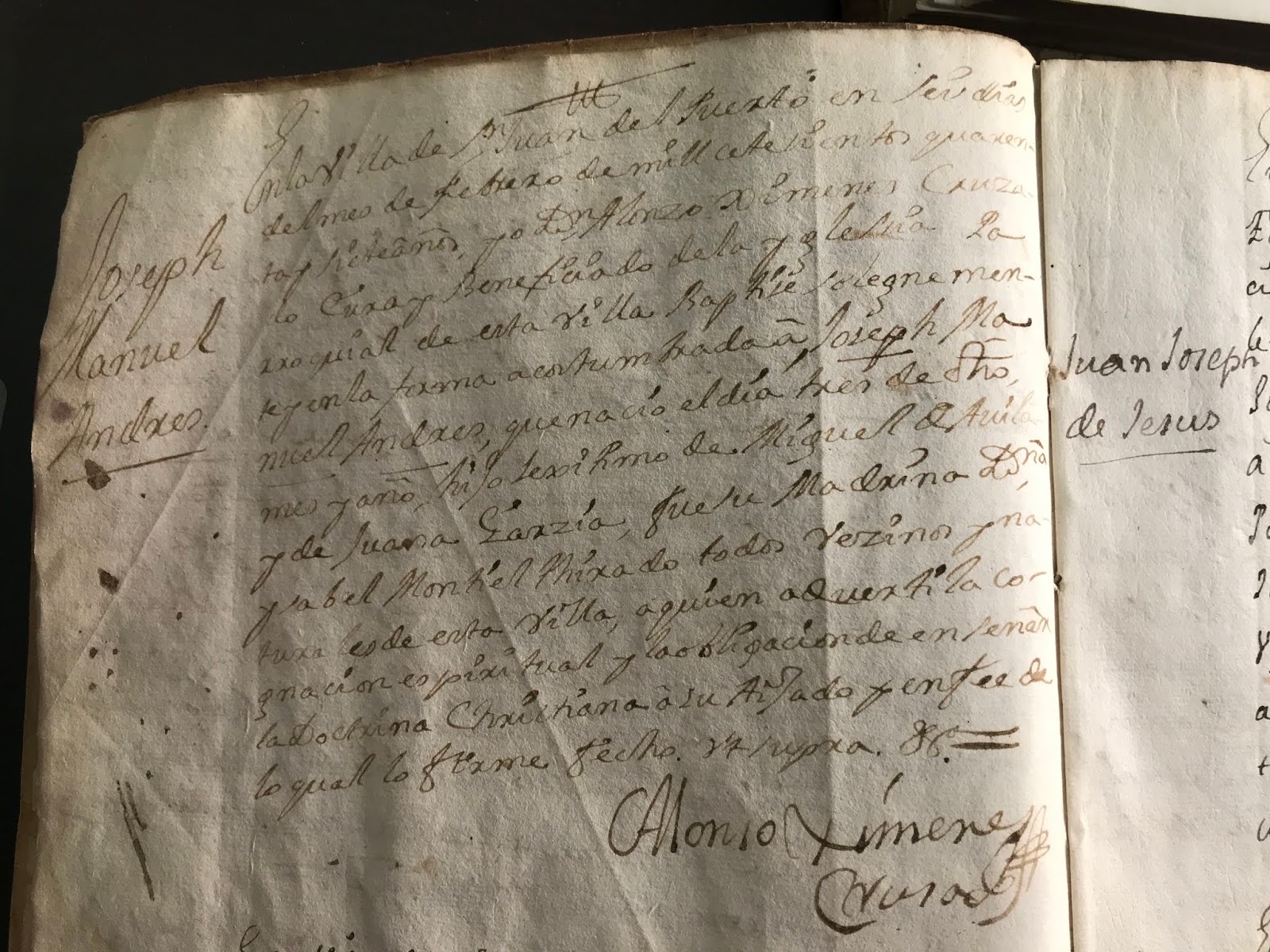
Baptism Entry for José Manuel Andrés de Ávila García [San Juan del Puerto Parroquial Record]

I noticed two things right away when I came across the entry: 1) The full name was José Manuel Andrés and the first two names "José Manuel" was also the name of my 4th great-grandfather born in 1818 in Maunabo, Puerto Rico - son of Bartolomé Dávila Cantos & María Cándida Rodríguez. 2) The father was actually "de Ávila" the symbol between Miguel and Ávila represented "de", also carried over and used in Puerto Rican church records.

So now I had a José Manuel Andrés de Ávila (Dávila) García, son of Miguel de Ávila and Juana García born the 3rd of January 1747. Could this be my ancestor? A few things overlapped: the use of "José Manuel", name given to my 4th great-grandfather, the use of the "de Ávila" surname, and the fact that the age was perfect. Back in Puerto Rico "José de Cantos Dávila" had his first daughter Catalina Dávila around 1765 (baptism not found yet) and the first official documented child my 5th great-grandfather Bartolomé Dávila in 1775, this would make this "José Manuel Andrés Dávila" about 28 when my 5th great-grandfather was born. Could it be him though? Luckily, the volunteer was pretty involved in my search and recommended I check to see if he married or died in the town, I went through the indexes searching for him and came up with nothing. No marriage, no death in San Juan del Puerto. With no other direction to go in, I decided to keep searching José Manuel Andrés' family and see what I could discover. 

My next step was searching for Miguel de Ávila and Juana García's marriage record. Since José Manuel's baptism record said that everyone mentioned were natural and neighbors of the town then technically they should have married in San Juan del Puerto. I searched within the 1742-1775 marriage book searching from 1747 backwards to see if I could find a Miguel de Ávila marrying in the town. 

Marriage Book 1742-1775 [San Juan del Puerto Parroquial Records

Bingo! - In the book I was able to find the marriage of Miguel de Ávila and Juana García. When I started reading the record I let out a kind of "oh" - Miguel's father was named "Bartolomé"! If you remember, Bartolomé Dávila was the name of 5th great-grandfather back in Puerto Rico! So here we now had two family names repeating themselves across various generations, the use of José Manuel and Bartolomé. I looked up at the volunteer and told him about the use of Bartolomé as well as José Manuel in my family back in Puerto Rico and that the information was lining up so far and that these were pretty big coincidences. He then told me that some coincidences are too hard to ignore. The next piece of information I would find would seal the deal for me.

Name repetition across various generations in my pedigree [Personal Photo]

I decided to keep searching this "de Ávila" family who had some pretty evident coincidences with my family back in Puerto Rico. My next search was for a marriage record for this Bartolomé Dávila, I was pretty surprised how lucky I was getting with finding records so far, since I was now reaching into the 1600s with this branch. And just like that I found Bartolomé Dávila's marriage record in the late 1600s, and when I read the name of his parents I jumped - his parents were named Miguel de Cantos and Francisca de Ávila. The surname I had seen in Puerto Rico had finally appeared in records! I told the volunteer about finally finding the "de Cantos" surname and he nodded, as if saying "this is it!".

Back in the days the tradition of using surnames wasn't as solidified in Spanish society as it is now, up until the 1600s and maybe even early 1700s surnames were chosen based off status and popularity of a certain surname. In this case, the "de Ávila" family had more status in the town (as I would later learn more about via a book of the Dávila family the volunteer found and copied for me) and thus the children became "Dávila/de Ávila" versus using the father's "de Cantos". Sometimes children even took the name of grandparents such as maternal grandmothers who came from illustrious families making genealogy in this time frame a bit more complicated, sometimes even siblings carried different surnames! However, it seems that years later the children especially José Manuel Andrés was still aware of this "de Cantos" name and would tack it on creating the "de Cantos Dávila" combination I repeatedly saw across various Puerto Rican records - yet 300 years later, Dávila would prevail and stay as the family's surname even up until today. 

As I kept searching throughout the town records, the use of "de Cantos" was very scant - practically no one in the town had the surname besides one other man who could probably be a father, uncle, sibling, or cousin to Miguel de Cantos. I imagine that this family maybe came from a nearby town but unfortunately there were a couple of books missing so finding the marriage for Miguel de Cantos and Francisca de Ávila was not possible.

Conclusions

In the 2-3 days that I was able to visit the church I was able to discover quite a bit. I was able to find a baptism record for a José Manuel Andrés de Ávila García born in 1747, though at first I was hesitant to believe this was my ancestor finding his grandfather's marriage record where it mentions his parents were surnamed "de Cantos" and "de Ávila" was helpful to me to solidify the theory that this man was one and the same to my 6th great-grandfather. I was able to trace about 2-3 generations back from José Manuel Andrés de Ávila and luckily I was given a copy of the Dávila/de Ávila book which traces the family's origins back to the mid-1400s. I have to read through the book again and see where I can find records to back up the family tree presented in the book. 

Before I parted ways with the volunteer, I thanked him for his time and asked how I could reach out to him in the future if I wanted to come back. He told me he worked for the diocese itself and had seen my email before my friend had called, which is good to hear because electronic communication is easiest across countries and time zones, I believe. I had also asked if there was any effort to digitalize documents and he said that since they were a small church the odds of that happening soon seemed little to none, funding would have to come from the church and it seems like too much of a monumental task at the moment for them - especially considering that there is only one volunteer who has a life/job as well. 

I also asked if I could see the inside of the church and leave a 'thank you donation' before I left. Mass had just ended so he went inside to find the parish priest to let him know I wanted to leave a donation. In the meantime I peaked inside the church and took some photos, it's always odd to see places where my ancestors would have stood because their history connects me to this location. To believe that my 8th great-grandfather would have married here in the late 1600s is kind of mind-boggling. 

Inside of La Iglesia Parroquial San Juan Bautista [Personal Photo]

After snapping some pictures I was presented to the priest, I told him I wanted to leave a donation and so he went to the back and got a donation envelope for me to leave behind money. I personally decided on leaving 50€ (about $55 USD), which isn't much but I wanted them to see I was appreciative of their efforts to conserve these documents. 

Thank you note and donation [Personal Photo]

Future Research

There is still much to research! Since I had limited time I basically focused on the main ancestor branches that would be my direct ancestors and tried to follow their trails as quickly as possible. Of course, there is still much desired to discover such as siblings and other records I might have glanced over in my haste to not waste time. Also, there are a few books missing here and there that might hinder my search for ancestors that might have migrated in from other towns. My goal is to hopefully visit San Juan del Puerto sometime in the near future and be able to dedicate enough time to searching without feeling too rushed - of course this would depend on how much time I can stay in the church researching and for how long I will be in Spain as well. So far I have been fortunate enough to research this branch and find out all that I did in the limited time I was there. Of course, with any research that is genealogy based there is the possibility that I've traced an incorrect family and miss associated my ancestor with them. So far, I am going off various elements of my research and I'm hoping that my research is correct and sound. 

For the time being, I will continue to search around the towns of Coamo and Maunabo and see if I can find a mention of "José de Cantos Dávila's" parents in order to help solidify the identity of my 6th great-grandfather. My current hunt is a death record for José Dávila or a marriage record which may shine some more light on my 6th great-grandfather!


Statue in front of Iglesia San Juan Bautista [Personal Photo]