Back in October 2018 (almost a year ago now), I posted about my
Dávila-Cantos family who I had at the time traced via genealogical records on the island of Puerto Rico from Maunabo to Coamo and ultimately back to a town in Spain. That was where my search had ended - with the name of 6th great-grandfather, José de Cantos Dávila, and a yearning to want to discover more about this family in Spain. I was unaware of the possibilities of me actually discovering anything about them there but I figured since I was going to be in Spain this summer I would try and head down to San Juan del Puerto and figure out the archival situation there. This post will detail my experience before heading to Spain and up to the point of searching the archival records there and how I went about it. Hopefully this can be seen as a useful guide for those of you who have discovered ancestors from Spain but aren't fully aware of how to go about searching them in their respective towns.
What I Knew
The first part was laying out all of the information I knew about my ancestor from San Juan del Puerto, a small town (of about 8.5K inhabitants) a part of Huelva, in the southern region of Andalucía. Because his first child was born in Puerto Rico, I figured he probably married there and came alone from Spain. From the information I had attained on him from the parroquial records of Puerto Rico, I had no parent names or sibling names so I knew it wasn't going to be a quick and easy search. However, luckily San Juan del Puerto is a small town and if he actually was from there then I didn't imagine the search would be too difficult.
For simplicity and "direct application's" sake, I am going to use my ancestor's information throughout the post to help provide actual examples to show how this information had grown throughout my searches. This was what I knew so far:
Name: José Cantos/de(l) Canto Dávila
Birth: 1730-1750, San Juan del Puerto, Huelva, Spain
Marriage: Josefa García Rodríguez y Bonilla; Puerto Rico
Death: Coamo, Puerto Rico
Because I have no marriage or death record for José Cantos Dávila I wasn't sure of his parents' names and thus I was going into this search almost blindly.
Before Arriving
I had read on another genealogical blog that reaching out to the church or diocese was the best move in terms of knowing who you needed permission from and how to go about spending time in the archives. Unfortunately for me this was the hardest part! First, I was able to locate the website for the town, I had sent an email to various people in hopes that I would receive permission to research my ancestors. After about a week and a half I had gotten no response about visiting the church and whether or not I would be able to conduct research there. Fortunately for me, I had a friend "on the ground", a friend who lives in Madrid and who was able to call and figure out the situation. By the time I was in Madrid myself, I had gotten the okay to do research and the phone number for the volunteer in charge of helping people in the church. If it wasn't for my friend I would have had to call internationally and to a different time zone in hopes of catching them at the right time. Given the green light for research, I planned my visit to the town.
Getting There, Part I - Huelva
When I travel, I use an awesome website called
Rome2Rio which gives you various options on how to get to where you're going, the time it'll take, and also the costs. What I like about the website is that you can build a route that includes various cities and countries and see which are the most convenient ways to get there and how much it'll approximately cost you in total. Since San Juan del Puerto is a small town I wanted to see what my options were.
 |
| Madrid to San Juan del Puerto Rico [Rome2Rio] |
Since there weren't many AirBnB housing options in San Juan del Puerto I could stay in farther away Sevilla and take the train/bus or closer in Huelva and take the bus in - ultimately I decided on Huelva since it was closer to San Juan del Puerto and unlike Sevilla I had never been there before. I decided I would take the train into Huelva from Madrid, stay at a hotel centric enough to the train and bus station, and commute to San Juan del Puerto. Watching the landscape change was beautiful and being in Huelva was very calming, I think there was a combination of small town feel + people being away for summer vacation that gave the town an eerily calm and deserted feeling. After being in Madrid and Barcelona, I didn't mind the calm!
 |
| Landscape view from the train - between San Juan del Puerto and Huelva [Personal Photo] |
 |
| Old Huelva Station [Personal Photo] |
 |
| ¡Llegué!/ I have arrived! [Personal Photo] |
 |
| Walking around the deserted streets of Huelva [Personal Photo] |
Getting There, Part II - San Juan del Puerto
In the town of Huelva there is a local bus company called "Damas" that runs the route from Huelva to San Juan del Puerto various times a day for 1.75€. Since I was going to be researching mainly in the evening I found times close enough to when I wanted to head over to the town and went to the bus station. In San Juan del Puerto the stops are basically one before entering town and the other at the other end of town practically exiting the town. I decided to get off at the first stop and walk into town, that way I could see the entrance sign versus doing a reverse trip into the town.
 |
| Bus Stop in Huelva [Personal Photo] |
 |
| Bus Stop in San Juan del Puerto [Personal Photo] |
 |
| Town Sign "San Juan del Puerto" [Personal Photo] |
 |
| Statue dedicated to traditions from San Juan del Puerto [Personal Photo] |
 |
| Street dedicated to the island of Puerto Rico [Personal Photo] |
 |
| Iglesia de San Juan del Puerto [Personal Photo] |
Researching
 |
| Researching the church records in San Juan del Puerto [Personal Photo] |
Once I headed to San Juan del Puerto, I grabbed some snacks and water at the nearby Día supermarket and sat in the main square waiting to met the volunteer who would help me with the records. I was fortunate to have his personal number so I was able to call him in advance that day, set our meeting time, and then call when I had reached the town. Also, I was fortunate to have an American phone plan that allowed me to call for only .25¢ for every minute. After our introductions and explaining what I was searching for we settled in the office where the documents are held. Every church and diocese is different so I can't speak for all Spanish churches in regards to genealogy, for example here in San Juan del Puerto the volunteer sat with me while I researched, while other churches will trust you with the records in the room and occasionally check in on you.
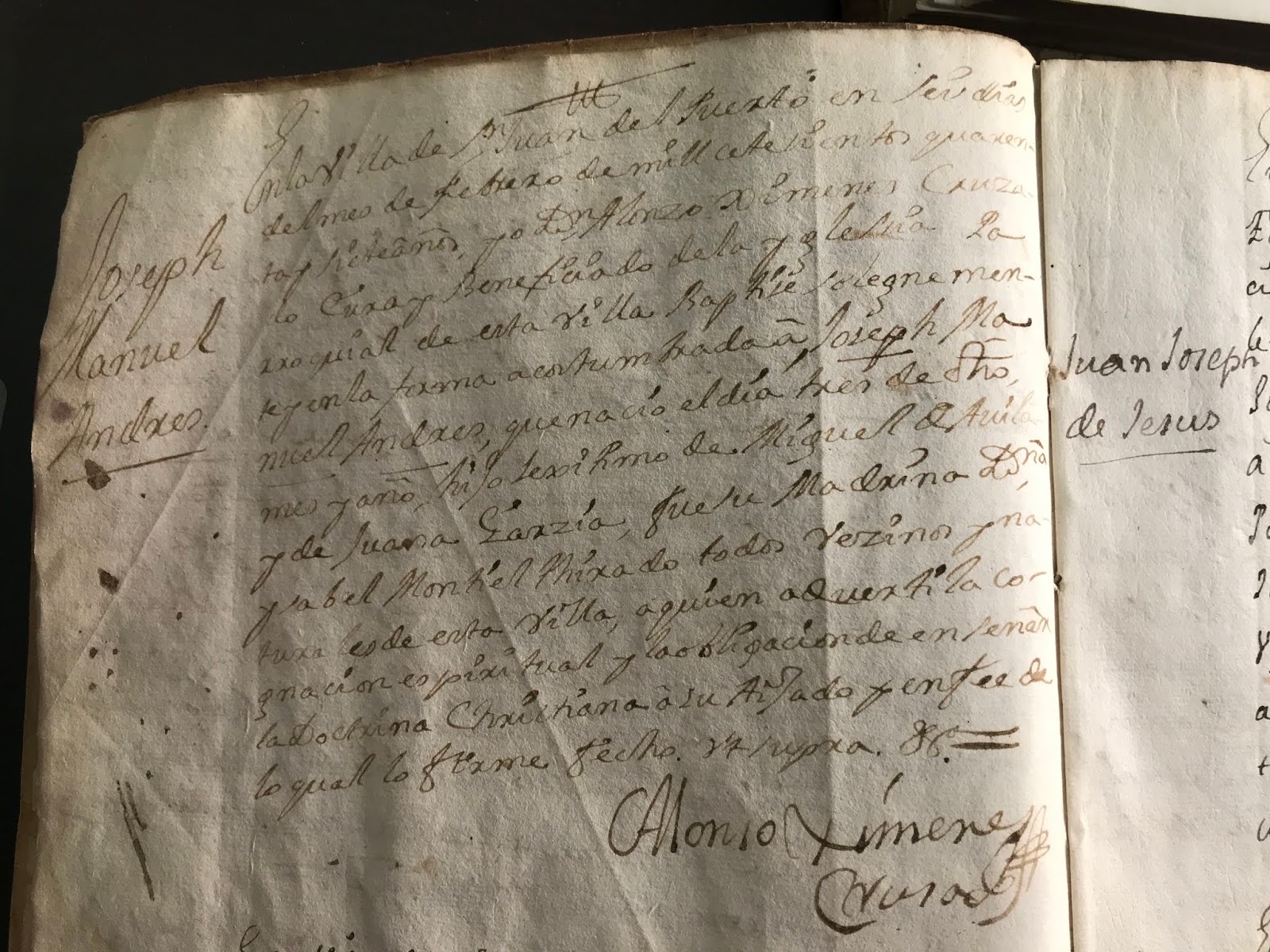
My first quest was using the index (whew, thank God they had one!) to find my ancestor. The index for the town baptisms didn't cover all available years, however, it did cover the range I was searching for, and the index was based on first names which can be a hit or miss. If your ancestor went by their middle name or had a combination of names that wasn't the first one you knew in the New World, then your search could end in nothing - so honestly I was nervous. I jumped to the "J" section and in the mid-1700s looking for a José Cantos or a José Dávila. In the index it mentions the name of the baptized child and the name of his/her parents, so ideally this would be easy I would search for a "Cantos Dávila" "Dávila/de Cantos" combination next to a José and be done, right?! So I set off on my search and didn't find much, a bunch of Josés being baptized, but none had a surname Cantos or Dávila. I looked up at the volunteer from the index book and asked if the surname "de Cantos" was common in the town, he told me he hadn't really heard it before and I then asked about the surname "Dávila", to which he said yes and that there was a well known branch which had been written about. I kept searching and finally came across a "José Ávila García" and shook my head. This couldn't be my ancestor since he was Ávila García and my ancestor was Dávila Cantos. This being my only lead in the mid 1700s (I then searched a little before and after to rule out an older man or lately registered child) so I decided to check it out. I asked the volunteer for the book in the mid-1740s, jotted down the book number and folio (page) number and dove in. I was able to find a record and this was the entry:
 |
| Baptism Entry for José Manuel Andrés de Ávila García [San Juan del Puerto Parroquial Record] |
I noticed two things right away when I came across the entry: 1) The full name was José Manuel Andrés and the first two names "José Manuel" was also the name of my 4th great-grandfather born in 1818 in Maunabo, Puerto Rico - son of Bartolomé Dávila Cantos & María Cándida Rodríguez. 2) The father was actually "de Ávila" the symbol between Miguel and Ávila represented "de", also carried over and used in Puerto Rican church records.
So now I had a José Manuel Andrés de Ávila (Dávila) García, son of Miguel de Ávila and Juana García born the 3rd of January 1747. Could this be my ancestor? A few things overlapped: the use of "José Manuel", name given to my 4th great-grandfather, the use of the "de Ávila" surname, and the fact that the age was perfect. Back in Puerto Rico "José de Cantos Dávila" had his first daughter Catalina Dávila around 1765 (baptism not found yet) and the first official documented child my 5th great-grandfather Bartolomé Dávila in 1775, this would make this "José Manuel Andrés Dávila" about 28 when my 5th great-grandfather was born. Could it be him though? Luckily, the volunteer was pretty involved in my search and recommended I check to see if he married or died in the town, I went through the indexes searching for him and came up with nothing. No marriage, no death in San Juan del Puerto. With no other direction to go in, I decided to keep searching José Manuel Andrés' family and see what I could discover.
My next step was searching for Miguel de Ávila and Juana García's marriage record. Since José Manuel's baptism record said that everyone mentioned were natural and neighbors of the town then technically they should have married in San Juan del Puerto. I searched within the 1742-1775 marriage book searching from 1747 backwards to see if I could find a Miguel de Ávila marrying in the town.
 |
| Marriage Book 1742-1775 [San Juan del Puerto Parroquial Records] |
Bingo! - In the book I was able to find the marriage of Miguel de Ávila and Juana García. When I started reading the record I let out a kind of "oh" - Miguel's father was named "Bartolomé"! If you remember, Bartolomé Dávila was the name of 5th great-grandfather back in Puerto Rico! So here we now had two family names repeating themselves across various generations, the use of José Manuel and Bartolomé. I looked up at the volunteer and told him about the use of Bartolomé as well as José Manuel in my family back in Puerto Rico and that the information was lining up so far and that these were pretty big coincidences. He then told me that some coincidences are too hard to ignore. The next piece of information I would find would seal the deal for me.
 |
| Name repetition across various generations in my pedigree [Personal Photo] |
I decided to keep searching this "de Ávila" family who had some pretty evident coincidences with my family back in Puerto Rico. My next search was for a marriage record for this Bartolomé Dávila, I was pretty surprised how lucky I was getting with finding records so far, since I was now reaching into the 1600s with this branch. And just like that I found Bartolomé Dávila's marriage record in the late 1600s, and when I read the name of his parents I jumped - his parents were named
Miguel de Cantos and
Francisca de Ávila. The surname I had seen in Puerto Rico had finally appeared in records! I told the volunteer about finally finding the "de Cantos" surname and he nodded, as if saying "this is it!".
Back in the days the tradition of using surnames wasn't as solidified in Spanish society as it is now, up until the 1600s and maybe even early 1700s surnames were chosen based off status and popularity of a certain surname. In this case, the "de Ávila" family had more status in the town (as I would later learn more about via a book of the Dávila family the volunteer found and copied for me) and thus the children became "Dávila/de Ávila" versus using the father's "de Cantos". Sometimes children even took the name of grandparents such as maternal grandmothers who came from illustrious families making genealogy in this time frame a bit more complicated, sometimes even siblings carried different surnames! However, it seems that years later the children especially José Manuel Andrés was still aware of this "de Cantos" name and would tack it on creating the "de Cantos Dávila" combination I repeatedly saw across various Puerto Rican records - yet 300 years later, Dávila would prevail and stay as the family's surname even up until today.
As I kept searching throughout the town records, the use of "de Cantos" was very scant - practically no one in the town had the surname besides one other man who could probably be a father, uncle, sibling, or cousin to Miguel de Cantos. I imagine that this family maybe came from a nearby town but unfortunately there were a couple of books missing so finding the marriage for Miguel de Cantos and Francisca de Ávila was not possible.
Conclusions
In the 2-3 days that I was able to visit the church I was able to discover quite a bit. I was able to find a baptism record for a José Manuel Andrés de Ávila García born in 1747, though at first I was hesitant to believe this was my ancestor finding his grandfather's marriage record where it mentions his parents were surnamed "de Cantos" and "de Ávila" was helpful to me to solidify the theory that this man was one and the same to my 6th great-grandfather. I was able to trace about 2-3 generations back from José Manuel Andrés de Ávila and luckily I was given a copy of the Dávila/de Ávila book which traces the family's origins back to the mid-1400s. I have to read through the book again and see where I can find records to back up the family tree presented in the book.
Before I parted ways with the volunteer, I thanked him for his time and asked how I could reach out to him in the future if I wanted to come back. He told me he worked for the diocese itself and had seen my email before my friend had called, which is good to hear because electronic communication is easiest across countries and time zones, I believe. I had also asked if there was any effort to digitalize documents and he said that since they were a small church the odds of that happening soon seemed little to none, funding would have to come from the church and it seems like too much of a monumental task at the moment for them - especially considering that there is only one volunteer who has a life/job as well.
I also asked if I could see the inside of the church and leave a 'thank you donation' before I left. Mass had just ended so he went inside to find the parish priest to let him know I wanted to leave a donation. In the meantime I peaked inside the church and took some photos, it's always odd to see places where my ancestors would have stood because their history connects me to this location. To believe that my 8th great-grandfather would have married here in the late 1600s is kind of mind-boggling.
 |
| Inside of La Iglesia Parroquial San Juan Bautista [Personal Photo] |
After snapping some pictures I was presented to the priest, I told him I wanted to leave a donation and so he went to the back and got a donation envelope for me to leave behind money. I personally decided on leaving 50€ (about $55 USD), which isn't much but I wanted them to see I was appreciative of their efforts to conserve these documents.
 |
| Thank you note and donation [Personal Photo] |
Future Research
There is still much to research! Since I had limited time I basically focused on the main ancestor branches that would be my direct ancestors and tried to follow their trails as quickly as possible. Of course, there is still much desired to discover such as siblings and other records I might have glanced over in my haste to not waste time. Also, there are a few books missing here and there that might hinder my search for ancestors that might have migrated in from other towns. My goal is to hopefully visit San Juan del Puerto sometime in the near future and be able to dedicate enough time to searching without feeling too rushed - of course this would depend on how much time I can stay in the church researching and for how long I will be in Spain as well. So far I have been fortunate enough to research this branch and find out all that I did in the limited time I was there. Of course, with any research that is genealogy based there is the possibility that I've traced an incorrect family and miss associated my ancestor with them. So far, I am going off various elements of my research and I'm hoping that my research is correct and sound.
For the time being, I will continue to search around the towns of Coamo and Maunabo and see if I can find a mention of "José de Cantos Dávila's" parents in order to help solidify the identity of my 6th great-grandfather. My current hunt is a death record for José Dávila or a marriage record which may shine some more light on my 6th great-grandfather!
 |
| Statue in front of Iglesia San Juan Bautista [Personal Photo] |