Saturday, April 26, 2014

Happy DNA Day!!

April 25, 2014 [DNAart]
I know I am a day behind with this post but I still wanted to publish it! DNA has truly changed the way I view myself, my culture, my history, and my view on the world. I wanted to share a bit why taking a DNA test was important to me.

Before taking my 23andme test, which back then was a hefty price ($500), I didn't really know what to think of myself. I knew that my history was full of multicultural ancestors, yet how much of me was actually native Taíno, African, or European? I had always been proud to be Puerto Rican and my tree was definitely helping me to realize more and more how deep my roots are on the island, yet I still had no idea what continents my lines ran back to.

Parranda en Puerto Rico [ElBoricua]

Taking the 23andme test and later the AncestryDNA test really helped to show how mixed our culture, my culture, really was. I learned about my Y-DNA, mtDNA, and my ancestral composition. I learned that my Y-DNA traces back to the area between Spain and France where the Pyrenees lie; this wasn't too surprising since many Spaniards came to Puerto Rico. I learned that my mtDNA traced back to the natives of the Americas and probably specifically to the native Taíno and/or Arawaks who lived in Borikén before the arrival of Cristóbal Colón. I also learned that while I am little over half European, I do carry about 15% and 12% African and Native American genes respectively. Other haplogroups in my family tie into various groups such as: West Africa, Middle Eastern/Jewish, Irish, English/French, and there is more to learn about.

Ancestry Composition - Luis Rivera [23andme]

I learned that even though my family has been on the island of Puerto Rico for at least 200+ years I have ancestors who immigrated to Puerto Rico from Martinique and Guadeloupe, bringing their own culture and identity with them to their new land. In that 15% Sub-Saharan African, I carry their names, their stories, their memories.

Many of us come from very complex and interesting backgrounds, we have to learn more from both a genetic and historic standpoint to understand who we are here today. I am a combination of curious explorers, friendly natives, and determined slaves. I have learned to view the world differently, that skin color doesn't make or break your identity and that there is more than meets the eye. My DNA results have made me proud of all aspects of my ancestry, to realizing that I am my own melting pot. 

So Happy DNA day: take your own DNA test, test someone in your family, or learn more about your results! I don't think you'll regret it!

Spanish, Taíno, Africans [TainoNationNews]

Friday, April 25, 2014

52 Ancestors – #17 Bartolomé Dávila Cantos

It's probably only been just about a full year that I have known about my 5th great grandfather Bartolomé Dávila Cantos. Having returned to New York City from college I was able to visit the FamilySearch center more and got to use more microfilm rolls for the churches of Puerto Rico. One of the towns I really wanted to research was the town of Maunabo where I have maternal roots. I have written about Pedro Dávila Ruiz, my 2nd great grandfather and Bartolomé would be Pedro's great grandfather.

Maunabo, Puerto Rico - Coat of Arms [Google]

I've talked about Maunabo in previous posts - it's a town located on the southeastern coast of Puerto Rico and was founded in 1799. By switching to the Spanish Wikipedia page of Maunabo I was able to learn that the town's first residents were people of Guayama. The town also suffered badly from the hurricane San Ciriaco in 1899, destroying most of its stores and the town's sugar mill "La Bordaleza". Also, from 1902-1905 the town was annexed to Yabucoa due to a law enacted by the Legislative Assembly of Puerto Rico. 

Faro Punta Tuna - Maunabo, PR [Rainforestsafari]

I'm not sure if Bartolomé himself was from Guayama but he was most likely born circa the 1780s, which is a few years before the founding of Maunabo. Since I went only through the baptism records, I was only able to find the records of Bartolomé's children and grandchildren being baptized in the church . So far I have been able to find six children's baptism records with his wife María Candida Rodríguez: José Laureano, Juliana, José Manuel, María Feliciana, Francisca, and Manuel Dávila Rodríguez. I am a descendant of José Manuel Dávila Rodríguez who was born on the 19th of March 1818 and baptized the 30th of March. His godparents were Manuel Cintrón and Nicolasa Baerga.

I actually don't know when Bartolomé passed away either, it seems that no death records were indexed by the LDS church, and I hope that doesn't mean that Maunabo doesn't have them. Hopefully they never got the chance to index them and Maunabo has them safely tucked away in their church. 

I wonder what Bartolomé's background was, there is family lore that the Dávilas were a Spanish family but of course you always hear those stories in Puerto Rico with all your family lines. Using the little nifty last name tool I found last week it seems that the surname name Dávila can be found mostly towards the western side of Spain in Pontevedra, Badajoz, and the Canary Islands. These maps however aren't conclusive on where my lines are from, they just provide some ideas as to where the surnames are currently mostly found in Spain. 

Dávila Frequency Map in Spain [INEBase]

Currently trying to get a Dávila Y-DNA-carrying male cousin tested to see what haplogroup Bartolomé and the other Dávila men would belong to -- the adventure continues!

Monday, April 21, 2014

Mystery Monday: Who IS the Father?!

One of the mysteries that I'm currently facing (one of the many, of course!) is the name of Julienne Malvina's father.

Since Julienne was born a slave in Martinique, I was lucky to have found the birth record of my 4th great grandmother in 1844. Julienne was recorded as a négresse which most likely means that her father was a slave as well to the Garnier-Laroche/ Lapierre family. But who among the men there was the father?!

Julienne was one of five children I have been able to find from their mother Eglantine Lautin. (Thanks to the help of David, of course!) Julienne was the first born in 1844 and then came her sister Pauline in 1846. Her brother Jean was born in 1851 and next came her sister Marie in 1855 and lastly Rose in 1858. Only Julienne and Pauline were born during slavery and the rest were born after emancipation. All received the surname Lautin from their mother, who received the surname during registration on the 21st of December 1848.

Yet who was the father!? In Puerto Rico a record mentions the name of the father as "Pedro". Was that the father's first name, last name, or just a random name used to add simply a father's name? Searching for all the slaves belonging to the Garnier-Laroche/ Lapierre plantation born during slavery I was able to find a family who received the name "Pitroo". Could the name "Pedro" be the Spanish-ified version of Pitroo??

Something interesting happened with Marie Lautin in 1862 -- she was recognized by her father! On the 4th of March 1862 a man named Adrien Boudré came forward and recognized Marie as his legitimate daughter.

Reconnaisance Marie Lautin- Adrien Boudré [ANOM]

Thanks to the Actes d'Individualités I was able to find Adrien living in Trois Bourgs, section of Rivière Salée, a native of Africa about the age of thirty. His parents are unknown being that he was born in another continent and brought over as a slave. Adrien was registered in the same Registry book that Eglantine was (Registry C) and his number was 11 while Eglantine was 192. Could they have known each other before arriving to Martinique?

Acte d'individualité- Adrien Boudré [ANOM]

What's interesting is that Marie is the product of two slaves directly from Africa. Was that the case with Julienne as well, and could Adrien Boudré be her father as well? I don't know if Julienne was still in Martinique in 1862 but a short five years later she was already living in Puerto Rico and giving birth to my 3rd great grandmother. Marie would go on to name son born in 1890 after her father, Adrien but Julienne named none of her sons Adrien.

My guess is that Eglantine and Adrien had a one time fling and produced Marie, while the other children belong to another father/fathers. My hope is to find a descendant of Jean Lautin (brother of Julienne) and see find out what the paternal line is -- which in essence I hope belongs to Julienne Malvina's father as well. 

Until then we have another mystery on our hands, and only time, documents and DNA can help unravel this mystery 170 years in the making!

Saturday, April 19, 2014

The Many Voyages of Tomás Charles

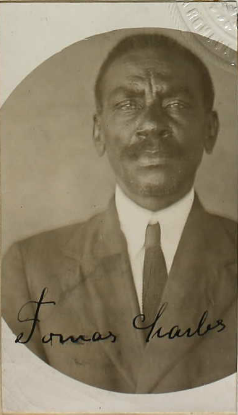
Recently while searching through ancestry's database I noticed there was an update on the "San Juan, Puerto Rico, Passenger and Crew Lists, 1901-1954" and even though I didn't have many different ancestors that traveled to the US and elsewhere I decided to search for my Charles/Gustave ancestors who indeed traveled a bit. My first and main search was for Tómas Charles Lotin [sic] who had lived and worked for a bit in La Romana, Dominican Republic as a carpenter. I knew that Tomás had left Guánica on the 29th of October 1916 and returned to Puerto Rico on the 31st of May 1918. Yet were those the only times Tomás came and left Puerto Rico. I decided to dig a little further. I searched for Tomás Charles in the database and was surprised with the number of hits! See below how many voyages were found for a Tomás/Thomas Charles.

Voyages of Tomás Charles [Ancestry]

The first six voyages seemed for sure to match the Tomás Charles I had and the latter half of the list interested me. Here are the some of the voyages Tomás my 3rd great-uncle took in chronological order and some information that the manifest lists revealed to me. Get ready to journey the Caribbean!

Tómas Charles- Passport Photo [Ancestry]

The first voyage I find is on a ship called the SS Falcon which traveled from La Romana, Dominican Republic the 7th of March 1917 and arriving in the port of Guánica, Puerto Rico on the 8th of March 1917. He is listed as Tomás Charles, Male, Married, born in Vieques, PR on the 29th of December 1873. All of the information matches what I have almost to a "T" except he was born on the 28th of December 1869, his birthday creeping up and making him younger will come to play a little later. The boat was inspected by Immigration Officer Frank L. Dayton and listed that only three men of "Porto Rican Citizenship" were on board. 

Tomás Charles- SS Falcon [Ancestry]

A few months later Tomás can be seen traveling from La Romana and this time arriving at the port of Ponce, Puerto Rico on the 29th of September 1917. All of the information provided for Tomás reminded the same. This time however 30 passengers in total were listed on the manifest.

Tomás Charles- SS Marina [Ancestry]

It seems that Tomás took about four more voyages between the Dominican Republic to Puerto Rico in the years 1918, 1920, and two voyages in 1921. Interestingly, during this voyage in 1918 to Ponce he is listed with a wife and child. The wife is named Valentina Malave[s] and their son Hipolito, finally some more information is provided about this mysterious Valentina! It seems she might have been Tomás' first wife and was listed in his passport record. On the manifest record she is listed as being from Peñuelas, Puerto Rico and born on the 20th of January 1876. According to Tomás' second marriage to Ramona Cortes his first marriage ended with no children, I'm still very confused as to who Valentina was and what role she played.

Valentina Malaves and Hipolito Charles- Passport Photo [Ancestry]

Tomás, Valentina & Hipolito- SS Marina [Ancestry]

On his next voyage on the SS Cricket he is listed as traveling alone from the Dominican Republic to Guánica in 1920. 4 other passengers and Tomás himself were listed on the manifest list. Similarly, in 1921 Tomás travels alone from La Romana, DR to Guánica, PR. While abroad the SS Romanita and the passengers listed how they proved their citizenship: some with birth certificates, others with witnesses and affidavits, but Tomás is listed "Known to the Inspector". I imagine he knew the inspector from all the travels between La Romana and Guánica.

Tomás Charles- SS Romanita [Ancestry]

One of the last voyages in which Tomás took included his second wife Ramona Cortes, his mother-in-law Magdalena Cruz and their three sons: Inés, Hipolito, and Juan. They took the SS Falcon from La Romana on the 21st of July 1921 and arrived in the port of Guánica on the 22nd of July, 1921. 

Tomás, Ramona, Magdalena, Inés, Hipolito, & Juan- SS Falcon [Ancestry]

What interested me the most about searching the database was that another Tomás/Thomas Charles appeared as well. This Thomas was slightly younger (born circa early 1880s) and was traveling between Puerto Rico and Saint Thomas. What's interesting is that I have yet to find another Thomas/Tomás Charles living in Puerto Rico. I do know that my Tomás Charles eventually moved up to San Juan and lived there throughout the 1930, 1935, and 1940 census records. I do know that there were other Charles families living in Puerto Rico, and their countries of origin varied as well. But could this Thomas Charles be the same man as my Tomás Charles? Their identity as a black male around 5'8" and living in San Juan definitely give me an inkling that it could be the same man. The year of his birth is slightly off, but seriously, Puerto Rican records are riddled with errors and why not make yourself a bit younger anyways if no one really cared? The only thing is that this Thomas Charles was married to a woman named Angelina and had a few children with her. Could it be wife #3?

I have heard stories that my Charles family had distant relatives or originated in Saint Thomas. Documents point to Gustave Jean-Charles having lived in Guadeloupe, but what if he originally was from Saint Thomas or his parents were? I don't know if this is the same man or what, I'd have to find more records to officially tie the two together or not. There are definitely some overlapping information going on and it's just going to take sifting through records and information to see if they could be the same man. Time to put on my detective hat once again!

Friday, April 18, 2014

52 Ancestors – #16 Cayetano Mercado Cajigas (1855-1905)

When looking through records for my family in Puerto Rico, I have been fortunate that many of my ancestors have lived either in the same town or a neighboring town for many years if not generations. Some of the migrations across the island in my family happened early when many of the towns were being created such as from Toa Alta to Corozal or from Coamo to Salinas. However, there are a few ancestors who seemed too antsy to stay put in one single town. There are many external reasons from wanting to move to a new town: new opportunities for work and land, droughts/bad weather, and of course running away from the past in order to start a new life. One of my 3rd great grandfathers on my paternal side of the family was born in one town, married in another, and died in another. So tracking him down wasn't the easiest of jobs - this is my 3rd great grandfather Cayetano Mercado Cajigas.

Cayetano Mercado Cajigas- Moving Around Puerto Rico

Cayetano Mercado Cajigas is my 3rd great grandfather via Felix Vélez Mercado (Cayetano was Felix's grandfather) yet they would never have the chance to meet since Cayetano passed away in late 1905 while Felix was born in early 1905. When I first discovered Cayetano I had no idea where he was born, I had seen the possibility of Utuado, Adjuntas, Lares, and San Sebastián. It wasn't until I discovered by coincidence his marriage in Adjuntas to Cristina Cruz Pérez that I learned his place of birth. Cayetano and Cristina married in Adjuntas in 1876 and on their marriage record it mentioned that Cayetano's town of origin was "Pepino" while Cristina was from Lares, Puerto Rico. There is currently no town named Pepino in Puerto Rico but doing some research allowed me to know where the name "Pepino" came from. The name "Pepino" refers to the old town name of San Sebastián on the western side of Puerto Rico. The town founded in 1752 with the help of Captain Cristóbal González de la Cruz was recognized as "Las Vegas del Pepino" due to nearby farms. In 1865 the town was still known as "San Sebastián de Las Vegas del Pepino" (Pepino being the Spanish word for cucumber). The town would later shorten its name to San Sebastián yet the residents of this town are still to this day known as Pepinianos. 

Cayetano and Cristina seemed to have about 5 daughters in total (currently this is the number of children I have) and their order of birth are as follows: María Juliana, Enriqueta, María del Carmen, Domitila, and Eduarda. I descend from Domitila, mother of Felix Vélez Mercado. The first three girls were definitely born in Adjuntas because I was able to find their baptismal records there but it seems that Domitila (of course it would be her, my ancestor!) to have been born in either Adjuntas or Utuado. I have searched Adjuntas around the time of her birth and have found nothing, so it is very possible that she was the first daughter to be born in Utuado. I'm not sure how Cayetano and Cristina ended up in Adjuntas, whether through a family move or through their own free will. Cayetano would have been in his early 20s if he had decided to move to Adjuntas which is very possible. I would have to find death records of their parents and see if they passed away in Adjuntas or in their native towns. 

Cayetano's birth is placed around 1855-1860 in San Sebastián to his parents Francisco Mercado Tirado and his mother María Isabel/Margarita Cajigas Ramos. His death certificate in Salto Abajo, Utuado helped to provided second surnames to his parents which is a very important detail when conducting genealogical research in Puerto Rico. His mother's last name is very interesting, I had never really run into it before and it doesn't seem to be very common in Puerto Rico (at least on the eastern side of the island). It seems the surname can also be found as Cajiga and Caxigas, which to me looks like a Basque name- when certain Spanish surnames have an 'x' or sound very strange I always think of Basque names. Even though this theory might not always correct, I always associate it with the Basque country. So I decided to see if I could find a website that would create a frequency map with the surname in Spain. 

I found a website called Instituto Nacional de Estadística (National Institute of Statistics) which allows you to enter surnames and names and search for either the frequency of the name in the province of residence and/or the province of birth. I searched for "Cajigas" and its frequency in the province of birth to see where my Cajigas could have potentially originated in Spain. It seems that my theory was right for the surname "Cajigas". See below where the highest frequency is in Spain for the surname which was found in Bizkaia (Viscaya), a province of the Basque country in northern Spain. This is the first time I used a frequency map for Spain and I think I'll try and use it more often to find out more about the surnames in my family. 

Cajigas frequency in Spain [INEbase]

Cayetano was listed as being blanco in his death certificate so who knows if his background was purely Spanish or had recent immigrants to the island (of course there is the possibility that he was just white but very mixed - as I am). So far only one other daughter of Cayetano has mothered any children and that was María Juliana who had about six children with Simplicio Bermudez Villanueva, I haven't found any recent descendants of María Juliana who might have some more information about our shared Mercado Cruz family.

Cayetano did however have two brothers, one named José and another named Juan Santos, both oddly passed away in 1900- José in Manatí and Juan Santos in their native town of San Sebastián. So it is very possible to find common Mercado Cajigas descendants through those lines, only time will tell!

Sunday, April 13, 2014

52 Ancestors – #15 Joseph de Rivera

I write today about my oldest male ancestor from whom I inherited the surname Rivera, my 4th great grandfather. I don't know too much about him, so I'll just add what I do know and see where it goes from there!

When I first began my research at the age of 14 (yup, I was that young when I really started my searches), there were a few goals I had in mind. I wanted to: 1) Find out my families ethnic backgrounds, 2) Find ancestors that traced back to Spain, and 3) Find the origins of my last name. I don't know if every genealogist goes through this or if it's more common amongst the male genealogists, but I wanted to know where my Rivera last name came from. Especially since I could and hopefully one day will pass this surname to my children, I wanted to know what it meant to be a Rivera descendant. The surname I carry everyday and identify myself with - the surname I sign on all my documents.

Don't get me wrong, I love both of my parents' surnames and definitely revere my mother's, but being born in the USA and only carrying one instead of both made me think a lot more about Rivera. When I started my search, it was definitely hard. Rivera is one, if not the #1, of the most common surnames in Puerto Rico. I had absolutely no idea where the name came from within Puerto Rico and only knew that my grandfather was born in San Juan, Puerto Rico. One genealogy-altering conversation with my aunt revealed to me that my great grandfather was born in Toa Alta, Puerto Rico and from there the family would begin to unravel itself.

Toa Alta, Puerto Rico [Google]


My Rivera ancestors have been in Toa Alta for about 150 years from what my research has shown. My great-aunt herself was born in Toa Alta and I imagine we still have distant cousins and family members there. With the help of the Toa Alta Civil Registry records as well as church records, I have been able to trace my surname back to a Joseph de Rivera. Equally, my Toa Alta family has lived through most of the municipality in the barrios of Río Lajas, Quebrada Arenas, Galateo and Quebrada Cruz (all on the Western side of Toa Alta).


Iglesia San Fernando Rey, Toa Alta, Puerto Rico [Geonorte Blog]
Joseph de Rivera (also written as José de Rivera), was probably born in Toa Alta, Puerto Rico himself. Based on the age of his earliest born child, Francisco Rivera Román born in 1806, it is likely that Joseph was born about the late 1770-mid 1780s. I have been able to find the baptism records for 9 of Joseph's children, and I'm pretty sure that's all of them. Joseph's wife was named Getrudis Román, also probably a native of Toa Alta. Since I haven't been able to find a death certificate for Joseph I can't tell whether he would have been categorized as blanco or mulato/pardo.

Gertrudis on the other hand passed away on the 29th of December 1844 and was written down as parda libre on her death record. Parda libre from my understanding was a term used for mixed people who were never enslaved in Puerto Rico. This would mean that Gertrudis was born and lived free while in Toa Alta; however there is some debate to what the actual mix of "pardo/parda" really is. Some argue that a person labeled as pardo/parda would have been mixed between Spanish and native Taíno, yet some argue that the term was synonymous with mulato/mulata and would have meant the mix of a Taíno and an African. Since many people at this time were all about keeping lines as pure as possible (not all families were of course), I tend to lean towards the first meaning of pardo. I imagine that Gertrudis could have been a mixed Puerto Rican for at least 2-3 generations if her parents arrived on the earliest boats to the island.

Toa Alta for me now means a lot. Growing up I had never heard of the town, despite it being so close to San Juan, I had no idea what "Toa Alta" was. I knew of towns such as Yabucoa, Lares, Manatí, and Vega Baja because we had family who had recently moved from these areas into San Juan. Yet because I didn't know my grandfather or his family I had no idea that we had ancestors from Toa Alta and from Corozal (a neighboring town of Toa Alta). Who knew that I had ancestors living in this town for close to 150 years and potentially some of the first settlers in this town as well.

Flag of Toa Alta, Puerto Rico [Google]


Emblem of Toa Alta "Non Deserit Alta" [Google]
I really hope to one day visit Toa Alta! In all the times I have been to Puerto Rico I have never visited this town - I have however been to Toa Baja which isn't too far off. The town is one of the oldest coastal towns of Puerto Rico being founded in 1751 and the church began its construction in 1752, who knows if Joseph or a brother/sister or maybe even parent was one of the first of their family to be baptized or married in this church. I also wonder how my Rivera family made its way into Toa Alta, being that they stayed on the western side of Toa Alta could they have moved in from Vega Alta or down from Dorado?


Like I previously mentioned, I don't know if Joseph de Rivera would have been categorized as blanco or pardo but with the help of my Y-DNA I can definitely take a guess as to which category he would fit into. When I took the 23andme test for myself, these were one of the results I was most excited for - the haplogroup of my paternal lineage. I would get a genetic glimpse into the origins of my paternal line, predating many current borders and even surname traditions. I was able to discover that my paternal haplogroup is a European group known as I2a1* commonly found in parts of Eastern and Southern Europe which definitely surprised me. But my specific group, I2a1*, has a bit of a different place of origin- up in the Pyrenees between present-day Spain and France.

Haplogroup I2a1* [23andme]

Origins of the branch I2a1 [23andme]

It is interesting to think that potentially Joseph de Rivera's father, grandfather or even great grandfather could have immigrated from this area and my guess most likely Spain. The origin of the surname "Rivera" is apparently a person who has lived by the riverbank, could that possibly be how we got our surname in Spain? It is very exciting being connected to a man born about 200 years before me who passed down his surname and haplogroup to me. I can't wait to discover more about Joseph and his origins, maybe I'll be able to trace my Riveras to a town/place outside of Puerto Rico!

Tuesday, April 8, 2014

52 Ancestors – #14 Julienne Malvina Lautin (1844-1897)

I know I have talked plenty about this ancestress but I love talking about her and she definitely deserves a spot in my 52 Ancestors Challenge! This ancestor is my 4th great grandmother, Julienne Malvina Lautin- a woman who was born a slave, later freed, and immigrated to another country with another culture and language. Even though we are separated by many years and generations, she is one ancestor I would have loved to get to know, if given the chance!

Rivière Salée, Martinique [Wikipedia]

Discovering Julienne Malvina Lautin definitely took a while! I've posted about her many a times before, pre- and post-discovery when all of the clues were beginning to unravel. Julienne Malvina Lautin was born on the 6th of February 1844 in Rivière Salée, section of Trois Bourgs in Martinique. Julienne was born a slave on a sugar plantation owned by a family named "Lapierre". She lived there for a good portion of her childhood, even after her emancipation. Julienne was labeled "negrésse" on her birth record which means that both of her parents were slaves, her father we have no idea who he is yet and her mother was Eglantine, a native of Africa.

Julienne Malvina Lautin, Birth Record, 1844 [ANOM]

Julienne was the oldest child of Eglantine and one of four. Her siblings were Pauline, Jean, Rose and Marie. Her sister Pauline passed away at the age of 8 which I imagine was hard for Julienne since they were so close in age. My 3rd great grandmother would receive the name María Paulina and I'm pretty sure it was in honor of her Pauline. I'm not sure if any of Julienne's sisters or brothers traveled outside of Martinique as well, but it is very possible. When Julienne left Martinique her mother was still alive as well as 3 out of her 4 siblings, I imagine it must have been very difficult leaving her family behind!

In 1848, when Julienne was 4 years old she and mother along with Pauline attained their freedom from slavery. This is when they received the last name "Lautin", which was not their slave owner's surname. I've talked about before how surnames were given to slaves after their emancipation, and mostly these names were given at random.

I ask myself a lot of questions about Julienne's life. Did she speak French to her children in Puerto Rico? Did she ever learn Spanish while living in Puerto Rico? How did she pay for her voyage to Puerto Rico from Martinique? Where did she meet her husband? Did she find the transition from French-cultured Martinique to Spanish-cultured Puerto Rico difficult?

As you can see, this is why I would have loved to meet Julienne. I would ask her all these questions and more, we would sit and chat about life, its subtle differences in various cultures and about her thoughts. Julienne would go on to pass away in Salinas on the 7th of April 1897 as "Balbina Pérez Glantin" (originally I thought it was another lady in Ponce based on the information I had). However this Balbina (one of the many nicknames of Julienne), is my ancestor based on the names provided for her mother and husband. Another mystery we have is the use of Pérez or Pedro as her father's "surname" and I've pondered about what it actually was in Martinique if they even knew. One theory is that Pedro is a Spanish version of "Pitroo", another slave family that shared the plantation Lapierre with the Lautin family.

I plan to one day visit Martinique and walk around Rivière Salée and sit down and really think about Julienne's sacrifices and how generations and years later because of her voyage (as well as Gustave Jean-Charles), I am able to learn about their/our past and my history.

Merci Julienne, pour toutes les choses que tu as fait dans ta vie. 
Gracias Julienne, pour todas las cosas que has hecho en tu vida. 
Thank you Julienne, for all the things you have done in your life. 

Mwen ka rimèsié'w anlo.
Mèsi.