Showing posts with label Yauco. Show all posts

Sunday, August 17, 2014

52 Ancestors – #26 Severina Padilla

Ok! So I'm back to posting about my ancestors and I'll keep going with the ones I had scheduled! Today I'll be talking about my 4th great grandmother Severina Padilla.

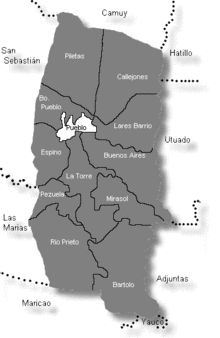
I actually don't have too much information about Severina and her life. Documents point to her origin being in the town of Yauco, Puerto Rico – a town located on the South-Western side of Puerto Rico. The town of Yauco has a couple of nicknames such as: "El Pueblo del Café" (The Coffee Town), "Capital Taína" (Taíno Capital), and "Los Corsos" (The Corsicans). Yauco is known for both its coffee and for being the center of the Corsican immigration most likely during the Cedula de Gracias in 1815. Also, it was the capital of Borikén during the reign of Agüeybana, the most powerful Taíno Cacique of the island.

Yauco, Puerto Rico [Wikipedia]

I'm not exactly sure which barrio in Yauco Severina was from or lived in because her descendants would later move to Lares, we can speculate that they lived on the north side closer to Adjuntas and Lares. Severina's daughter and my 3rd great grandmother, Antonia, was already living in Lares by the 1910 Census and would eventually pass away there in 1944. Severina's husband, though never officially married through the church, was Juan González (a very common name and hard to track because of that fact). Equally, Severina's parents are currently unknown to me as well. Based on the age of Severina's children, I would guesstimate that she was born around the 1830s-early 1840s the latest.

Something interesting to note is that Severina is Dionisia González Padilla's grandmother meaning that the maternal haplogroup passed down to my father's generation comes originally from Severina – the sixth generation carrying the mtDNA haplogroup L2a1.

Haplogroup L2a1 [23andme]

Hopefully, I'll be able to find more information one day on Severina as well as the origin of the L2a1 haplogroup in my family. I haven't been able to find any Corsican family members yet in my family but maybe somewhere with my family from Yauco there is an ancestor waiting to be found! 

Friday, May 2, 2014

52 Ancestors – #18 Dionisia González Padilla (1892-1918)

Today's ancestress, my 2nd great grandmother, Dionisia González Padilla is a very interesting ancestor because her death was very different than most of my other ancestors. Dionisia died fairly young at about the age of 26 and it was due to the 1918 Flu Pandemic.

Dionisia was born probably in the year 1892 in Lares, Puerto Rico where she lived the entirety of her life. Since she was actually born out of wedlock most of the times she just appears as "Dionisia González". Her parents never officially married and had been together for 19 years when the 1910 census was taken; her mother Antonia González passed on her surname while her father's surname José Padilla, became the second surname on the few documents she appears on.

Lares, Puerto Rico Flag [Google]

Dionisia lived in the barrio of Río Prieto with her parents and five siblings (three were full siblings, and two were half-siblings from her father). According to the census record they lived on rented land and the entire family was unable to read or write - none of the children were attending school as well.


Río Prieto, Lares, Puerto Rico [Google]

A year after the census was taken my 2nd great grandmother would marry José Avilés Magraner, also a resident of Río Prieto, Lares (and also a son born out of wedlock). They would marry on the 22nd of July 1911 in Lares, Puerto Rico. From their marriage, Dionisia would mother four children: Pedro, Rosalia, Pedro, and Natalia. The first Pedro Avilés González passed away at only three months old from bronquitis aguda [acute bronchitis]. 

Dionisia would shortly pass away on the 10th of December 1918 from Influenza. What is interesting is that during this time there was a pandemic occurring which infected more than 500 million people across the world making it one of the deadliest natural disasters in human history. (Wikipedia) Something interesting that the Wikipedia articles states is that: 

"Most influenza outbreaks disproportionately kill juvenile, elderly, or already weakened patients; in contrast the 1918 pandemic predominantly killed previously healthy young adults. Modern research, using virus taken from the bodies of frozen victims, has concluded that the virus kills through a cytokine storm (overreaction of the body's immune system). The strong immune reactions of young adults ravaged the body, whereas the weaker immune systems of children and middle-aged adults resulted in fewer deaths among those groups." (Wikipedia). 

Affected Soldiers in Fort Riley, Kansas [Wikipedia]

I imagine that Dionisia was a part of the healthy young adult group, she would have been around the age of 26 and was raising four children, the youngest Natalia born in November of 1917. I wonder how Dionisia got the virus, who would she have caught it from? The Wikipage states that with the introduction of modern travel, the virus was easier to spread amongst people. Also, the movement of sailors, soldiers, and civilian travelers was a factor in the worldwide spread. It seems that Dionisia died from the second wave of Influenza (also known as the Spanish Flu) which began in August of 1918 and had mutated to a much deadlier form.  

It was possible to survive the influenza and I wonder if José had introduced the flu due to an interesting piece of information on Dionisia's death certificate. Throughout all of José's life he was listed as farmer or laborer on a farm, yet on Dionisia's death record he reported a different profession. The record listed José Avilés as a widower, of the military profession, native of Lares Puerto Rico, living on the street Camp. "Las Casas" in San Juan. 

Death Record 1918 - Dionisia González [FamilySearch]

There is no family lore of José serving in the military (there is however lore that his Spanish father was a soldier), the record even goes on to state that José: was twenty eight years old, white, widower, a soldier in the Company L. No. 374 Camp. "Las Casas"… When and why did José head to San Juan to become a soldier? What's so interesting is that there is a Company Number and everything! Did he temporary look for work as a soldier in San Juan, return to Lares because he was sick and ended up passing it onto his wife? Two years later he is living again in Río Prieto with his brother, sister-in-law, their children, and José's own children. He is employed on a coffee farm as a celador or "watchman/guard". Apparently Camp. Las Casas was the main training base of the "Porto Rican Regiment of Infantry".  I actually just found his name in a book titled "Historia de la guerra del Mundo" by Frank Herbert Simonds.

Company L, Regiment 374 [Google Books]

Looking at his 1917 WWI Draft Registration Card, it states that he has a wife, and a daughter (3 y/o) and son (1 y/o) who solely depend on him (thus if I am correct granting him exclusion from serving). Again he is listed as working on a farm this time with a Ramón Magraner (this name is driving me ABSOLUTELY insane since Magraner is his paternal surname yet no Ramón is recorded living in Lares in either the 1910 or 1920 censuses!!)

WWI Registration Card - José Avilés [Ancestry]

I don't know if José would have introduced the virus to his wife or if it was another person from the town. (Lares is a small mountain town towards the central-west and I don't know how much travel there would have been in 1918). I can't even imagine what José would have felt, he himself was about 27 years old when his wife died and was left with three small children all under the age of 5.

Since Dionisia passed away so early on I have no pictures of her. At that time the family was too poor to afford the luxury of getting photos taken or even affording a camera. It is always interesting to view the lives of my ancestors, but when things tie my ancestors to historical events it is so much more interesting. Digging through some old emails I found some information on the Regiment 374 which José would have been a part of: "In June 1918, the 373rd, 374th, and the 375th, were created. The Puerto Rico Regiment of Infantry provided the cadre for the three. The units were trained in Puerto Rico and ready for overseas deployment when the war ended. All were inactivated in January 1919." What if José would have stayed in Camp. Las Casas, what if he was drafted to war and served overseas? Would Dionisia have lived a longer life? Too many questions I can't even begin to answer from 96 years ago!

Thursday, December 6, 2012

Early Christmas Miracle!

Two days ago I got a really nice Christmas miracle. Ironically or coincidentally,  every time I help someone out with something genealogical, I get, or rather gave myself, something back in return. I never do anything expecting something back, rather I love genealogy and love providing help whenever I can squeeze myself in. I do believe everything happens for a reason and there is some sort of system of Karma set into place in our world. But enough about that, and onto genealogy!

A couple of days ago I was chatting with my grandmother about her dad's family. My great grandfather is still alive at 90 years old but due to his health he isn't very knowledgeable about genealogical queries. I was looking into one of his dad's sibling's family who relocated to Vega Alta from Vega Baja. [This isn't too important but provides the background]. So I attempted to find some children born in Vega Alta with the last name Calderon and came across something completely different by chance. Another spark!

I came across someone born with the surname Charles! Seeing as this name isn't too common due to its foreign introduction, I decided to track down the person's birth certificate. On the child's birth certificate, it stated that her father was from England and her mother from Vieques, Puerto Rico. Seeing as how Vieques is where my Charles family most likely passed by, I decided to follow up on Jorge Charles, the father of the registered child. Typing Jorge Charles into the Ancestry search bar gave me something very interesting.

Ever since I discovered my Charles/Gustave(o) family I've searched these surnames throughout the various census records, family trees available and another other possibility where they might pop up. Yet, for whatever reason something new appeared yesterday. A passport registration appeared for a Tomas Charles. My heart jumped!! If this man was somehow related to me, then there would be a picture attached and I could get a glance of a child of Juan Carlos Gustavo and Juliana Lotin.

Looking at the Passport Application so many things jumped out at me: Tomas Charles was born in Vieques, his profession was a carpenter, he was living in Guanica before heading out to La Romana, Dominican Republic before his re-entry into Puerto Rico and lastly his deceased father's name was Gustavo J. Charles. I was beyond sure that he was a 3rd great granduncle. Many things matched and overlapped with the information I previously had, but I needed more solid proof.

Luckily Tomas re-entered Puerto Rico to reside, providing me with his wife's name as well as his childrens'. I headed over to the Yauco and Guanica records to find information to help me prove his relation to me. The main record which I'll talk about is his marriage record to Ramona Cortes which mentions his last names as Charles Lotin! Here we see the surname which appears first in 1885 as Lotten and here in 1918 as Lotin. Interestingly since most of the other children (or rather the writers) by this year were providing very different variations. I'm glad to see that Lotin is SO close to Lautin which to me proves that there was just a small discrepancy between the Spanish and French spellings. Here is a clip of the marriage certificate:

Tomas Charles Lotin, and his parents listed in the marriage certificate
Here we also see that his father appears as Juan Charles, natural from Guadeloupe and his mother Juliana B. Lotin, natural from Martinique. I wonder why Juan appears sometimes from Guadeloupe, did he arrive from Guadeloupe to Martinique and then later they traveled to Puerto Rico? Or was there just some confusion on some of the information? So much to still discover about him!

So he definitely is related to me! Also, Tomas was still living in Puerto Rico in 1910 so he appears in the census and interestingly enough a nephew is listed as Jose Rosado Charles. So turns out there is another sister named Alejandrina who also lived in Ponce and had this child with Pedro Rosado!! Alejandrina most likely died between 1897-1910 seeing as how Jose was living with Tomas in 1910. 

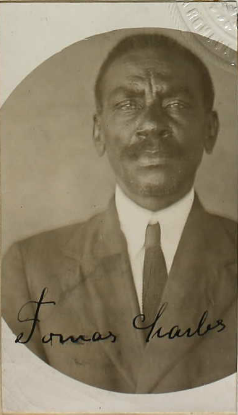
Back to the passport! So now that I had my confirmation I could accept this new branch to my tree. And with it came pictures which literally were a gold mine! I was able to look back five generations to how my ancestor's sibling looked phenotypically and also giving me a small glance into how Maria Paulina Gustavo would have looked like. 

Tomas' description in the passport goes as follows: Age: 48 years; Stature: 5 feet, 8 inches; Forehead: High; Eyes: Black; Nose: Large; Mouth: Large; Chin: Round; Hair: Black-grayish; Face: Round. And finally here is his picture!

Tomas Charles Lotin
I couldn't believe it and as I stare at the picture I still can't. If you look at my profile picture you can see that I'm pretty light, actually very light. I'm able to tan and get some color and it can be noticeable, but it takes me being out under the sun to tan. But nonetheless, a lot of people probably wouldn't believe that this was a relative of mine by blood. Yet if you look at my grandfather and then his father (Manuel Correa- who's picture is here in the blog), you'll notice that each generation further back gets progressively darker and not just 'native' darker but African darker. Also, his wife registered for a passport and his children were photographed as well so it shows another generation closer to me. Here it is: 

[Family Charles Cortes] Ines (left), Hipolito (top), Juan (bottom) and Ramona (right)   
You can also see that Ramona is much lighter than Tomas yet their children are pretty dark, Ines darker than Juan and Hipolito.

I'm to happy to have extended my Charles/Gustavo Lotin family collaterally to include 6 children in total. So far I've only found one death certificate so there's still a lot of searching to be done! I'm hopeful that I'll found some cousins along the way you can add sometime to these families. I'm just waiting for another little miracle to happen ;)